-4.6 C
New York
Home Blog Page 437

Study: Lowering containership emissions through Just In Time arrivals

0

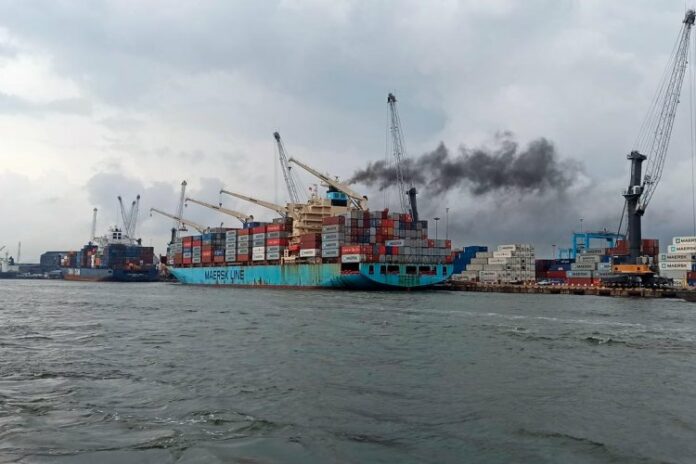
Containerships can reduce fuel consumption and resulting carbon dioxide emissions by 14% on a per voyage basis using JIT arrival, according to a new study, commissioned by the IMO-Norway GreenVoyage2050’s Global Industry Alliance to Support Low Carbon Shipping (Low Carbon GIA).  

JIT is an important tool that can contribute to a ship attaining its required carbon intensity indicator (CII) and associated CII rating in accordance with IMO’s short-term GHG reduction measure, which will enter into force later this year. JIT can be taken up, together with other operational measures, in the enhanced Ship Energy Efficiency Management Plan (SEEMP) which will play a central role in the implementation of IMO’s recent energy efficiency measures. 

This latest study, undertaken by MarineTraffic and Energy and Environmental Research Associates (EERA), explores the global implementation of JIT in the container sector. Using AIS data from the calendar year 2019 (pre-pandemic), the impact of JIT on fuel consumption and emissions was assessed by optimizing all voyages in three scenarios:

1. Over the entire voyage,  

2. Over the last 24 hrs, and  

3. Over the last 12 hrs.

The results show that while optimizing speed over the entire duration of a voyage offers the greatest saving opportunity (displaying a mean fuel saving per voyage of 14.16%), there were benefits in all scenarios with savings of 5.90% (24 hrs scenario) and 4.23% (12 hrs scenario), respectively. This indicates that implementing JIT over the last 12 hours of a voyage can already greatly contribute to fuels and emissions savings.

Capt. Andreas M. van der Wurff, Port Optimisation Manager at A.P. Moller-Maersk and Chair of the Low Carbon GIA Ship-Port Interface workstream, said:

“In fighting climate change, global shipping has a steep mountain to climb, and we need to pull all levers to deliver in line with the Paris Agreement. The study underlines that while we work to accelerate and scale the availability of the future green fuels, in the short-term significant emissions reductions can be achieved by bringing vessels, terminals and ports together to exchange standardized data and facilitate Just In Time arrivals.”

The Low Carbon GIA is a public-private partnership with the aim to develop innovative solutions to address common barriers to decarbonizing the shipping sector. It has been actively exploring the concept of JIT through various research projects and several industry stakeholder roundtables. In 2020, it published the Just In Time Arrival Guide – Potential Barriers and Solutions, providing guidance to stakeholders towards the implementation of JIT Arrivals.
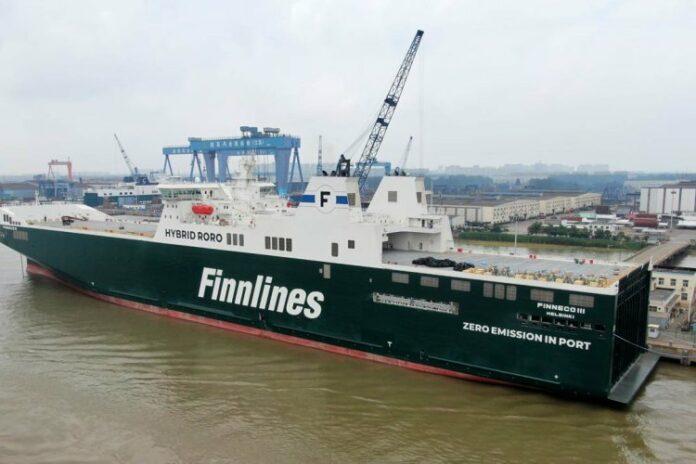
The third hybrid ro-ro vessel delivered to Finnlines

0

Finneco III, the third and last of the three ro-ro vessels in the Eco class was delivered at the China Merchants Jinling Shipyard (Jiangsu) in China on 6 June 2022. 

The Chinese shipyard China Merchants Jinling Shipyard (Jiangsu) delivered the third and last of three hybrid ro-ro vessels to Finnlines. The first vessel, Finneco I, was delivered on 28 April 2022 and the second, Finneco II, on 30 May 2022.

The ships are 238 metres long, each with a cargo capacity of 5,800 lane metres. Consequently, the vessels can carry 400 trailers per voyage. Compared with the largest vessels in today’s Finnlines fleet, the cargo carrying capacity of the hybrid newbuilds will increase by nearly 40%.

The three vessels represent another move towards sustainable shipping as they are energy-efficient. Energy saving is the best way to reduce the emissions.

The vessels have the highest Finnish/Swedish ice class.

Finnlines’ EUR 500 million Newbuilding Programme also includes two eco-sustainable Superstar ro-pax vessels scheduled to be delivered in 2023.

Emanuele Grimaldi, Chairman of the Board, Finnlines, says:

“This is a significant milestone in our EUR 500 million Newbuilding Programme, and we are delighted to welcome the Finneco trio to the Finnlines fleet.” 

“Through our ambitious investment, we can bring to our customers, not only the economies of scale and increased frequency, but a green and well scheduled infrastructure in the Baltic Sea, the North Sea and the Bay of Biscay. Finneco trio will give added value to Finnlines and its customers when they start to operate on their routes.”

Ship particulars, Finneco I–III

  • Type of vessel: Ro-ro
  • Ice class: 1 A Super
  • Length, overall: 238.0 m
  • Breadth, moulded :34.0 m
  • Gross tonnage: 60,515
  • Deadweight: 17,377
  • Lane metres: 5,800
  • Design speed: 20.7 knots
  • Engine output: 2 x 12,780 kW
  • Flag: Finland

W&O Supply is launching a digital valve management service

0

W&O Supply is launching a digital valve management service which is underpinned by the innovative use of RFID technology to identify critical valves on board.

Many vessel operators lack even basic identifying information about the valves they have on board, such as type, material, age, or size and struggle to maintain a clean valve database in their ERP system to allow automatic purchasing by their teams ashore. This lack of insight increases the risks of wrong delivery of valves in case of an unexpected breakdown, or means that replacements may not be fit for purpose or lack essential class testing, all wasting time and money. Taking a digital approach to valve management helps vessel owners to avoid ad-hoc ordering and last-minute parts delivery that could delay their operations.

Vessel owners or shipmanagers often only review the condition of their critical valves when vessels are in dry-dock. This increases pressure on dry-dock management teams to have the ship refitted and back in operation as soon as possible. A pre-dry dock survey completed by an expert technical team to check and identify valves not only saves time and money in the up-coming dry-dock but, by applying an RFID tag to the valve, makes future surveys quicker and simpler. The RFID tag contains details on the valve specification and its inspection and installation history, including survey photos, any safety pressure settings, and any relevant testing certificates. 

By digitising valve identification in this way, the crew, technical departments and purchasing groups will find it easier to track when valves need replacing and find the right parts. However, W&O believes that operators should go further, by properly digitalising and linking the valves identified on-board across the fleet with their technical database and its purchasing system. This ensures that operators can supply their vessels with the right valves at the right time, wherever they are in the world.

Kristof Adam, European Managing Director, W&O Supply, says:

“The budget spend on marine valves is only a very small percentage of the total running cost of a fleet.  Over the years we learned that technical and purchasing teams spend a lot of time to get the correct valves on-board. There are a huge number of valves onboard every ship so an effective management process is essential to get this right, and it can be hugely costly when this process goes wrong. Valves can cause a serious administrative headache during normal operations or when in  dry-docking The use of RFID tags and digitising valve management and administration makes identifying, ordering and supplying valves much simpler, reducing the risk of financial losses due to errors.

“Digitising valve data using RFID tagging allows owners to track the status of valves over time across their entire fleet and adopt a time-based maintenance strategy. Knowing which valves they should be replacing, based on the data available on the RFID tag, will allow operators to eliminate costly run-to-fail approaches that lead to ad-hoc and ill-informed valve ordering, that too often means the wrong valves are ordered.”

A pre-dry dock valve survey is designed to mitigate the risks of getting valve orders wrong. The RFID tags make the valve easily identifiable and connect it to a digitalised valve inventory that allows a dry-dock project team to know exactly what valve type to order and its specifications. With a clear understanding of what valve to order, and any critical needs, such as Class Society testing ahead of time, valve installation during dry-docking is quicker and simpler, saving owners and operators time and money during this essential project. 
 

Brødrene Aa delivers the first AERO to serve the Saronic islands

0

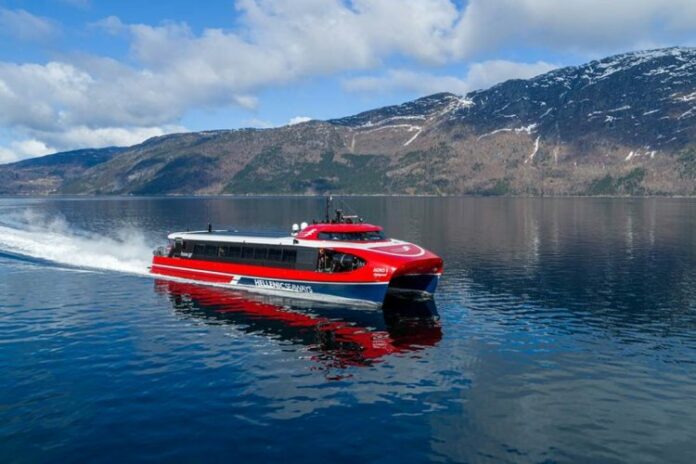
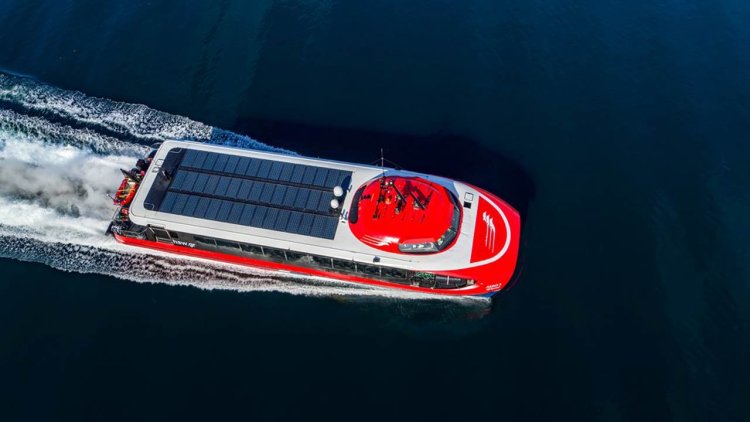
Aero 1 Highspeed is the very first vessel of Brødrene Aas newly introduced AERO concept, featuring aerodynamic and energy efficient design, accompanied with lightweight carbon fiber trademark construction.

The extremely light construction of carbon fiber contributes to a reduction of fuel consumption and air emissions.

Tor Øyvin Aa, CEO of Brødrene Aa, said:

“We are very pleased and proud that our vessels will soon be sailing in the demanding Greek Seas trusted by one of the largest European ferry operators.”

The new, state-of-the-art Aeros boast an ultra-modern design and innovative features that will significantly upgrade the travel experience for the over 3 million passengers travelling annually on the Saronic routes.

Upon delivery of the new AERO 1 Highspeed, Mr. Spiros Paschalis, CEO of Attica said: 

“In these challenging times, Attica Group remains focused on providing first class sea transport services to our passengers, with new, innovative and more environmental friendly vessels, to the benefit of our islands and their people and to the Greek tourism and economy”.

Aero 1 Highspeed is with its 36 length meters and 9.7 width meters, the first of three Aero catamarans ordered by Attica. With a full load, it will be able to maintain a maximum speed of 32 knots.

The interior is designed with a focus on comfort, even in rough seas. The spacious passenger accommodation area has large windows, providing excellent view and ample natural light. It also has special provisions for the facilitation of passengers with reduced mobility and dedicated area for bicycle transportation.

CIP partners with Cbus in the Australian offshore wind project, Star of the South

0

Copenhagen Infrastructure Partners (“CIP”), through Copenhagen Infrastructure IV, and Cbus Super (“Cbus”) are pleased to announce the acquisition by Cbus of a 10% interest in CIP’s Australian offshore wind project, Star of the South. This follows Cbus’ investment into CIP’s flagship fund, CI IV. CI IV is the majority owner of Star of the South.

CIP specialises in energy infrastructure investments, being one of the largest developers of offshore wind projects globally. Cbus is Australia’s leading building and construction industry super fund.

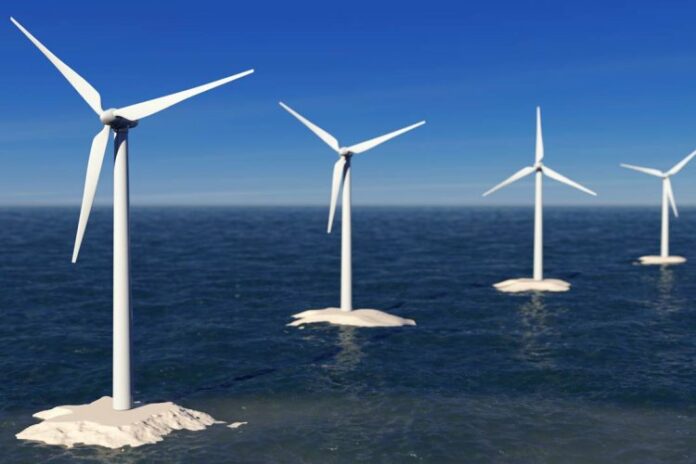
Star of the South is Australia’s most progressed offshore wind project, to be located off the south coast of Gippsland in Victoria, with a capacity of up to 2.2 GW. The new partnership demonstrates confidence in Victoria’s offshore wind sector, with Star of the South forging the way for a new local industry to deliver a clean energy boost, create thousands of jobs and reduce carbon emissions.

Star of the South aims to deliver on the Victorian Government’s strong policy ambition for offshore wind, with the Government targeting at least 2 GW of offshore wind capacity by 2032 and up to 9 GW by 2040, establishing an entirely new clean energy sector in Victoria. Offshore wind will transform energy supply in Victoria, complementing other forms of power generation. Star of the South alone has the potential to power around 1.2 million homes and supply up to 20% of Victoria’s electricity needs while creating jobs and investment in the Gippsland region.

CIP’s partnership with Cbus will strengthen local participation in Star of the South, while continuing to draw on CIP’s leading global expertise in developing and delivering offshore wind projects.

Michael Hannibal, Partner at CIP, says:

“CIP is pleased to continue to strengthen our long-term partnership with Cbus, a superannuation fund that shares a similar perspective as CIP on the importance of clean energy resources. Combining CIP’s industrial background and international experience within offshore wind with Cbus’ local experience, our partnership will enable the provision of renewable power to Victorian homes and businesses and contribute to reaching Victoria’s decarbonisation targets. The transaction highlights the significant potential of offshore wind in Australia, with the opportunity for Victoria to be a leader in the significant global growth of offshore wind.” 

Kristian Fok, Chief Investment Officer at Cbus, says:

“Star of the South is a landmark investment for Australian superannuation into the local offshore wind sector. Cbus is excited to be partnering with CIP, one of the world’s largest and most successful developers of offshore wind, while helping to pioneer the offshore wind industry in Australia. Star of the South will support, establish and grow the offshore wind industry in Australia, while assisting the Victorian Government’s commitment to a net-zero emissions economy.” 

LGM Engineering awarded order for six dual fuel bulk

0

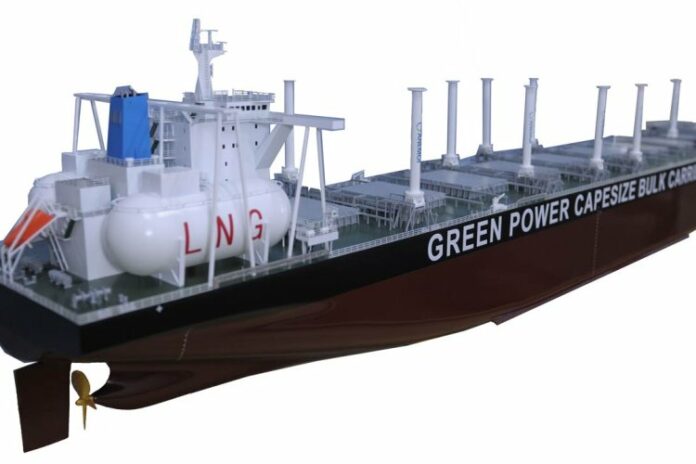
Gloryholder Liquefied Gas Machinery (DL) Co., Ltd (LGM Engineering) signed a LNG fuel gas supply system contract forsix 190,000 DWT dual fuel bulk carriers with Shanghai Waigaoqiao Shipbuilding Co., Ltd. (SWS) in October 2021. 

The deliveries of the LNG fuel gas supply systems will start in June 2022. The shipowner is Anglo American Shipping, and the Classification Society is DNV.

LGM Engineering will provide an EPC delivery of the LNG fuel gas supply system package for the subjected vessels. The scope of supply includes; two setsof type C single walled LNG fuel tanks with PUF insulation, LNG bunkering stations, HP/LP gas supply system, Water/Glycol system ESD system and N2 generator system as well as system commissioning, gas trail, and crew training.

Following the LNG fuel gas supply system contract of four 190k dual-fuel bulk carriers for U-Ming, SWS and LGM Engineering work together again.

Sabella tidal stream turbine injects electricity again into the Ushant grid

0

After the successful re-immersion of the D10 turbine in April 2022 and its reconnection to the Ushant island electricity grid, the third test and production campaign of this tidal turbine has started as planned after a period of testing and adjustments.

The improvements made to the turbine over the last few months, in particular the modification of the turbine’s export connections and the smoothing of the electrical production on land, have been a success and now allow the turbine electricity production to be injected into the grid.

This smoothing function, developed in partnership with the Syndicat d’Energie et d’Equipement du Finistère (SDEF), and the company ENTECH, within the framework of the European Interreg ICE project (led by Bretagne Développement Innovation), had never been tested in situ before.

This innovation is a major advance, given that the electrical production of a tidal turbine generates brief disturbances of the signal induced by natural swell movements or current turbulence, particularly present in the Fromveur Passage, which must be regulated in order to be able, in the future, to rapidly deploy marine technologies on a large scale.

The smoothing function will greatly improve the quality of the electricity injected into the island’s grid and thus ensure stable operations for the operator ENEDIS.

The injection of green electricity from the D10 turbine into the island’s grid will gradually increase over the coming weeks in coordination with ENEDIS, from 100 kW to the maximum injection capacity allowed by the grid. In addition, the tidal turbine will supply green energy to the Ilophone 2022 festival which will take place next September in Ushant, after two years of interruption due to COVID-19. 

Fanch Le Bris, Managing Director of SABELLA, states:

“The main innovation tested during this new campaign at sea is of course the smoothing function of our electrical production, which should guarantee the network operator ENEDIS a constant quality of electricity injected into the Ushant Island network. We are very satisfied with this technological development, with performance exceeding the operator’s requirements. This success augurs well for our future projects in non-interconnected areas which will require the implementation of this type of function to secure these networks which are often more fragile than the large interconnected networks.“

Thomas Archinard, Project Manager at Sabella, adds:

“This campaign also aims to prepare the PHARES project, which consists of providing the island with a renewable energy package, including two 500kW Sabella tidal turbines, in order to make it more autonomous in green electricity. More specifically, we will focus on better understanding the site’s environment with a view to the deployment of future commercial farms.”

Van Oord celebrates christening of trailing suction hopper dredger Vox Ariane

0

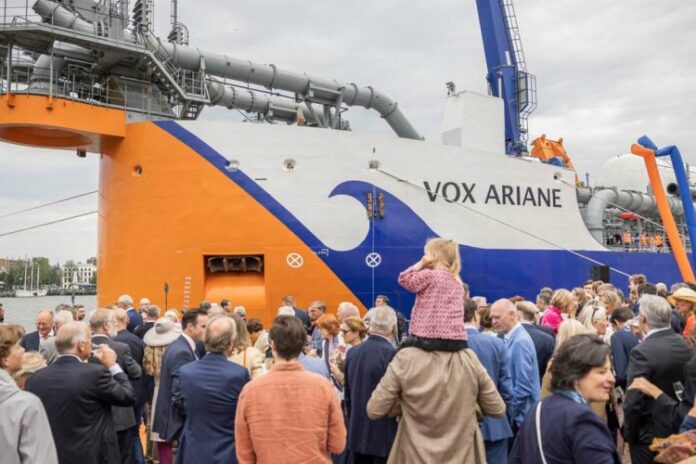
Vox Ariane, Van Oord’s first trailing suction hopper dredger equipped with an LNG fuel system, was christened by its CFO and member of the Executive Committee Ms. Jolanda Poots-Bijl.

The Vox Ariane has a hopper capacity of approximately 10,500 cubic metres and measures 138 metres in length and 28 metres across the beam. It is the first hopper in Van Oord’s fleet equipped with an LNG fuel system and an outstanding example of Van Oord’s sustainable ambitions.

The vessel was built by Keppel Singmarine Pte Ltd at its shipyard in Singapore. The Vox Ariane and its 2 sister vessels (Vox Alexia and Vox Apolonia), which are still under construction, will replace existing vessels and fit in with Van Oord’s aim of making its fleet state-of-the-art and more energy efficient. Their energy-efficient design will reduce fuel consumption and therefore carbon emissions substantially , qualifying them for a Green Passport and Clean Ship Notation.

Van Oord operates trailing suction hopper dredgers for a wide range of global activities, such as coastal protection, port construction, deepening waterways and land reclamation. The vessels are equipped with a suction pipe with electrically powered underwater dredge pump, 2 inboard dredge pumps, 5 bottom doors and have a total installed powerof 14,500 kW. Each vessel can accommodate 22 crew members.

A regular Ro-Ro line to Sweden starts operating in the port of Riga

0

The line operator “Scandic Line” starts regular Ro-Ro cargo transportation between the ports of Riga and Södertälje, providing a new logistics route from Riga to Scandinavia for transporting diverse types of cargo. 

Viesturs Zeps, Chairman of the Freeport of Riga Board:

“In order for the Port of Riga to develop in various segments, it is necessary to increase the volume of transported cargo, including the development of new logistics chains and new modes of transportation. The port of Riga is one of the few ports in the region where there is no permanent Ro-Ro ferry line, so it is vitally important to provide entrepreneurs with a new logistics route, which will enable the port to increase cargo volumes and attract new customers.”

The “Scandic Line” will continue to provide cargo transportation, including all types of Ro-Ro cargo – mobile cranes, caravans, campers, agricultural machinery, tractors, other vehicles, as well as tow trucks and trailers, all types of self-propelled and non-motorized machinery, mafi cargo trailers, project cargo, as well as all types of containers. The new line will also provide for the transportation of oversized and / or heavy cargo, which is not always possible with Ro-Pax ferries serving lines in other ports of Latvia and neighboring countries.

The 108.5 meter long and 17-meter-wide freight ferry MIDAS is expected to run three times a week from / to Riga Central Terminal (RCT) to / from Sweden in each direction, initially serving local customers, but in the future it is planned to attract transit cargo from China and Central Asia, providing line traffic with two daily ferries.

Zigmunds Jankovskis, Head of the line operator “Scandic Line”, said:

“There is intensive construction in Sweden at the moment involving many Latvian and Baltic manufacturing companies. The geographical location of the ports of Riga and Södertälje is advantageous for transportation of those companies’ products.”

“Until now, the companies were forced to transport the products of the production facilities and logistics centers located in the Riga region to approximately 200-300 km distant ports in Lithuania or Ventspils, from where they could be further transported by sea to Sweden. The new sea connection from Riga will facilitate planning process of those transport and logistics companies (including helping to solve the acute problem of driver shortages), reduce logistics costs, relieve Latvian roads of many heavy loads, as well as reduce harmful emissions.”

Ansis Zeltins, the Freeport of Riga CEO, emphasized:

“With the change in logistics chains, it is now especially important to create new, stable cargo supply routes and strengthen the positions of Riga and Latvia in global cargo transport flows. We consider Scandinavia to be a promising market. After the shutdown of the Tallink Ro-Pax line, this segment has remained vacant in the port of Riga, so it is gratifying to re-establish a direct connection with Sweden. The Ro-Ro segment is important for us, and we hope to expect another Ro-Ro line in Riga soon to connect to one of the Central European ports.”

ADNOC acquires three new-build LNG vessels

0

ADNOC Logistics & Services, the shipping and maritime logistics arm of the Abu Dhabi National Oil Company (ADNOC) and the region’s largest shipping and logistics company, announced today its decision to purchase three additional liqueified natural gas (LNG) vessels.

ADNOC L&S is the region’s largest shipping and integrated logistics company and the state-of-the-art new-build vessels will bolster the company’s capacity as it responds to the growing global demand for LNG.

The new-build LNG vessels, each with a capacity of 175,000m3, are significantly larger than the current ADNOC L&S fleet which have a capacity of 137,000m3 each. ADNOC L&S previously announced in April 2022 that it will acquire two LNG vessels which brings the total number of new-build LNG vessels ordered to five, with the vessels scheduled for delivery in 2025 and 2026. 

Captain Abdulkareem Al Masabi, CEO of ADNOC L&S, said:

“ADNOC is an active player in the evolving global energy landscape, where natural gas and LNG are playing an increasingly important role. ADNOC L&S’ strategic acquistion of five state-of-the-art LNG vessels will support ADNOC’s existing LNG business as well as its significant growth plans.

“Several dynamics are stengthening the LNG market which makes the timing of these acquisitions particularly significant. This includes a renewed emphasis on energy access and security, as well as new environmental regulations that favor more fuel-efficient vessels, such as the new-builds that we are purchasing.” 

All five new-build LNG vessels will be built at the Jiangnan Shipyard in China. Jiangnan Shipyard was also previously commisioned by ADNOC L&S in 2020 to build five Very Large Gas Carriers (VLGC) for AW Shipping, ADNOC L&S’ Joint Venture company with China’s Wanhua Chemical Group.

Mr. Lin Ou, Chairman of Jiangnan Shipyard, said:

“We would like to thank ADNOC L&S for its continued collaboration with Jiangnan. We are committed to the promotion of new efficient, energy-saving and environmentally-conscious vessels and proud to be able to support ADNOC L&S’ growth strategy for the future.”

The acquisition of larger, more energy efficient vessels will allow ADNOC L&S to meet growing customer demand while improving the environmental footprint of its fleet. The new vessels’ engine technology will reduce emissions (CO2, NOX and SOX) and in combination with the innovative Air Lubrication System, further reduce fuel consumption by at least 10%. 

ADNOC L&S has the largest and most diversified fleet in the Middle East, with more than 200 vessels transporting crude oil, refined products, dry bulk, containerized cargo, liqueified petroleum gas (LPG), and LNG to global markets. When combined with its 1.5 million square meter integrated logistics base in Mussafah and its comprehensive end-to-end logistics capabilities, ADNOC L&S is the region’s leading provider for integrated maritime logistics solutions.  

Over the past 24 months, ADNOC L&S has acquired 16 deep sea vessels, including eight Very Large Crude Carriers (VLCC) in 2021, that added 16 million barrels of capacity. Furthermore, the company acquired six product tankers, which expanded the product tanker fleet capacity to over 1 million metric tonnes as well as five VLGC for AW Shipping.