-4.6 C
New York
Home Blog Page 434

Climate: offshore methane gas leak spotted from space

0

The findings add a crucial tool to an expanding space-based arsenal for pinpointing previously invisible methane plumes from the oil and gas industry.

Fossil fuel operations globally emitted about 120 million tonnes of the planet-warming gas in 2020, nearly one-third of all methane emissions from human activity, according to the International Energy Agency (IEA).

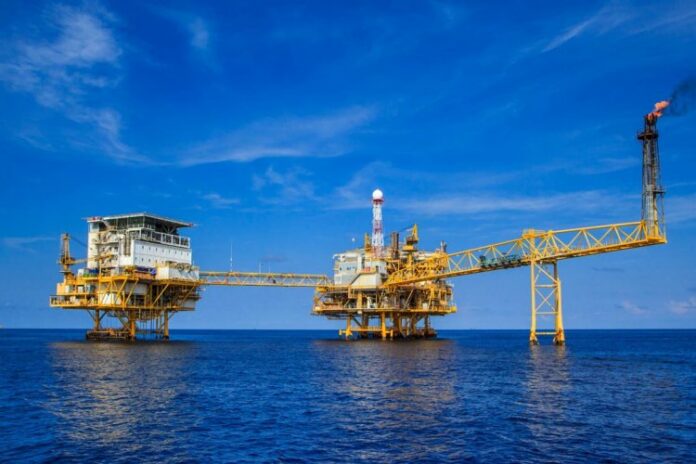
The new study in the journal Environmental Science and Technology Letters identified a plume from an oil and gas production platform in the Gulf of Mexico that spewed some 40,000 tonnes over a 17-day period in December.

The platform, near Campeche in southern Mexico, is in one of the country’s biggest oil producing fields.

Senior author Luis Guanter, a professor at Valencia Polytechnic University, said in a statement:

“Our results demonstrate how satellites can detect methane plumes from offshore infrastructure. It opens the door to systematic monitoring of industrial emissions from individual offshore platforms.”

Satellite-based methods for spotting methane leaks over land have developed rapidly in the last few years, training an uncomfortable spotlight on regulators and industry.

But equivalent techniques have been lacking for leaks from offshore oil and gas operations, which account for about 30 percent of global production.
Up to now, ocean water’s capacity to absorb short-wave infrared radiation has limited the amount of reflected light reaching space-based sensors.

Guanter and colleagues overcame this problem with a new method for measuring solar radiation bouncing off the water’s surface, called Sun-glint observation mode.

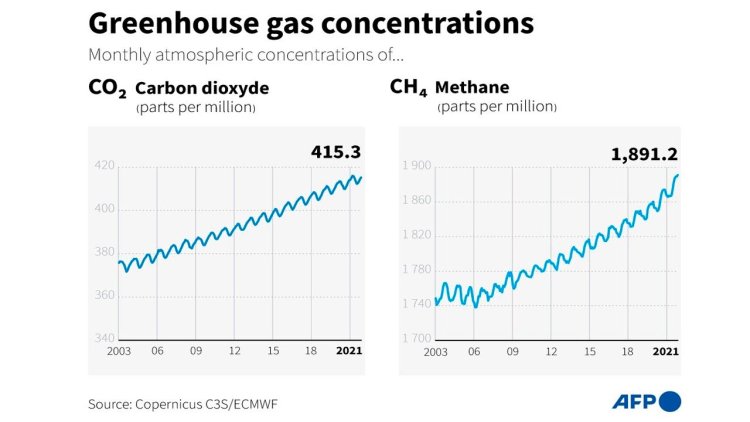
Methane is responsible for roughly 30 percent of the global rise in temperatures to date.

While far less abundant in the atmosphere than CO2, it is about 28 times more powerful as a greenhouse gas on a century-long timescale. Over a 20-year time frame, it is 80 times more potent.

Methane lingers in the atmosphere for only a decade, compared to hundreds or thousands of years for CO2.

This means a sharp reduction in emissions could shave several tenths of a degree Celsius off of projected global warming by mid-century, helping keep alive the Paris Agreement goal of capping Earth’s average temperature increase to 1.5C, according to the UN Environment Programme (UNEP).

Last year saw a record jump in the atmospheric concentration of methane, US government scientists reported in April.

Methane is generated by the production, transport and use of fossil fuels, but also from the decay of organic matter in wetlands, and as a by-product of livestock digestion in agriculture.

At last year’s COP26 climate summit in Glasgow, more than 100 nations agreed under the Global Methane Pledge to reduce emissions 30 percent by 2030. But several major methane emitters—including China, Russia, Iran and India—failed to sign.

Source: AFP

Petrofac awarded five-year Integrated Services Provider contract

0

Petrofac has been awarded an  Integrated Services Provider (ISP) contract by Anasuria Operating Company (AOC). Under the contract, Petrofac will provide onshore and offshore personnel and a range of technical support services. The five-year contract, which has an option to extend, starts in June.

The new contract follows a long history of providing outsourced support for the Anasuria FPSO (Floating Production Storage and Offloading). Petrofac has been duty holder for AOC since 2016 when the asset was divested from Shell.

As part of the transition, the Duty Holder role will transfer to AOC, while the majority of the offshore workforce will continue to be provided by Petrofac.

Nick Shorten, Chief Operating Officer for Petrofac’s Asset Solutions business said:

“I’m proud that we are supporting our long-term client AOC in their ambitions to maximise value in the North Sea. In 2016 we helped AOC take on ownership of the mature assets, and today we see AOC take on the operatorship of a successful and long-term business. This is an important milestone for them, while cementing our long partnership, and our continued provision of safe, efficient, integrated services in our core UK market.”

First emission-free sailing into a world heritage fjord made possible by Corvus ESS

0

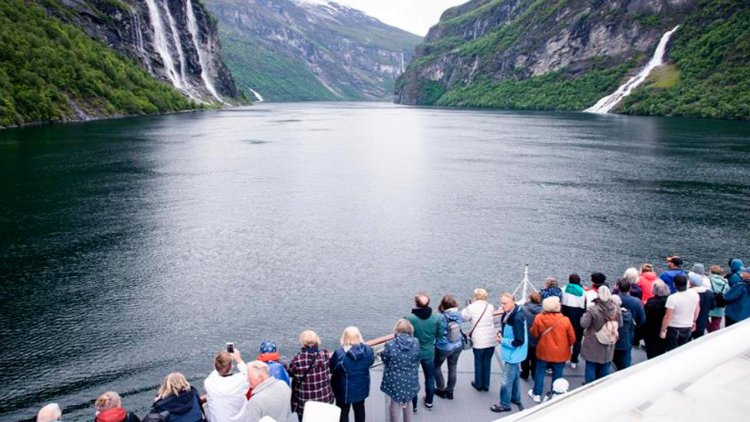
On June 2nd Havila Kystruten`s passenger ship “Havila Castor” proved it could sail in and out of the Geiranger fjord on zero-emission with help from the largest battery pack installed onboard a commercial vessel.

Geir Bjørkeli, CEO of Corvus Energy, says:

“This is a big step for the decarbonization of shipping. For the first time in history, a large passenger ship has sailed this route silent and emission-free. This proves that technology is ready even for large ships to operate in zero-emission mode for longer periods of time.”

Havila Castor is one out of four identical ships built for Havila Kystruten to operate on the coastal route between Bergen and Kirkenes in the North of Norway. The full roundtrip takes 11 days and is an epic journey through some of the most scenic and unspoiled nature. Corvus has delivered a complete 6.1 MWh Orca battery system for each of the vessels.

Bent Martini, CEO in Havila Kystruten, says:  

“By continuous focus on the environment and the best passenger experience, we have managed to set a new standard for the cruise and passenger industry. The first trip on battery alone went exceptionally well and we see that we can achieve even more by testing and finetuning all the systems onboard.”

Energy efficiency has been key through the entire design phase. Ship design, equipment and smart control systems are mainly delivered by the HAV Group and its subsidiaries:

HAV Design has done the ship design, Norwegian Greentech has delivered the low energy, low footprint ballast water cleaning system, Norwegian Electric Systems has been system integrator and supplied the hybrid gas-electric propulsion system inclusive batterysystem, generators with complete switchboards, trafos, frequency converters  and  control systems in addition to the new Raven INS™.

The Raven INS is a fully integrated bridge system included smart features such as data hoarding and analysis to continuously develop better and more efficient operations.

The propulsion system onboard all four sister vessels are also prepared for the installation of next-generation technology using hydrogen and fuel cells by HAV Hydrogen

The entire trip from the city of Ålesund and back took 9 hours where more than three hours were on battery only. Feedback from Havila technical personnel on board was that the battery performed beyond expectations. After three hours on battery only, they had close to 40% of the battery capacity left which means four hours is no problem.

The energy storage systems along with all other environmental technologies on the ship reduce CO2 emissions by around 30% and NOx emissions by 90%. With the gradual blending of biogas, emissions of CO2 will be reduced to 50% in 2023 and 80% in 2024.

Havila Capella, Castor`s identical sister ship, won “the Next Generation Ship Award” during Nor-Shipping in Oslo earlier this year due to its groundbreaking design. Read about the 7 reasons why here:

The last two ships, Havila Polaris and Havila Pollux, will be delivered to Havila Kystruten by end of this year.

Huisman to equip Cadeler F-class vessel with Leg Encircling Crane

0

Huisman has announced a contract award from COSCO Shipping (Qidong) Offshore Co., Ltd. for the design and construction of a Leg Encircling Crane (LEC)

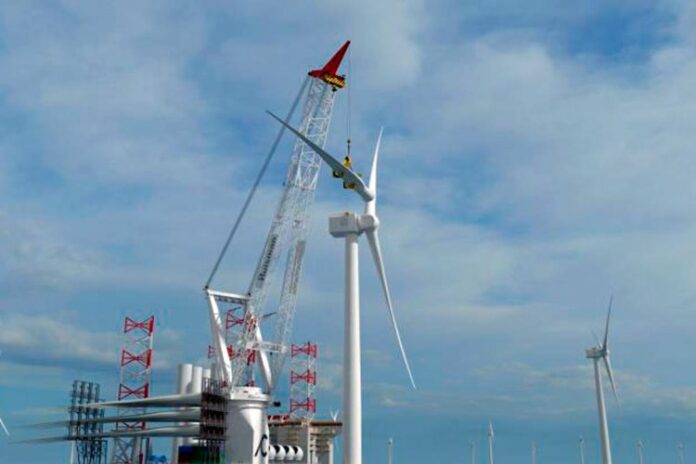
This crane will be installed on the new build  F-class jack-up vessel of Cadeler, a key supplier within the offshore wind industry for installation services, operations and maintenance works.

The contract award follows last year’s contracts for two identical 2,600mt Leg Encircling Cranes for Cadeler’s X-class vessels.  

With this crane, Cadeler will be capable of installing foundations and wind turbines for next generation offshore wind projects worldwide. The F-class vessel features a unique design, allowing the vessel to convert from being a foundation installation unit to a wind turbine generator installation vessel within a short period of time.

Huisman has designed its LECs to meet the requirements of the continually developing offshore renewables sector. The cranes are lightweight yet robust, have high positioning accuracy and are highly energy efficient, contributing to a reduced emissions footprint during the installation of increasingly large turbines.

The scope of work for Huisman consists of the design, engineering and construction of the LEC at its production facility in Zhangzhou, China. The cranes will be commissioned in 2025 at COSCO’s shipyard in Qidong, China, where the F-class vessel will be built.

David Roodenburg, CEO of Huisman:

“We are thankful and proud that, with this third order, we are able to make a significant contribution to Cadeler’s fleet expansion. We look forward to delivering the cranes in the coming years and, as a committed partner helping Cadeler to boost installed offshore wind capacity around the world.” 

Damen Shiprepair Amsterdam converts cruise ship into Azamara Onward

0

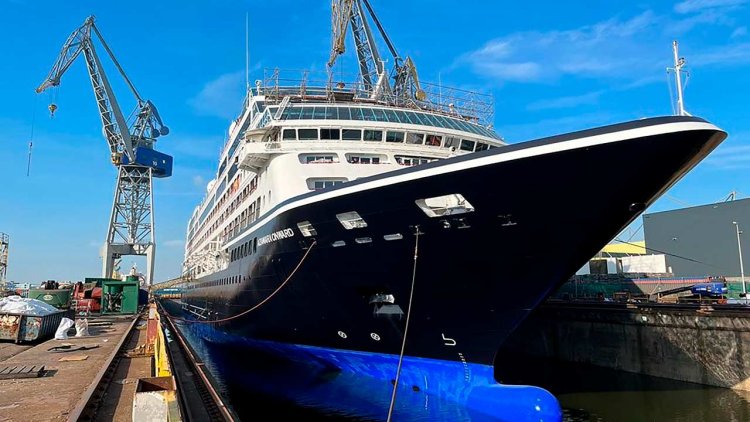
The fourth ship was added to the fleet of the new cruise line operator Azamara following extensive refitting at the yard of Damen Shiprepair Amsterdam. Benefiting from equipment overhaul and conversion to cleaner fuel, Azamara Onward sailed to Monte Carlo for her naming festivity on 2 May.

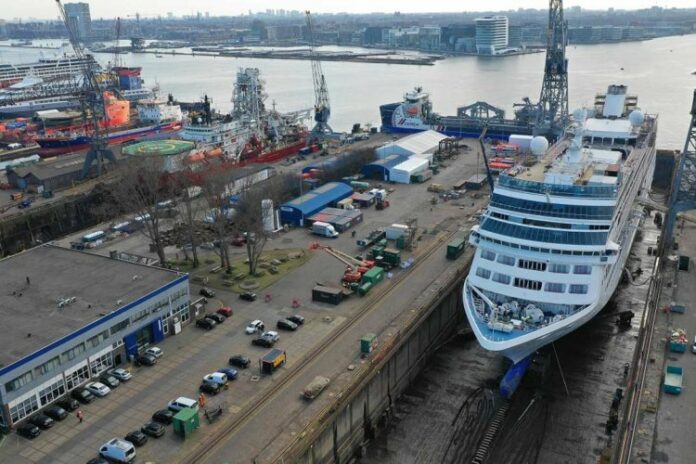
The 180 meter passenger vessel was berthed alongside at the Amsterdam yard from August 2021 to get an upgrade to the standards of cruise operator Azamara, refurbishing all cabins and suites and adding spa suites and terrace rooms. Passenger shared spaces like restaurants were upgraded and a new bar was created. As a relatively small vessel in today’s cruise market, this vessel aims to offer an intimate luxury cruise experience.

From mid-March through April 2022, the vessel was in the largest dry dock of Damen Shiprepair Amsterdam where technical and maritime conversion was performed. Lots of steel work for the reconstruction of deck arrangements, balcony structures allowed for the creation of the newly planned luxury suites, some of them with their own Jacuzzi baths. This steel work was on deck 8 and 9, where also the onboard spa is located. Steel reinforcements were placed to support the spa pools and installations.

Tanks for ballast water and fuel oil were restructured, to accommodate for bunkering larger volumes of Marine Grade Diesel. The work included a lot of piping throughout the vessel and the engine room. The grey water tanks as well as the tanktop were replaced. Stabilisers both on starboard and port were overhauled and the shaft seals were replaced. Thrusters were upgraded to allow for the use of Environmentally Acceptable Lubricants. The tailshaft and the propeller seal were replaced.

The hull was completely cleaned and painted to fit in the appearance of the Azamara fleet. The steel logo on the top side was taken off and replaced with the new sign Azamara Onward. Performing all of these interior, exterior and technical upgrades in limited time, required complicated logistical planning and strict schedules. 

Project manager Colin Husslage from Damen Shiprepair Amsterdam says:

“It was challenging to organise all the operations to be performed in time and in a manner that steel work does not interfere with decorative jobs. We managed to deliver the ship to its proud new owner at the date agreed, so Azamara can have it in full service during the 2022 season.”

Head of Marine Operations Nico Corbijn of Azamara says:

“Azamara selected Damen Shiprepair Amsterdam to complete the revitalization of the Azamara Onward following an extensive comparative analysis of shipyards in Europe. With an estimated investment of approximately 55 million dollars, it was very important for us to identify a yard that could provide not only the technical expertise and know-how for this large project, but also offer logistical support for the outfitting companies and their teams that would be attending the ship daily. Despite the supply chain and labour challenges as a result of the COVID-19 pandemic, Damen delivered beyond our expectations. The yard team’s collaborative spirit and “can-do” attitude made this refit a technical success, and a reason for us to return to Amsterdam for future engagements.”

ABB set for France’s biggest shore power installation to date

0

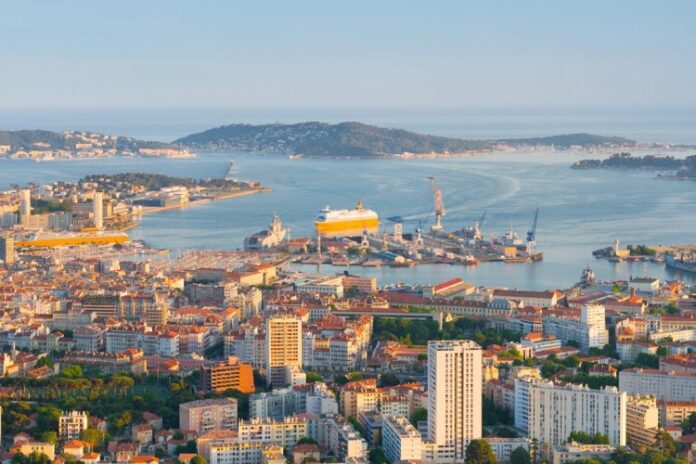
With around 1,300 yearly calls from ferries and cruise vessels right in the heart of the city, the port of Toulon plays an important role in developing the attractiveness of the region for business and tourists. The port is also central to the “Zero-smoke stopovers” plan by the region of Provence-Alpes-Côte d’Azur (Région Sud PACA), which aims to electrify the docks of Toulon, Marseille and Nice to enable emission-free stays for vessels1.

Shore-to-ship power connections allow ships to turn off diesel generators during port calls. For shipowners, this means savings on fuel and maintenance costs while switching to cleaner and more sustainable energy. Cruise and ferry passengers, as well as local residents benefit not only from cleaner air, but also from less noise and vibrations generated when ships are docked.

Hubert Falco, President of the Toulon Provence Méditerranée Metropolis, said:

“This is an innovative project built on an intelligent energy flow management system with a unique energy mix. With the support of ABB as well as the Région Sud PACA and our partners, we are significantly improving air quality in the port, while maintaining business activity. The shore-to-ship power connection will eliminate more than 80 percent of pollutant emissions. It will also save 9,000 hours of vessels running on diesel annually. For the ferry activity in the city of Toulon alone, this adds up to a reduction in sulfur emissions equivalent to those of 50,000 cars in a year.” 

Frédéric Mestivier, designer and technical director of the power project for the Toulon Provence Méditerranée Metropolis, said:

“Technically, this project is developing a new, intelligent smart grid power network using digital technology to manage energy flows from several interconnected sources. The infrastructure makes it possible to optimize overall energy efficiency while limiting the carbon footprint.”

ABB is leading the consortium selected to manage and execute this turnkey project, with commissioning due in 2023. The ABB solution will be capable of delivering enough energy to cover the needs of three ferries calling to port simultaneously, or one cruise ship. Vessels will have the possibility of 50 or 60Hz power connections. As part of the consortium, Eiffage Construction will carry out the civil engineering work, and Fauché will be responsible for installing and connecting the equipment.

Through the innovative design established by the Toulon Provence Méditerranée Metropolis, the system implemented with ABB equipment will have the ability to automatically adjust the energy mix to supply vessels through the local power network (Enedis), with solar energy produced from a photovoltaic shelter, as well as an energy storage system made up of lithium batteries. The system will help to smooth consumption peaks while allowing the storage of excess solar energy production. It will also be able to use other renewable energy sources such as fuel cells, as they become available.

Schlumberger and Subsea 7 renew global Subsea Integration Alliance

0

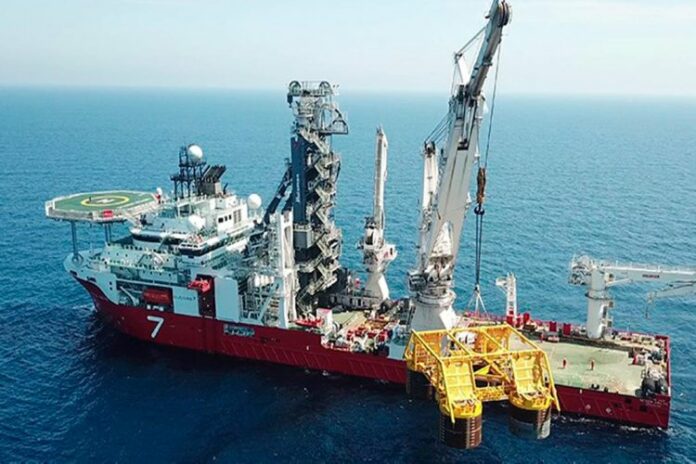
Subsea Integration Alliance is a worldwide non-incorporated alliance between Subsea 7 and Schlumberger’s OneSubsea® subsea technologies, production and processing systems business, to jointly design, develop and deliver integrated subsea development solutions through the combination of subsurface expertise, subsea production systems (SPS), subsea processing systems, subsea umbilicals risers and flowlines systems (SURF), and life-of-field services.

John Evans, Subsea 7 Chief Executive Officer, said:

“The success of Subsea Integration Alliance is a result of the drive and commitment of both Subsea 7 and OneSubsea to deliver an enhanced experience and outcome for our clients. Driven by the demonstrable benefits to clients of this mode of collaborating, integrated projects are expected to remain a significant component of the subsea market. We look forward to extending our relationship with OneSubsea as we address the opportunities of the offshore energy market.”

Over the past seven years, the alliance has successfully combined the complementary capabilities and market-leading technologies of OneSubsea and Subsea 7, and worked collaboratively with clients to design, develop and deliver integrated SPS and SURF solutions proven to optimize the cost and efficiency of deepwater developments.

The alliance, in recent years, has been awarded major greenfield projects in Australia, Brazil, Africa and Turkey, as well as significant tie-back work in the Gulf of Mexico and Norway. Since January 2020, Subsea Integration Alliance has won the majority of integrated SPS and SURF projects worldwide.

Abdellah Merad, EVP, Core Services and Equipment, Schlumberger, said:

“Subsea Integration Alliance has proven to be a tremendous success. Having been awarded 12 integrated projects and more than 130 early engineering studies around the world, it has helped—and will continue to help—customers achieve maximum value from their subsea developments through industry-leading innovation and expertise.”  

Vattenfall sets a target to recycle all dismantled wind turbine blades by 2030

0

Gustav Frid, Senior Environment & Sustainability Specialist at Vattenfall, sees the recycling of the turbine blades from Irene Vorrink Wind Farm primarily as a pilot project.

“First of all, we want to learn from this process and see which companies are suitable to help us recycle the wind blades. We believe that there is no single solution for this, but rather a number of different ones. Because Vattenfall has proven to be a leader in sustainability in recent years, many companies want to collaborate with us, and they are contacting us.”

Marcin Rusin, co-owner at Gjenkraft in Norway, recognises himself in these words. “We were looking for partners for our wind blade recycling project, came into contact with Vattenfall and since then we have been in constant contact with Gustav Frid about the progress of the work in our project. When the wind turbines of the Irene Vorrink wind farm were dismantled, we were one of the first to offer to recycle the wind blades.”

Recycling wind turbine blades is specialist work, as they have a complex structure.

Marcin Rusin says:

“The blades consist not only of resin and glass or carbon fibre, but also of balsa wood, PVC or PET foam, other polymers and metals. It is almost impossible to separate the individual components, so they have to be processed together. This complicates the recycling process and the possibility of recovering residual value from the blades.”

Gjenkraft recovers glass and carbon fibres, depending on the type of blade.

“In the recycling process, we can adjust the parameters to obtain the properties that our customers expect from our products. Our products are used again to make skis or snowboards and other products that contain glass fibres and carbon fibres.”

Based on the results of the EU project LIFE Carbongreen which studied recycling of carbon fibre composites, Professor Gregor Luthe says:

“Wind turbine blades are designed to withstand extreme loads, so they consist of strong fibres of glass and carbon that are bound by duro-plastics. We have managed to make new duro-plastics that can be used in the construction materials of so-called agrophotovoltaics, solar panels placed above or among agricultural products. With our material, we replace the steel and aluminium of the construction. Both these raw materials use a lot of energy in their production and are now also very scarce due to the war in Ukraine.”

In one fell swoop, BillionPeople, the company founded by Professor Luthe, achieves many goals with this method: 100 per cent recycling of wind blades, saving CO2, building solar parks with recycled materials, producing renewable energy, increasing yields, and improving the climate.

“Finally, our goal is to have a fully commercial application as early as 2025 enabling Vattenfall to reach its 100 per cent target much sooner than 2030.”

ABS, DSME and GasLog agree to develop carbon capture onboard technology

0

The three companies have committed to work together to develop an onboard CO2 capture and storage system (OCCS) by signing a joint development project (JDP) at the Posidonia International Shipping Exhibition.

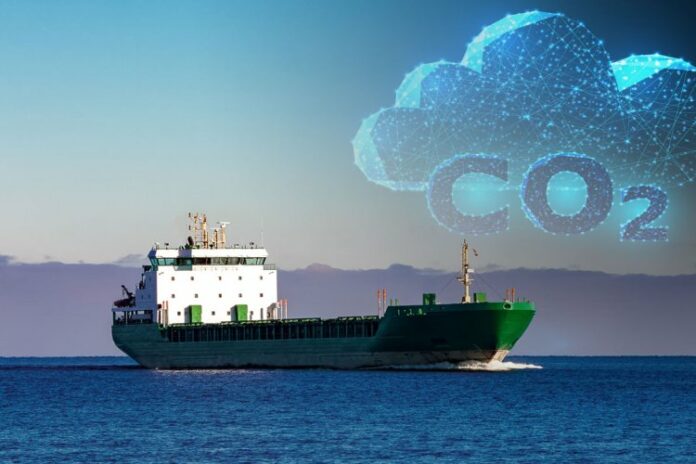
This emissions reduction technology returns CO2 from the exhaust gas back to the ship for storage by the process of absorption, regeneration and separation. The stored CO2, as a form of byproduct, can then be safely offloaded to shoreside facilities after entering port.

The three companies will collaborate on the design of an optimal OCCS for an LNG carrier to be built by DSME and verify the system through various risk analysis and tests before installation and operation. At the same time the project will seek to obtain ABS approval in principle (AIP) for the OCCS system. OCCS joint development is intended to be complete by the first quarter of 2023. ABS will guide the rules and regulations for OCCS development and provide technical advice and support. In particular, ABS will conduct a series of risk assessments and supervise the assessment procedure for the final AIP for this technology.

DSME received an order for four LNG carriers from GasLog last year. These vessels are scheduled to be delivered sequentially from the first half of 2024. The actual installation of OCCS on the LNG carrier is targeted to coincide with construction. GasLog will undertake the technical requirements for the installation and operation of OCCS. They will also provide valuable ship management know-how necessary for OCCS design evaluation.

John McDonald, ABS Executive Vice President and Chief Operating Officer, said:

“Carbon capture onboard is going to be a critical technology in the industry’s push for net zero. We are proud to be able to use our insight into OCCS to support these industry leaders with this landmark project, which promises to materially advance the adoption of this technology at sea.”

Mr. Karathanos, GasLog COO said:

“Strong collaborations with industry leaders such as DSME and ABS is a key enabler to decarbonizing shipping. At GasLog we firmly believe that onboard carbon capture will become one of the main methods to reduce emissions from shipping and contribute to keeping global temperature increase to 1.5 degrees Celsius.”

A spokesperson for DSME said:

“We are pleased to establish a place for environment-friendly technical cooperation in Greece, which is one of our biggest customers in the shipbuilding industry.”

A new partnership for Bureau Veritas to advance augmented ship services

0

Bureau Veritas (BV), one of the world’s leading ship classification societies, Laskaridis Shipping and METIS Cyberspace Technology, who provides ship environmental and operational performance smart tools, have agreed to embark on a pilot project to develop and apply a new BV SMART 3 Class notation covering the use of augmented data in ship operations.

Modern ships increasingly use smart systems designed to improve their operational efficiency. As part of its strategy to support maritime digitalization, BV has developed a framework of SMART notations for ships, which provide consistent and uniform standards for the ‘smart’ techniques used to monitor and improve fleet performance. 

In a new ‘Smartship’ pilot project, BV is working with Laskaridis Shipping and METIS to develop a range of additional class notations adapted to the latest advances in digitalization technology, with a focus on augmented ship. The SMART 3 notation will also cover ship to shore connectivity, remote decision support and remote operations.

Paillette Palaiologou, Vice President for Southeast Europe, Black Sea & Adriatic Zone at Bureau Veritas Marine & Offshore, commented: “Digitalization is transforming the maritime industry, bringing new challenges and opportunities. The new range of notations will help advance the journey towards more digitalized and autonomous ships. We are delighted to partner with Laskaridis Shipping and METIS Cyberspace Technology on this new project. Collaboration is essential to help progress new technologies and to support the industry’s transition.”

Laskaridis Shipping has been at the forefront of applying advanced real time monitoring solutions which help optimize ship efficiency and minimize environmental impacts. 

George Christopoulos, Chief Operating Officer, Laskaridis Shipping, said:

“We are very proud to be a partner in the highly innovative SMART certification project. We have committed to being at the forefront of maritime digitalization based on the gains these technologies deliver in operational excellence and enhanced ship sustainability.”

METIS Cyberspace Technology SA specializes in data acquisition, real-time performance monitoring and intelligent analytics for the maritime industry, using machine learning and artificial intelligence. 

Mike Konstantinidis, Chief Executive Officer, METIS, commented:

“Collaboration in this part of the SMART certification program confirms BV’s recognition of METIS intelligent analytics as fully ready to secure the rewards of shipping’s digital future. We would also like to acknowledge the vital role forward-thinking shipping companies like Laskaridis Shipping play in delivering the true benefits of maritime digitalization.”

Drawing on Bureau Veritas expertise in the certification, implementation and survey of data infrastructure, the new SMART 3 class notation is expected to provide added value for owners, shipyards and manufacturers of digital solutions for the maritime industry.