-0.9 C
New York
Home Blog Page 387

NYK to establish training center for offshore wind power generation

0

NYK, through a consortium with Nippon Marine Enterprises, Ltd. (Nippon Marine Enterprises), has been selected in a public offering for subsidized projects in the 2022 Subsidy for Offshore Wind Power Human Resource Development Project administered by the Agency for Natural Resources and Energy, which is part of Japan’s Ministry of Economy, Trade and Industry.

Around fiscal 2024, NYK, together with Nippon Marine Enterprises, will establish a comprehensive training center for offshore wind power generation in Akita Prefecture and will start training and human resource development related to offshore wind power generation. Toward the start of operation of the training and human resource development, the consortium will proceed with studies in collaboration with partner company Tohoku Electric Power Renewable Energy Service Co., Ltd. (Tohoku Electric Power RENES) and partner local governments Akita Prefecture and Oga City. The target number of trainees to complete the training course every year is approximately 1,000.

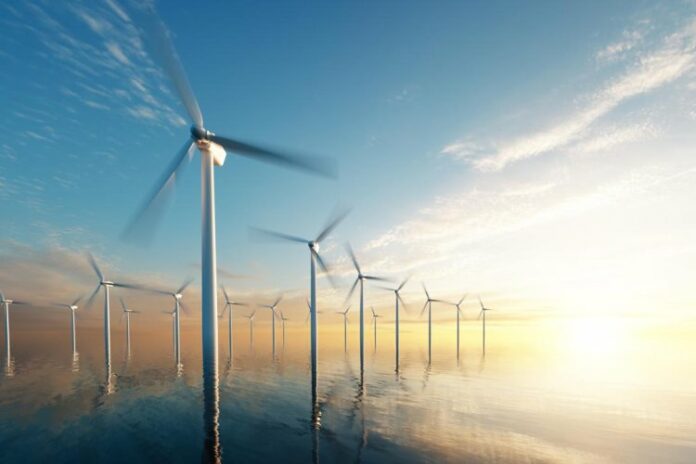
Offshore wind power generation is one of the fields that is expected to expand in the future. In Akita Prefecture, developments in several sea areas are planned in accordance with Japan’s Act of Promoting Utilization of Sea Areas in Development of Power Generation Facilities Using Maritime Renewable Energy Resources. 

Offshore wind power generation in the areas of Akita and Noshiro ports is expected to start commercial operation within 2022. The sea areas of Aomori, Yamagata, and Niigata prefectures, which are adjacent to Akita Prefecture, have been selected as “Promising Sea Areas,” and future expansion of offshore wind power generation is expected.

In order to develop specialized human resources related to the offshore wind power generation business, it is necessary to develop infrastructure such as training facilities for the training of personnel involved in the maintenance of offshore wind turbine facilities and operation of offshore wind power generation workboats. The training center of NYK and Nippon Marine Enterprises will respond to training needs and nurture human resources in the wind power generation business.

This training center will utilize facilities on the premises of Akita Prefectural Oga Marine High School, in addition to neighboring facilities, and will be linked with onshore wind turbine maintenance training provided in Akita City by partner company Tohoku Electric Power RENES. The consortium will provide training for specialized workers and workboat crews supporting offshore wind power generation. In addition, the consortium will also engage in offshore human resource development in collaboration with local governments and educational institutions to expand the offshore wind power generation business and develop human resources.
Hurtigruten Expeditions completes fleetwide implementation of Starlink

0

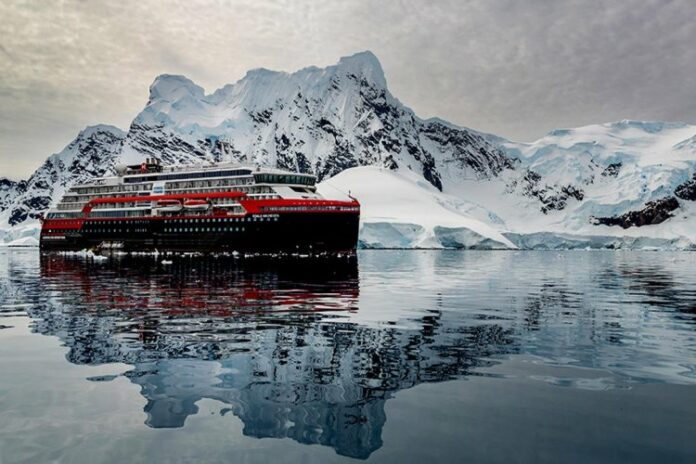
Hurtigruten Expeditions, the world’s largest and leading expedition cruise line, and its long-time connectivity partner, Speedcast, began initial testing and integration of Starlink’s LEO service onboard the fleet in March. 

Roll-out of the high-speed, low-latency connectivity will be finished by the end of October, making the cruise line likely to be the first in the industry to complete a fleetwide installation.

Starlink’s broadband connectivity is being integrated via Speedcast’s advanced network management technologies, blending the LEO coverage with multiple transmission paths delivered to the fleet as part of a complete managed service. This includes traditional geostationary (GEO) orbit coverage, and 4G/5G for Hurtigruten Expeditions’ high-demand applications.

Joe Spytek, Chief Executive Officer at Speedcast, said:

“With vessels operating in some of the most remote and spectacular areas of the world, Hurtigruten Expeditions is an ideal partner for introducing groundbreaking technology in the cruise industry. Speedcast’s expertise lies in our ability to combine all available connectivity paths and manage a complete service that offers the highest levels of uptime, availability, and performance. Hurtigruten’s vessels sailing from more traditional GEO coverage areas into lower look-angle locations, such as Antarctica, Alaska, Greenland, and the Chilean fjords, will be bolstered with this new LEO coverage, where available.”

For Hurtigruten Expeditions, Speedcast’s implementation of Starlink brings faster, more reliable internet to its guests and crew.

Hurtigruten Expeditions CEO, Asta Lassesen, said:

“As the world leader in exploration travel, it’s only fitting that we bring the world’s most innovative technologies onboard our ships to further enhance the experience and day-to-day lives for our guests, crew, partners and the communities we visit.”

Earlier this month, Speedcast announced an agreement with SpaceX’s Starlink to offer the broadband service to enterprise and maritime customers. At the time of the agreement, SpaceX’s Vice President of Starlink Sales, Jonathan Hofeller, commented: “We’re excited to provide Starlink’s high-speed, low-latency internet to Speedcast maritime and enterprise customers. This significant leap in connectivity will open even more possibilities for companies to manage operations anywhere on Earth.”

Speedcast will integrate Starlink connectivity into the multi-path, multi-orbit service that it offers, leveraging its SIGMA network platform and SD-WAN solutions, which make it possible to prioritize traffic, offer guaranteed service levels, and fully manage the customer experience.

Speedcast and Hurtigruten Expeditions’ multi-months trials, integrating the new technology into the managed connectivity service onboard a Hurtigruten Expeditions vessel, showcased how Speedcast’s network design enabled seamless failover from Starlink’s LEO connectivity to Speedcast’s global maritime network.

Three of Hurtigruten Expeditions’ vessels will operate in Antarctica this season, introducing Starlink to Antarctic waters. The new LEO service is slated to add Antarctic maritime coverage in Q4 2022.

Lassesen said:

“Our partnership with Speedcast and fleetwide introduction of the new service not only puts us ahead of the rest of the cruise industry, it also puts us ahead of the technology. When Starlink introduces maritime coverage in Antarctica and the Arctic, we will be ready.” 

Hurtigruten Expeditions offers free internet connectivity not only for guests, but also for all crew members.

LR and Triumph announce JDP for sustainable and advanced vessels

0

Lloyd’s Register (LR) and Triumph Energy (Triumph), a marine technology company specialising in green technology and automation, have announced a new Joint Development Project (JDP) to ensure vessels are built and operated sustainably.

The collaboration will see a new ShipRight procedure for vessels used within the offshore energy, decommissioning and renewable energy sectors.

The new ShipRight Procedure will guarantee that vessels comply with relevant sustainability and ECO requirements, being built with the most sustainable materials that are currently available and ensuring that ships can be constructed and operated to meet the current IMO 2030 and 2050 requirements.

The joint development project will also focus on integrating advanced, remote facilities and artificial intelligence to reduce the crewing levels required for offshore and back deck operations, thus minimising personnel exposure offshore in hazardous areas and reducing the carbon footprint used in mobilising and demobilising personnel for offshore based operations.

As part of the JDP, Triumph have developed designs which incorporate technology that demonstrates reduced Greenhouse Gas (GHG) emissions, advanced energy recovery systems, and the use of certified sustainable materials for vessels used within offshore, renewables and decommissioning sectors.

These designs have been independently verified to be Carbon Positive and are compliant for carbon credit trading, green financing and green bonds, a global first. The joint development project will welcome other technology partners in the months to come.

Graeme Hyde, Americas Sr. Business Development Manager, LR said:

“Under this joint development partnership with Triumph the development of the ShipRight Procedure will build on Lloyd’s Register’s existing ECO notations, LR will support the creation of a landmark 100% sustainability notation that will provide evidence whether a vessel is certified as Carbon Positive and is compliant for all green financing. This will enable our clients to build and operate IMO 2030 and 2050 compliant vessels today.”

Gray Johnstone, Chief Operating Officer, Triumph said:

“Triumph has always had the vision of designing and building vessels that could be as future proofed as possible and now achieving IMO 2050 compliancy and Carbon Positive verification are two major milestones. Working with Lloyd’s Register, this joint development partnership will set the groundwork for us to further advance what we have achieved thus far.

“Verification of a vessel’s green credentials along with the initial higher CAPEX has always been a major barrier to entry for obtaining financing for new build vessels. The development of a notation that verifies 100% a vessels sustainability, compliance to IMO 2050 and Carbon Positive verification will remove these barriers and pave the way for a decarbonized maritime sector.”

Ports face more disruption from strike action as cost-of-living crisis bites

0

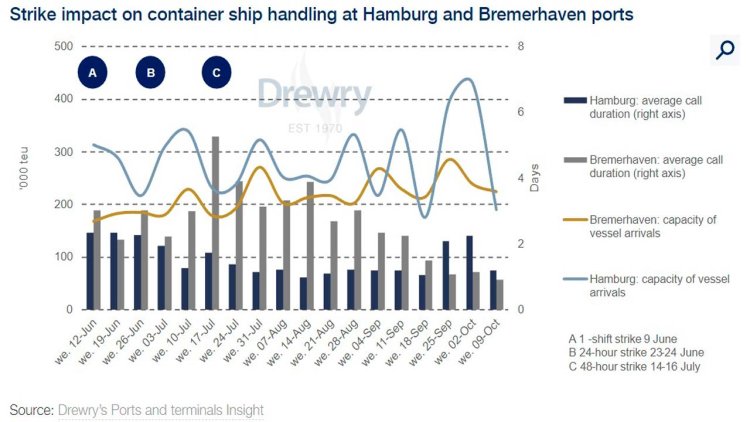
Strike action at major German and UK ports has caused major disruption to carrier schedules and has adversely impacted port performance with average call durations rising after the strike action.  

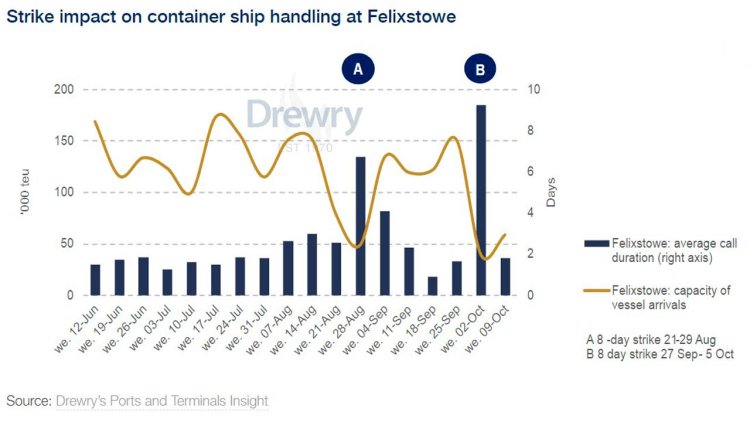
A series of dockworker strikes impacted the main German seaports in June and July, while the UK’s largest container port Felixstowe was hit by two 8-day walkouts in late August and September. 

In response to these planned strike actions, carriers took steps to divert vessels away from the impacted terminals. Nonetheless, Drewry’s analysis, published in its Ports and Terminals Insight, shows a significant increase in pre-berth waiting time, especially in Hamburg, where larger mainline vessels incurred an average 4-day wait to enter the port in July and August.

While agreement with the unions has now been reached in Germany, labour availability – particularly at weekends – remains challenging. Yard occupancy remains high and this is impacting productivity, resulting in extended call durations

In the UK, cargo handling operations at Felixstowe also remains disrupted, due to the backlog created by 8-day walkouts by dock labour in both late August and late September / early October. Strike action at Liverpool is further adding to shipper woes. As a result disruption is expected to continue through 4Q22.

Drewry’s view is that rising inflation increases the likelihood of strike action in other markets as dock labour push for higher wages to address the increasing cost of living. Disruption on the US West Coast remains a risk, for instance, while labour contract negotiations remain ongoing between the International Longshore and Warehouse Union (ILWU) and employer body the Pacific Maritime Association (PMA).

Whether terminal operators will be able to pass higher wage costs back to customers at the end of the year remains to be seen.

Damen to build two emergency response vessels for Romania

0

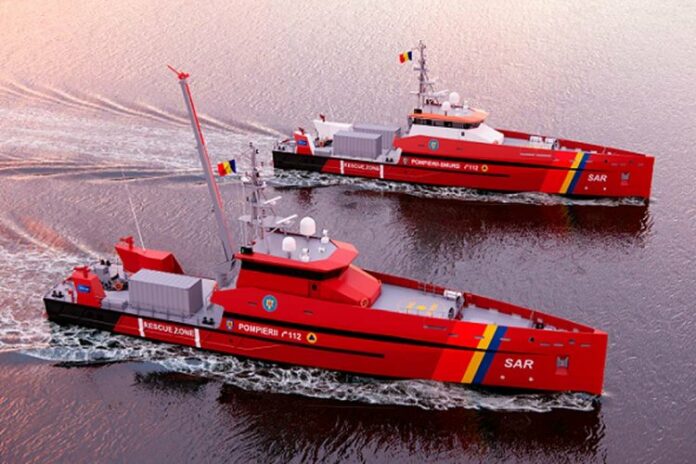
The General Inspectorate for Emergency Situations of the Romanian government has ordered two Damen Stan Patrol 5009 emergency response vessels. 

The contract was signed by Inspector General Iamandi, in the presence of Minister Lucian Bode and Secretary of State Raed Arafat at the Ministry of Internal affairs in Bucharest on October 10th. Romania sets to upgrade their fleet for emergency response significantly by this order.

The order is the finalizing of an extensive tender process that the Romanian government issued from the ‘Vision 2020’ project that aims to improve Romania’s disaster-response capacity by purchasing new equipment and training staff, aiming to better protect its population in emergencies. This program aligns with the national strategy on climate change and economic growth based on low emissions. Damen Shipyards won the tender process with the proposal for delivery of the two Stan Patrol 5009 vessels.

The Search and Rescue Multirole Vessels as requested by the Romanian government and engineered to specifications by Damen, will be able to complete missions up to three days in rough seas and adverse conditions. The range is at least 2000 nautical miles at cruising speed. One vessel is a Search and Rescue Multirole Ship with emphasis on medical aid, while the other is a Firefighting Multirole Ship, equipped to stop fires at vessels and platforms at sea. 

The first can evacuate at least 50 people from emergency situations, while the firefighting vessel is laid out to take at least 30 people on board. It has FiFi-1 notation. Multiple spray nozzles for firefighting are installed, one of them on top of a hydraulic arm to reach high and far in order to be able to direct the water into the heart of a fire.

Both vessels have a winch area for touch and go helicopter operations, rescue boats that can be launched fast, have the ability to launch drones and waterborne unmanned vehicles and are extensively equipped with communication and navigation instruments to participate in extensive missions with other vessels, vehicles and aircraft. The instruments enable rapid detection of objects and people in the water for emergency response. Both vessels can maintain a top speed of 22 knots. They will be finished and equipped at Damen Shipyards Galatí.

Delivery of the previously ordered vessels by the Romanian Border Police, two Damen Fast Crew Supplier 4008 Patrol is foreseen at the end of 2022.

Kongsberg to supply Hugin AUVS plus HiPAP Equipment to Poland

0

Kongsberg Maritime (KONGSBERG) is pleased to announce a contract award with Polish shipbuilder Remontowa Shipbuilding SA (RSB) to supply three shipsets of KONGSBERG HUGIN AUV (Autonomous Underwater Vehicle) systems and related HiPAP positioning and communication systems for three newbuild warships for the Polish Navy.

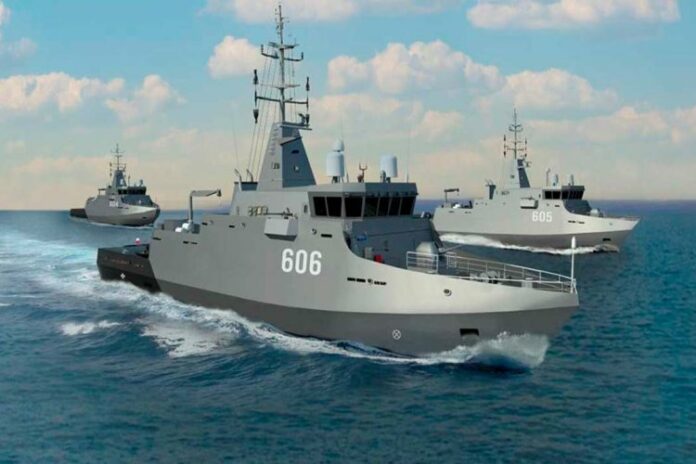
The total contract value is in excess of €10M, with the KONGSBERG equipment destined for the next three vessels (#4, #5 and #6) in the Kormoran II Mine-Countermeasures (MCM) vessel program. These three ships will be commissioned from 2026 to 2027.

The three HUGIN/HiPAP shipsets will be delivered to the yard over the next four years to match with the new vessel delivery schedule. This new contract follows on from previous contracts for the successful integration of HUGIN and HiPAP systems on the first three vessels in the Kormoran II program by Kongsberg Maritime and RSB.

KONGSBERG HUGIN Autonomous Underwater Vehicles are marine robots offering the ultimate in autonomous remote subsea search and survey capability. These free-swimming autonomous underwater vehicles are characterised by great manoeuvrability and excellent stability for high-quality data collection. Hydrodynamic shape, accurate instruments and excellent battery capacity make these AUVs a popular choice for governments and militaries worldwide.

One of the many benefits of the HUGIN systems is their modular platform and wide range of options. The HUGINs aboard the Kormoran II vessels will benefit from:

  • KONGSBERG HISAS 1032 Synthetic Aperture Sonar for long range, high-resolution imagery and bathymetry
  • KONGSBERG EM2040 Multibeam Echosounder, an industry standard bathymetric mapping sonar
  • UHD Colour Camera with LED Lighting Panel for high-resolution optical imagery
  • Forward-looking Sonar and altimeters for obstacle avoidance and trajectory planning
  • Low magnetic-signature stinger launch & recovery system (LARS)
  • KONGSBERG Sunstone advanced Inertial Navigation System (INS) for industry leading autonomous position accuracy

Capable of fully autonomous operations without surface vessel support, HUGIN is also designed to work in conjunction with the HiPAP (High Precision Acoustic Positioning) family of underwater positioning and navigation systems. This allows for high-accuracy position updates for the vehicle, as well as real-time communications for status, sensor quality assurance and on-the-fly mission replanning.

According to defence publication Janes, the non-magnetic steel hull Kormoran II class is designed for minehunting in Poland’s exclusive economic zone (EEZ), with task forces in the Baltic and North seas. The vessels are intended to provide substantial increase of Polish MCM capabilities, doubling the number of existing Kormoran II type vessels in service, to secure the sea lines of communications.

The Kormoran IIs class minehunters have a full load displacement of 850 tonnes, an overall length of 58.5m and can carry a crew complement of 45, with accommodation for seven additional personnel. The RSB’s own in-house design is a multi-toolbox concept, hybrid solution, minehunter where HUGIN AUV is one of underwater systems for stand – off mine countermeasure operations.

Commenting on the contract award, Kongsberg Maritime SVP Stene Førsund said:

“These latest contracts are a true acknowledgment of a team effort over many years, and it shows that Kongsberg Maritime offers the right technology and solutions for the growing AUV market. We see that customers put AUVs into operation in many applications, and we believe that Autonomous Underwater Vehicles will be used in even more applications in the future. We have some big-name clients, but when the navy of a sovereign nation and fellow NATO member continues to put its trust in our technologies, it’s an inspiring moment for us.”

Dariusz Jaguszewski,  CCO at Remontowa Shipbuilding said:

“These mine countermeasure vessels represent an important contract for Remontowa Shipbuilding as well as an important statement and reinforcement of Poland’s national security in a fast-changing world. Kongsberg Maritime has already successfully delivered and commissioned HUGIN and HiPAP systems to us for the first three vessels in the Kormoran II program. The experience of nine years work with Kongsberg through these deliveries has been highly professional throughout and we are confident that the technologies to be delivered represent the state-of-the-art in underwater autonomy and mine countermeasure systems.”

Maersk orders six further methanol-fueled vessels to ABS Class

0

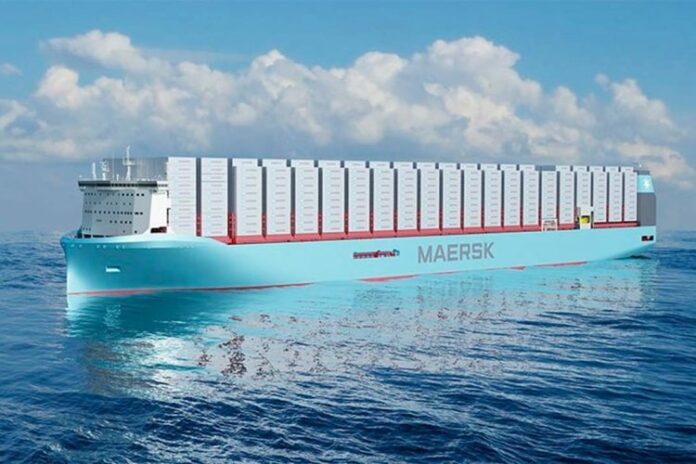
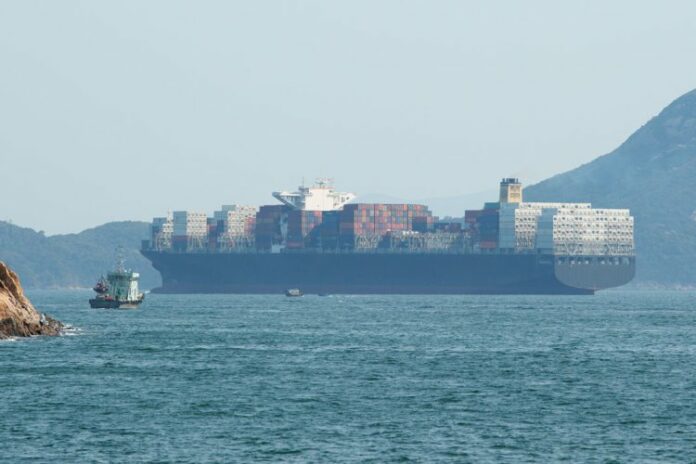
The order takes the total of dual-fuel engine vessels that can sail on green methanol on order from Maersk to ABS class to 19.

These 17,000-TEU vessels will be built at Hyundai Heavy Industries, scheduled for delivery in 2025. When all 19 vessels on order are deployed and have replaced older vessels they will, when operating on green methanol, generate annual CO2 emissions savings of around 2.3 million tonnes.

Christopher J. Wiernicki, ABS Chairman, President and CEO, said:

“Decarbonization of shipping is a complex challenge with many moving parts. Green methanol is a promising fuel for the decarbonization of our industry and these vessels are a vital step in creating more sustainable global supply chains. ABS is proud to be able to use its insight into methanol as a marine fuel to support Maersk.” 

Palle Laursen, Chief Fleet & Technical Officer at Maersk, said:

“All vessels we currently have on order will be able to operate on green methanol, which we see as the best scalable green fuel solution for this decade. We look forward to build on the current momentum and continue the cooperation with ABS on our path to decarbonizing our fleet.” 

NASA’s S-MODE field campaign deploys to the Pacific Ocean

0

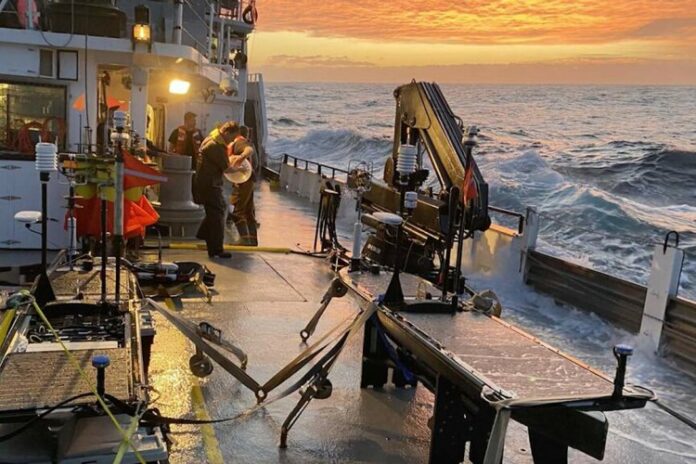
When the research vessel Bold Horizon sailed from Newport, Oregon, in early October, it joined a small armada of planes, drones, and other high-tech craft chasing the ocean’s shapeshifting physics.

Over the course of 28 days, the team will deploy a new generation of tools to observe whirlpools, currents, and other dynamics at the air-sea boundary. The goal: to understand how these dynamics drive the give-and-take of nutrients and energy between the ocean and atmosphere, and ultimately, help shape Earth’s climate.

Perhaps the most familiar “sub-mesoscale” features are the phytoplankton-rich swirls, or eddies, that can be seen spiraling across the ocean from orbiting Earth satellites.

“Some of the coolest images of ocean sub-mesoscale eddies come from photographs taken on the Apollo spaceflight missions,” said Tom Farrar, a scientist at the Woods Hole Oceanographic Institution in Massachusetts and principal investigator for S-MODE.

Such features are challenging to analyze, because spanning up to 6.2 miles (10 kilometers), they are larger than any vessel but smaller than regions typically studied with satellite measurements. Infused with energy, they can change within hours. Farrar says researchers’ ability to model these dynamics on a computer has outpaced their ability to tackle them at sea—until recently.

This work is important because while the surface layer makes up only about 2% of the ocean, it plays an outsize role in the climate system. It is there, at the air-sea boundary, where nutrients, gases, and heat are traded—a process called vertical exchange.

Photo: NASA

The process is not fully understood and S-MODE’s observations may help reconcile differences among today’s models. The implications for climate science are significant. By some estimates, the net effect of sub-mesoscale eddies on the vertical exchange of heat is an order of magnitude larger than the planet’s energy imbalance linked to the greenhouse effect.

Protruding from the belly of a King Air B200 aircraft from NASA’s Armstrong Flight Research Center in Edwards, California, is an instrument Farrar calls one of the stars of the mission. From its perch 28,000 feet (8.5 kilometers) in the air, DopplerScatt uses radar to bounce electromagnetic energy off wind-tossed ocean surface and measure the energy that scatters off.

Developed at NASA’s Jet Propulsion Laboratory in Southern California, the instrument can simultaneously map surface currents and winds. “With S-MODE, we’re trying to observe two things at the same time: how the ocean moves, and how ocean and atmosphere communicate and affect each other,” said Nadya Vinogradova Shiffer, S-MODE program scientist and physical oceanography program manager at NASA’s Headquarters in Washington.

The team relies on state-of-the-art weather forecasting to identify rough, windy conditions because radar can’t “read” a calm, flat sea, said Dragana Perkovic-Martin, principal investigator for DopplerScatt at JPL.

“A glossy sea surface produces very little radar signal. We need wind to disturb the surface and produce the signal we are after,” she added. “Being part of a mission of this scale can be exciting and nerve-wracking.”

Aboard another aircraft is an instrument that can image microscopic marine life in billions of colors. Resembling a metal basketball, JPL’s Portable Remote Imaging SpectroMeter (PRISM) will ride inside a Gulfstream III jet, spying phytoplankton blooms in hundreds of wavelengths ranging from ultraviolet to infrared.

Photo: NASA

By tracking chlorophyll, a telltale signature of these algae, PRISM will help scientists visualize ecology interacting with ocean currents, providing exponentially more information than familiar three-channel (red, green, blue) cameras. It will also inform next-day flight planning during the campaign, said David Thompson, JPL principal investigator for PRISM.

“PRISM is one of our eyes chasing sub-mesoscale features across the ocean,” he said. “The mission is incredibly interdisciplinary, and we all come together around this instrument.”

For the team sailing below on Bold Horizon, life aboard a research vessel cruising 5 miles per hour can feel cramped and adventurous. “It’s fun, but fun like camping or climbing a mountain,” Farrar said.

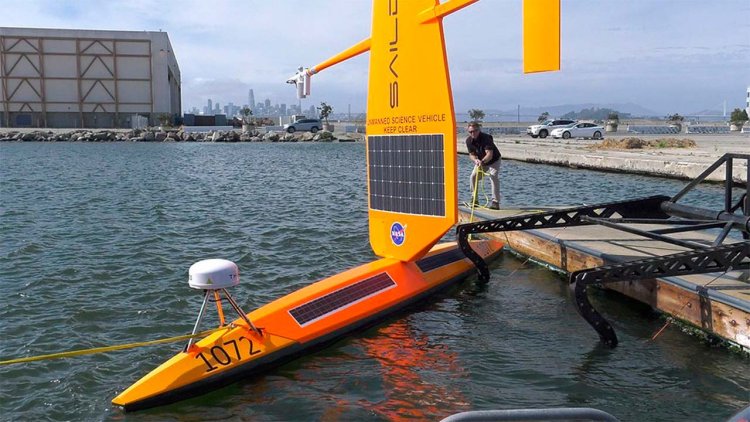
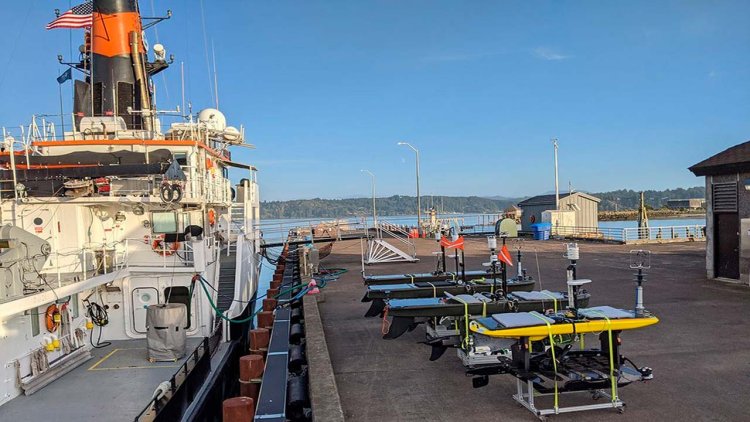
The challenges can be unpredictable. Last year’s pilot launch overcame COVID-19 delays and a rogue wave that disabled several wave gliders—surfboard-like marine robots studded with scientific instruments.

In this second of three deployments, the mission looks to collect more than 15 data sets, ranging from biology to atmospheric weather patterns. The data will complement another NASA mission launching later this year. The Surface Water and Ocean Topography, or SWOT, satellite will survey nearly all water on Earth and in higher definition than before.

“The ocean is turbulent at all spatial scales, and there are a lot of insights that can be gained by having these measurements made together,” Farrar said. “NASA has had a big role in oceanography and is still pushing the boundaries of what we understand about the Earth.”

Principle Power to advance FEED for Wind-to-Hydrogen Dolphyn project

0

Principle Power has been contracted by ERM to advance the Front-End Engineering Design (FEED) for a Wind-to-HydrogenDolphyn 10 MW demonstrator project off the coast of Aberdeen. The contract was signed after ERM Dolphyn was awarded £8.62m of funding from the UK Government, via the Low Carbon Hydrogen Supply 2 Competition.

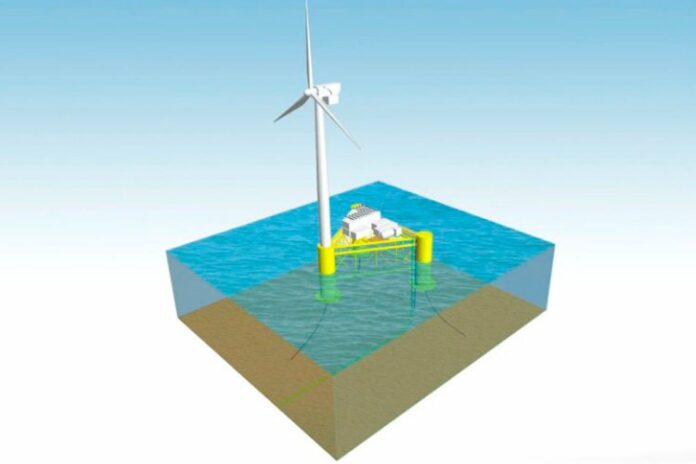
ERM Dolphyn (Deepwater Offshore Local Production of HYdrogeN) has developed a concept design to produce large-scale green hydrogen from floating offshore wind. The ERM Dolphyn concept employs a modular design integrating electrolysis and a wind turbine on a moored floating semi-submersible platform based upon the proven WindFloat® technology by Principle Power to produce hydrogen from seawater, using wind power as the energy source. ERM and Principle Power have been collaborating on the development of decentralized hydrogen production opportunities since 2019.

David Caine, Partner, ERM, said:

“It is now established that to meet net-zero ambitions in the UK and all around the world, hydrogen from offshore floating wind needs to be a significant component in any viable long-term solution for heat, electricity generation, and transport. The ERM Dolphyn project, a first-of-a-kind, is an innovative integrated system combining all the technologies required to bring the latest floating wind and hydrogen production technologies together to enable offshore wind resources to contribute toward hydrogen production at scale. Principle Power has been instrumental in this process, and we’re delighted to extend our collaboration.”

The 10 MW demonstrator project is a key step in proving the Dolphyn concept prior to commercial-scale deployment. The demonstrator project is targeting operations in late 2025. Commercial scale projects (300MW+) are under development and expected for operation pre-2030, followed by large-scale (GW) deployment post-2030. When fully deployed, at an expected 4 GW total capacity, ERM Dolphyn has the potential to supply energy to heat more than 1.5 million homes with no carbon emissions, thus avoiding the release of millions of tonnes of CO2 into the atmosphere every year. 

ERM Dolphyn is a core project for the UK’s Hydrogen coast strategy, and is expected to help generate >10,000 new jobs by 2030 and more than 100,000 by 2050. Many of these jobs will rely on the world-class skills and knowledge found in the offshore renewables and Oil and Gas sectors. This massive opportunity is not without challenges: the rapid scaling up of floating offshore wind to meet both governments’ and markets’ energy transformation goals requires an equally massive investment in the entire supply chain. 

e1 Marine partners with Green Marine to accelerate methanol-fueled newbuilds

0

From 1 October 2022, Green Marine Engineering is e1 Marine’s sales representative in northern Europe. The partnership will focus on offering shipowners the benefits of e1 Marine’s methanol-to-hydrogen reformer for generating fuel for PEM fuel cells. 

Copenhagen-based Green Marine Engineering is an independent maritime transition advisory and project management firm that leverages its commercial, technical and operational methanol dual fuel expertise to offer turnkey methanol based maritime transition solutions. Green Marine facilitates investments in methanol powered vessels across multiple market segments such as container, bulk and tanker vessels. 

e1 Marine’s technology provides the industry with an additional solution for decarbonization, adding to what is a relatively small selection of methanol-enabling technologies within the industry. In tandem, Green Marine brings expanded potential for co-operation with shipowners, ports and shipyard to e1 Marine. 

Robert Schluter, Managing Director at e1 Marine, commented:

“Collaboration, such as our agreement with Green Marine Engineering, is essential to better provide services to our customers in North Europe. The local representation will focus on enabling shipowners to meet decarbonization goals set for 2030 and beyond using methanol-reforming technology. We are ready to support first-movers – those leaders who will forge the way forward on decarbonization. Our on-demand power system has no moving parts, generates no vibration and is more future-proof than internal combustion engines due to its greater efficiency and clean power production.

“We are confident that by partnering with Green Marine who not only understands the intricacies of our technology but has the broader knowledge and networks to hold meaningful conversations with ship owners in Europe, will help to accelerate uptake of this vital solution in the region.”

e1 Marine’s system produces zero particulates, zero NOx, zero SOx, and less CO2 than a diesel generator. In addition, when using renewable methanol, the system produces near zero greenhouse gas emissions. As a result, the e1 Marine methanol-to-hydrogen generator enables shipowners to meet decarbonization targets set by the EU and International Maritime Organization (IMO) and offers significant savings in OPEX due to its high efficiency. One-third of the hydrogen produced is attributable to the addition of water which can be recycled from the PEM fuel cell exhaust. 

Fredrik Stubner, Co-founder and CEO of Green Marine Engineering, says:

“Methanol is a safe, bio-degradable and globally available marine fuel. We are taking action to help decarbonize the global shipping industry through innovative methanol-based solutions that align with IMO emission reduction targets for 2030/2050 and the Paris Agreement. Methanol technology is transforming shipping and delivering an economically feasible solution.”