-0.2 C
New York
Home Blog Page 343

Deep-sea devices detect earthquakes, singing whales and an exploding ship

0

The seismometers, which have now been collected after spending a year at the bottom of the ocean, record the Earth’s ground motions on the sea floor and thus capture the Earth’s “pulse.”

Many of these recordings capture seismic waves that traveled deep and long inside the Earth following distant earthquakes, as well as from lots of small local ones, which will be used to build images of the Earth’s interior down to ~2,800 km depth. The techniques used are similar to those employed by medical doctors to build CAT scans of the human body.

The aim of the project, called UPFLOW (UPward mantle FLOW from novel seismic observations), is to better understand massive “upwellings” of material pushing up from Earth’s mantle, which are poorly understood and ultimately cause volcanic eruptions and can lead to earthquakes.

But as well as ground motions due to earthquakes, the seismometers also pick up vibrations caused by a wide range of phenomena—including passing ships, magma intrusions in nearby volcanoes causing small local earthquakes, and singing whales.

Some signals in the data were linked to a massive volcanic eruption on the other side of the planet. The January 2022 Hunga-Tonga Hunga-Ha’apai eruption sent pressure waves through the Earth’s atmosphere that connected with the sea surface and were detected by the seismometers on the seafloor.

Other signals were linked to the sinking of the Felicity Ace ship near the Azores, carrying 4,000 luxury cars on March 1, 2022. The signals suggest that there may have been separate explosions as the ship sank.
The seismometers were deployed as deep as 5km below sea level, across a region encompassing the Canary islands and the archipelagos of Azores and Madeira.

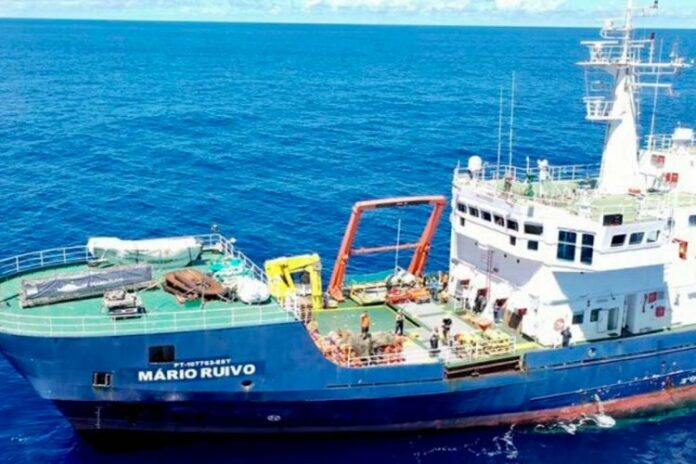
They were collected over five weeks during an expedition on the research vessel Mário Ruivo (owned by project partner IPMA, the Portuguese Institute of Sea and Atmosphere).

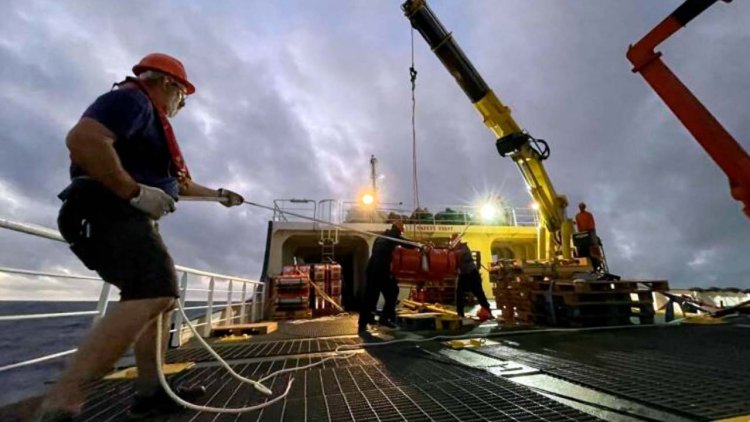
The research team retrieved the seismometers by sending a series of sounds, or an acoustic code, to the instrument, which the instrument answered with its own unique acoustic signal. Another sound code from the ship instructed the instrument to release itself from its anchor, so that it floated to the surface. The process, said Professor Ferreira, “felt a bit like magic.”

The team searched for the device on the sea surface, before fishing it out with the help of the ship’s crew using ropes and cranes.

Primary investigator Professor Ana Ferreira (UCL Earth Sciences) said:

“Because deep sea communication systems are very limited (GPS does not work under water), we had no idea how our data would look before we opened the instruments, took the data cards out and started exploring. Thankfully, the quality has been really good. At that depth, the currents are possibly weaker, and there is likely little life—not too many fish are going to bump into the instruments—and there seems to be little incoherent noise.”

The researchers will now combine this new unique data with existing global seismic data to produce sharper images of the Earth’s deep interior than previously possible, improving our understanding of how deep hot rocks rise to the surface, and ultimately how they feed volcano systems and link with earthquakes. The team will also investigate if there is a link between how the Canary Islands and the volcanic islands Madeira and the Azores were formed (this link could be potentially as deep as 2,800 km).

The seismometers will also shed light on life on the ocean floor. Professor Miguel Miranda (IPMA’s president and project partner) said:

“Such deep sea regions are essentially unknown—we know more about the surface of the moon—and so by recovering instruments that stayed at such depths for over a year, we are bringing to surface invaluable new deep sea probes potentially full of little known bacteria.”
Solar and wind power generation begins at Port of Tianjin, China

0

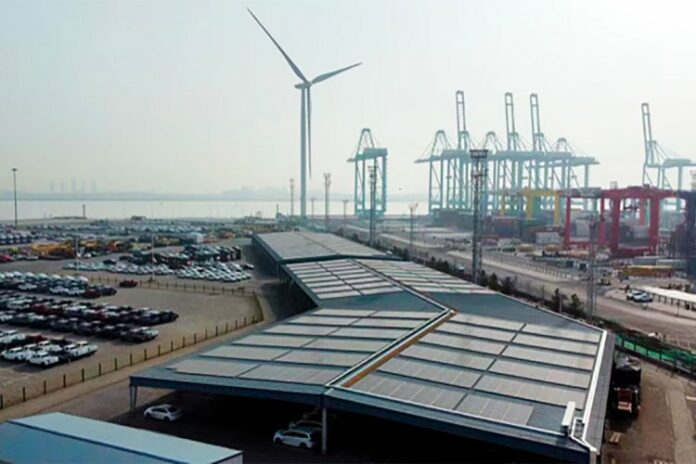
Together with the terminal’s solar power system, which has been in operation since March 2022, the new facility will be able to supply all the electricity needed by the finished-vehicle logistics terminal operated by the NYK affiliate at the port of Tianjin.

In fact, on January 17 the terminal was presented with a carbon neutrality evaluation certificate from China Classification Society, a third-party certification body.

The terminal’s solar power system includes photovoltaic panels that have been installed on top of the terminal’s covered parking lot. The amount of electricity generated will be approximately 1.75 million kwh/year, which will reduce dioxide (CO2) emissions by about 1,400 tons/year.

In terms of wind power generation, two wind turbines have been installed on the terminal site. The amount of electricity generated will be approximately 23 million kwh/year, which will reduce CO2 emissions by about 23,000 tons/year. The wind turbines have been designed and installed with due consideration for the surrounding environment and safety.

Yutaka Ikeda, managing executive officer and chief executive of NYK’s Automotive Transportation Headquarters, commented:

“I am very pleased that the solar and wind power generation systems at the finished-vehicle logistics terminal in Tianjin, China, in which NYK has invested, have started operation and that the terminal has received a carbon neutrality evaluation certificate in recognition of the effectiveness in combating climate change and reducing the environmental impact. The finished-vehicle logistics terminals operated by the NYK Group have already begun using renewable energy at the Daikoku C-3 Terminal at the port of Yokohama and the ICO Terminal at the port of Zeebrugge, Belgium. The NYK Group will continue to realize eco-friendly green terminals by horizontally expanding the know-how of use of renewable energy to the finished-vehicle logistics terminals that we operate around the world.”

HHLA Next invests in FERNRIDE – joint pilot project in Tallinn

0

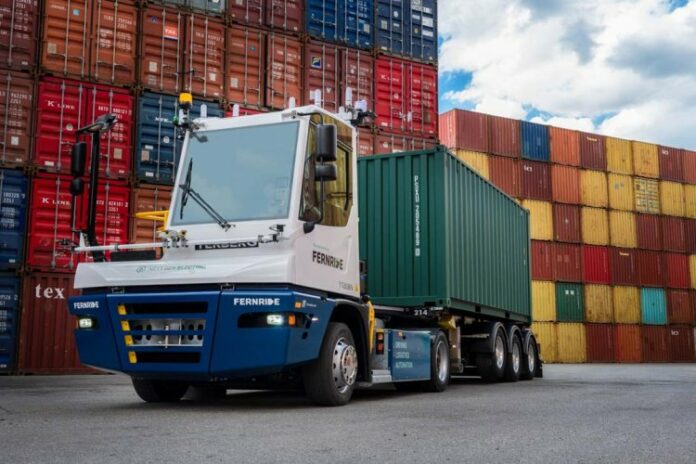
The goal of the project is to develop solutions for the gradual automation of trucks within live operations. HHLA Next is investing in FERNRIDE’s innovative solution to drive forward automation and sustainability in logistics and to address the lack of truck drivers.

The approach of FERNRIDE lies in the gradually increasing autonomy of trucks and tractor units. The combination of autonomous driving technology of the vehicles and human expertise in remote operation already offers a reliable service available now in live operations. This creates an immediate added value and speeds up the journey towards more sustainable logistics.

Simone Lode, Managing Director of HHLA Next:

“We at HHLA Next invest in digital and sustainable business models in maritime logistics. We see great potential in autonomous driving solutions, also because of the current lack of truck drivers. With FERNRIDE, we are investing in a company that has already implemented a viable solution with a partner network of respected companies from industry and logistics with very good results. In addition, the project highlights our focus on sustainable logistics.”

Hendrik Kramer, CEO FERNRIDE:

“The advantages of remote control can already be actively used by a part of the workforce within ports. With our solution, truck drivers can now also benefit.”

HHLA Next is providing the new portfolio company with access to subsidiaries in the HHLA Group. A pilot project will start in early 2023 at the HHLA TK Estonia terminal in Tallinn – the first FERNRIDE project at a container terminal. The goal of the project is to determine the technology’s operational reliability in automated container handling and to validate the technology’s viability for future business opportunities.

Philip Sweens, Managing Director of HHLA International:

“This partnership with FERNRIDE as part of the pilot project in Tallinn will help us to jointly explore new opportunities and to create workflows at our international terminals that are future-oriented and sustainable.”

Martin Isik, CCO FERNRIDE:

“With our joint project during ongoing, live operations, we are creating the basis for series development and the adaptation of our solution to container logistics. We will use our gradual automation approach to demonstrate the high value proposition of the FERNRIDE platform for customers at container terminals.”

The technology start-up FERNRIDE, which has approximately 100 employees, equips trucks and tractor units with sensors and cameras so that they can be remote-controlled via mobile networks. Teleoperators at a computer workstation that resembles a vehicle cockpit take remote control of the vehicles. The teleoperator receives and sends targeted commands in real time by controlling the gas pedal, brakes, steering wheel and joystick. FERNRIDE’s algorithms can be further trained using data from the real-life operation in order to roll out additional autonomous functions.

Truck drivers can be more flexibly deployed through the use of this new technology, which has a positive impact on operating procedures. In addition, the option to work remotely increases both the attractiveness of the job profile and safety on the respective premises.

Denmark launches the world’s first digital ship register

0

This week, Denmark has launched the world’s first digital ship register. 

There are currently more than 6000 ships registered in the Danish shipping registers. The registrations of these ships have until now been handled manually.

That is why the Danish Maritime Authority launches the new digital ship register. It will ease the workload with faster and more efficient workflows for everyone working with registration of ships in Denmark. At the same time, the system contributes with an extra layer of security and control in relation to ship registration.

Deputy Director, Niels Peter Fredslund, said:

“Digitalization is a focal point for future shipping. The launch of the digital ship register is a significant initiative in this regard. The digital ship register will get rid of manual paperwork and has great potential for streamlining and reducing the administrative burdens for shipping companies in ship registration and ship trading.”

Aker Solutions wins Lapa South West subsea contract in Brazil

0

Aker Solutions has been awarded with a sizeable contract by TotalEnergies to provide the subsea production system, tools and all related EPCI interfaces for the Lapa South West field Construction, in the pre-salt Santos Basin offshore Brazil. 

The development concept is a subsea tie-back to the Cidade de Caraguatatuba FPSO, using existing facilities and infrastructure.

Aker Solutions will deliver a subsea production system including up to three subsea trees and control systems, tie-in, structures and subsea umbilicals, as well as associated equipment and installation work. The scope also covers EPCI interface management, in partnership with Saipem Brazil, and Control System upgrade of the existing Lapa South West subsea trees. Work starts immediately with deliveries scheduled from the first quarter of 2024 until the fourth quarter of 2024.

“We are pleased to be selected to execute the Lapa South West subsea project. The Brazilian offshore market is becoming increasingly diverse with regard to work scope and customer opportunity. We look forward to extending our long-standing relationship with TotalEnergies, as representative of Lapa JV, to the Brazilian market and to further enhance the hydrocarbon potential of Brazil,” said Maria Peralta, Executive Vice President and head of Aker Solutions’ Subsea business.

Marlink and Fraunhofer CML Institute partner to map maritime KPI data

0

Marlink has signed an agreement with leading research institute Fraunhofer CML (Center for Maritime Logistics and Services) to identify Key Performance Indicator (KPI) data to accelerate digitalisation and define the Return on Investment (ROI) scenarios for long term operational efficiency.

Within this agreement, Marlink will leverage its BridgeLink solution to deliver data from core engine room and bridge systems including VDR, ECDIS, Radar, AIS, AMS, engine control systems, cargo systems, propulsion and sensors. The outcomes will enable shipowners to better understand how to optimise voyages, reduce fuel consumption and optimise operational maintenance. Fraunhofer CML develops and optimises processes and systems for the maritime supply chain. The institute supports private and public sector clients, including ports, logistics services providers and shipping companies, implementing innovation using practice-oriented research.

The joint research project reflects the importance of data collection to the transformation needed to achieve long term efficiencies and compliance with decarbonisation targets, optimising investments to reflect vessel lifespan. To do so, shipping companies will need to shift from reactive or procedural operations to centralised and data-driven work processes if they want to maximise the expected optimisation and efficiency savings and comply with regulations and commercial terms.

Using quantitative analysis techniques and industry-specific knowledge, Fraunhofer CML will produce a unified dataset that will be used as a reference model by owners who want to improve efficiency in data-driven use cases but whose technical departments may require additional support. Feedback already collected by Marlink suggests that operators of all sizes would benefit from assistance in gathering the harmonised data that they can use to develop a practical digital decarbonisation strategy.

The KPIs generated will be measured against a baseline of historical data which will define and set out the new data to be collected. From the data and supporting information provided, Fraunhofer CML and Marlink will produce representative data on ROI scenarios for shipowners’ different use cases. Owners will use the results to make operational improvements and plan strategic investments in energy saving devices based on ship type, age and fleet profile.

Nicolas Furgé, President, Digital, Marlink, said:

“Decarbonisation is challenging for many shipping companies, as it represents a fundamental change to their operations and a transformation in their customer relationships. This research project will help shipowners implement their decarbonisation and optimisation strategies and help them plan investment and make decisions on a shorter timeline.”

Dr.-Ing. Anisa Rizvanolli, Team Leader at Fraunhofer CML, said:

“Fraunhofer CML has vast experience in addressing shipping industry challenges using interdisciplinary teams of engineers, economists, mathematicians, computer scientists and navigators to create customised solutions. This project will fill a vital need by providing actionable KPI data that companies can adopt into their daily processes and use to plan for a low carbon future.”

Carnival Corporation expands next-generation Wi-Fi connectivity with SpaceX’s Starlink

0

Carnival Corporation & plc has announced an agreement for the next-generation of internet connectivity across its global fleet, the latest in a series of moves that have nearly tripled ship bandwidth since 2019. The company has signed a new agreement with SpaceX’s Starlink, the leader in Low Earth Orbit (LEO) satellite technology, to provide faster service, greater capacity and more reliable Wi-Fi on a global scale.

Fleet roll-out of Starlink began in December 2022 with Carnival Cruise Line and AIDA Cruises ships, with plans to expand Starlink to several of the company’s other world-class cruise brands, which include Princess Cruises, Holland America Line, Seabourn, P&O Cruises (Australia), Costa Cruises, P&O Cruises (UK) and Cunard.

Rivaling on-land connectivity experiences, Starlink greatly advances Carnival Corporation’s focus on providing the best available Wi-Fi experience for its guests to stay connected while on vacation, including sharing photos and videos, streaming movies and live sporting events, and enjoying other content onboard with a reliable connection at even faster speeds.

Josh Weinstein, CEO of Carnival Corporation, said:

“For many of our guests, it has become more and more important to maintain the type of connectivity at sea that they’ve become accustomed to at home, and of course to share the unforgettable experiences of their cruise with friends and family. We are in the business of delivering happiness, and Starlink makes it as easy as possible for our guests to share all their great moments and memories, giving them even more joy out of their cruise vacation.”

“The added bandwidth will give the brands the capabilities and flexibility to introduce new guest services and features, as well as help boost operational functions like onboard equipment monitoring and real-time communications between ship and shore teams. And importantly, adding Starlink’s innovative technology to the company’s existing connectivity platform will also help our amazing crew stay in touch with friends and loved ones.”

Jonathan Hofeller, vice president of Starlink sales for SpaceX, said:

“High-speed, low-latency broadband internet is critical in our modern age, and we’re excited to provide Carnival Cruise Line and AIDA’s guests an internet experience that makes their travel even more enjoyable. In even the most remote waters, guests onboard Carnival Corporation ships will be able to share real-time updates with friends and family.”

Parkwind’s Arcadis Ost 1 wind farm produces first electricity

0

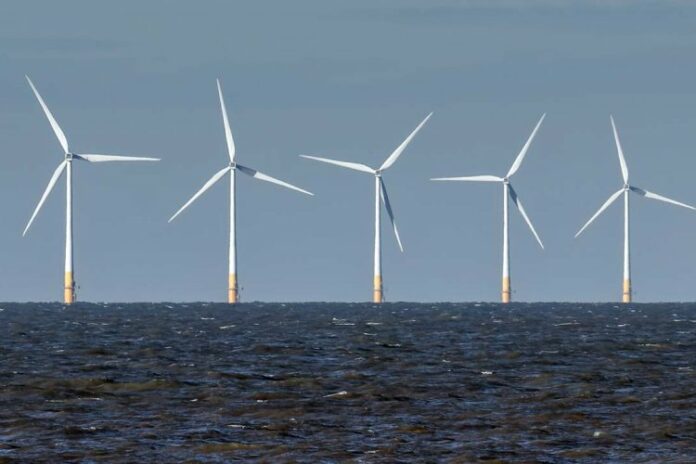
The first Arcadis Ost 1 turbines have been successfully energized, and are now producing energy. Parkwind’s Arcadis Ost 1 is delivering power to the German grid since 12th of January 2023.

Arcadis Ost 1 is a 257 MW wind farm developed by Parkwind, located in the German territorial waters of the Baltic Sea, northeast of the island of Rügen and will generate enough green energy to power the equivalent of up to 290,000 households. It is the first wind farm equipped with Vestas V174-9.5MW turbines and Parkwind’s first international project.

Foundation and offshore substation installation started in June, shortly followed by the laying of cables in August and turbine installation end of November. In full winter period floating turbine installation, cable termination and turbine commissioning ensued in a seamless process. Together with our partners 50 Hertz, the first turbines were brought online over the past few weeks.

Parkwind Ost’s Project Director Wim Verrept commented:

“What better way to celebrate the New Year than with another huge milestone achieved by our Arcadis Ost teams? First power is the culmination of a long string of achievements each demonstrating the skills and efforts of a group of exceptionally talented people that I have the honor to work with. We are now delivering the first green energy produced by the Arcadis Ost windfarm to the German grid at the connection point in Lubmin contributing to a carbon free German society.”

AD Ports Group signs strategic agreements with KazMunayGas

0

AD Ports Group has signed a strategic partnership agreement with Kazakh National Oil Company (KazMunayGas) and a Memorandum of Understanding (MoU) with the Ministry of Industry & Infrastructural Development for strategic cooperation in the development of a marine fleet and coastal infrastructure in the Caspian and Black seas.

The agreements build upon the shareholder agreement signed in December with KMTF (Kazmortransflot), a subsidiary of KazMunayGas, to launch an exclusive joint venture to provide offshore services for energy companies in the Caspian Sea.

The new agreements signal a significant expansion for AD Ports Group in Central Asia and Kazakhstan, which is a major market for energy, transport and logistics that continues to gain in strategic importance as a key trade route between Europe and Asia.

Under the terms of the strategic partnership agreement with KazMunayGas, the two companies will review opportunities to collaborate on a broad range of projects in the area, including the development of a new fleet of shallow-water vessels to support offshore operations in the Caspian Sea and the development of a tanker fleet to support the export of Kazakh oil.

There is also potential for the joint venture to participate in bulk cargo transportation, reviewing opportunities to build or acquire bulk cargo vessels in support of that enterprise. AD Ports Group will also look to develop bespoke training and development programmes for Kazakh teams via Abu Dhabi Maritime Academy.

The MoU with the Ministry of Industry & Infrastructural Development will see AD Ports Group look to collaborate on the development of international trade and transport corridors through the Republic of Kazakhstan, potentially developing port and logistics facilities as well as enhancing the national maritime fleet.

AD Ports Group sees the launch of collaborative ventures in the Central Asian region as a key strategic priority, both as a major source of growth and in support of key trading partners of the UAE. Furthermore, these agreements have significant potential to stimulate job creation and growth of the Kazakh economy.

H.E. Falah Mohammed Al Ahbabi, Chairman of AD Ports Group, said:

“We are honoured to have His Highness Sheikh Mohamed bin Zayed Al Nahyan and Kassym-Jomart Tokayev, President of the Republic of Kazakhstan, witness this significant event. This wide-ranging and far-sighted partnership agreement, which is the first of its kind between a UAE company and KazMunayGas, aligns with the strategic priorities of the UAE and establishes a strong platform for growth in Kazakhstan and the wider region. We are also pleased to work with the Ministry of Industry & Infrastructural Development on developing international trade and transport corridors.”

Marat Karabayev, Minister of Industry and Infrastructural Development of the Republic of Kazakhstan, said:

“We see significant potential in the development of port and logistics facilities in Kazakhstan to enhance our role as a trade corridor and increase export opportunities for our companies. We are pleased to work with AD Ports Group on these projects, building on their expertise to develop integrated ports, trade and logistics hubs in key strategic locations.” 

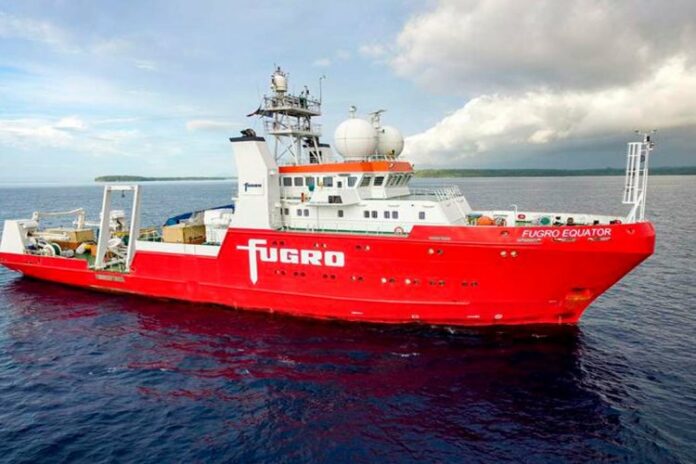
Fugro awarded a contract for Brunei’s deepwater gas field development

0

Fugro has received a sizeable contract for the Kelidang Cluster gas field development project from Petronas Carigali (PC) Brunei.

Fugro will perform various site characterisation surveys to support the front-end engineering design for offshore production facilities and the pipelines to prospective buyers onshore. Geotechnical and geophysical data will be acquired using amongst others autonomous underwater vehicles and a seafloor geotechnical drill. The majority of the work will be executed during 2023 in different phases.

The Kelidang Cluster development consists of two fields, Keratau and Kelidang North-East located offshore Brunei Darussalam.

 “We are pleased to support our clients, who understand the value provided by our Geo-data expertise for the responsible development of this transition fuel,” said Amar Umap, Group Director Asia Pacific region. “Fugro’s global track record, especially in deep to ultra deepwater, exemplifies our market leading position. This new award demonstrates that our Triple A approach of Geo-data acquisition, analysis and advice is recognised by the client.”

This award was partly included in Fugro’s 12-month backlog per the end of September 2022.