0.4 C
New York
Home Blog Page 309

BV and Kongsberg launch new capability for digitised machinery maintenance

0

Bureau Veritas has taken a significant step forward in the delivery of digitally optimised machinery maintenance with the launch of a new capability that enables its Machinery Maintenance Application (MMA) to connect directly to a vessel operator’s own maintenance management system, K-Fleet from Kongsberg Digital.

This capability allows the vessel operator to directly transfer the required Machinery Maintenance data to Bureau Veritas. The first such connection between BV’s MMA and a vessel owner’s Computerized Maintenance Management System (CMMS) went live on April 3rd, using K-Fleet software from the world-leading technology group, Kongsberg.

Kongsberg Digital has released this connector allowing ship operators to easily push their PMS (Planned Maintenance Survey System) data to BV’s MMA. This enables the first use of this connection by one of the leading Swedish shipping companies, Furetank.

This new connector serves as a communication channel between ship operators and Bureau Veritas. Based on the data, Bureau Veritas can prepare the periodical audits with greater speed and efficiency.

Using this new connector, the vessel’s list of equipment (LOE) is sent with a click and the maintenance report data is pushed automatically from Kongsberg K-Fleet. When the Machinery Maintenance Audit is requested by the vessel operator, the Bureau Veritas Surveyor will log into BV’s Machinery Maintenance Application and generate the maintenance report for the time period in question with the latest data received, ready for review. K-Fleet will then continue to update with new data on a regular time schedule until a new request for annual, occasional or renewal audit is received.

Laurent Hentges, Digital Solutions & Transformation Vice President at Bureau Veritas Marine & Offshore, said:

“This is a significant step forward in supporting ship owners, operators and managers with their machinery maintenance requirements. Jointly developed by Bureau Veritas and Kongsberg, it is a great example of how two leading digital solutions can be integrated to meet the needs of vessel operators.

“This collaboration with Kongsberg also highlights our ambition to take advantage of new technology and data exchange to advance the digitalisation to support class surveys, as well as support our clients with their digital transformation.

“Our aim is to replicate this first connection done with Furetank with other ship owners and CMMS. Data acquired will also open the door for data analytics and optimised maintenance models in the future.”

This new solution builds on BV’s Machinery Maintenance application (MMA) which was launched in 2022. This digital tool connects directly to ship operators’ Computer Machinery Maintenance System (CMMS) and helps them transition to optimised machinery maintenance schemes.

In order to sail safely, all vessels must undergo regular surveys of their machinery equipment and systems. However, most modern ships have more than 300 separate pieces of machinery onboard, each with its own specific maintenance requirements. This poses a challenge for owners, operators, and managers on how to conduct machinery maintenance regularly, but also efficiently.

For normal machinery maintenance scheme, this process is done through an in-person survey of all machinery items by a BV surveyor once every five years, during the renewal survey. But today, a large part of the world’s fleet is using more optimised survey schemes such as Continuous Survey Machinery scheme (CSM) or a Planned Maintenance Survey System (PMS).

Bureau Veritas’ MMA connects the ship operators’ maintenance system with BV’s own system, facilitating the development of a Planned Maintenance Survey System (PMS) plan with online guided booking. It collects data on the maintenance status of all machinery items, manages modifications to onboard equipment, and provides access to manufacturer manuals. This enables ship operators and BV surveyors to get a clear and comprehensive overview of onboard machinery maintenance, efficiently prepare for surveys and assess the machinery maintenance conditions. 
Proman Stena Bulk completes US Gulf Coast’s first barge-to-ship methanol bunkering

0

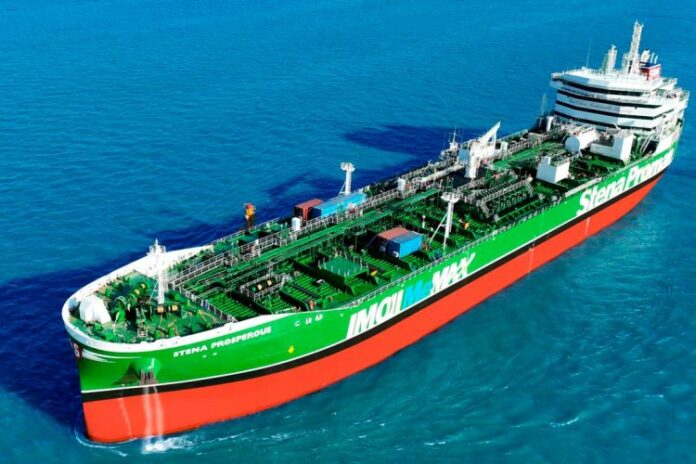
Stena Pro Marine and Stena Prosperous bunkered via barge at the Port of Houston earlier in April 2023. The JV tankers Stena Pro Marine and Stena Prosperous were refuelled with methanol via barge while discharging clean petroleum products at a terminal in the Port of Houston in the first week of April.

Stena Pro Marine was bunkered with 1,408MT of methanol, and Stena Prosperous was refuelled with 1,203MT during the operation. Both ships were time-chartered to a global trading house at the time of the refuelling.

The barge bunkering operation was conducted jointly with Kirby Corporation, the largest tanker barge provider in the United States. The ability to refuel both vessels with methanol whilst they were alongside demonstrates the ease and minimal infrastructure requirements associated with methanol as a marine fuel, as well as its widespread availability.

Speaking on the announcement, Anita Gajadhar, Executive Director, Marketing, Logistics and Shipping, Proman, said:

“Completing the first barge-to-ship methanol bunkering on the US Gulf Coast is a tremendous achievement for the Proman Stena Bulk joint venture. The Port of Houston is a major global cargo hub with significant latent methanol storage capacity. These qualities made it a natural testbed for our first US ship-to-ship bunkering.”

Kirby Marine Group President Christian O’Neil said:

“Kirby was pleased to be the service provider for this job. It was a natural for us: we have extensive expertise with methanol as a cargo, with conventional bunkering, and with barge-to-ship lightering of all manner of products.”

Methanol is widely available in the Port of Houston, which is the United States’ busiest port in terms of foreign tonnage. Thanks to the presence of major petrochemicals hubs and significant storage capacity, more than 275,000MT of methanol is available at the port. 

The landmark first bunkering supports wider efforts by US ports and shipping companies to make the industry more sustainable. The Port of Houston aims to become carbon neutral in the next 30 years. A key pillar of the port’s strategy is the deployment of alternative fuels and clean energy sources.

The bunkering also supports U.S. commitments to cut methane emissions by 30% by 2030 under the Global Methane Pledge, which was announced at the COP26 climate summit in 2021. Methanol as a marine fuel clearly supports the ambitions of the pledge to cut back on methane emissions across the energy value chain in the near term.

Currently available conventional methanol, produced from natural gas, virtually eliminates SOx and particulate matter, cuts NOx by 80%, and reduces tank-to-wake CO2 emissions from the vessel’s commercial operations by up to 15% compared to conventional marine fuels. By using methanol, the joint venture vessels are futureproofed against every incoming emissions target, as greater quantities of low-carbon and green methanol become available for blending and bunkering in the near future.

Production of green methanol from sustainable sources such as sustainable bio-mass or renewable energy is growing and highly scalable. Proman is investing in its own low-carbon and green methanol production capabilities, including a new 100,000 tonne per year methanol facility in development in North America. The project is currently being constructed with a target start of operations in 2025. The facility will produce bio-methanol from non-recyclable forestry residues and municipal solid waste and will substantially contribute to the circular economy.

The news of this first US Gulf methanol barge-to-ship bunkering comes ahead of the naming ceremony for Stena Promise in the Port of Rotterdam. Rotterdam was the site of Proman Stena Bulk’s first barge-to-ship methanol bunkering, in August 2022, when Stena Pro Patria took on the fuel during a regularly scheduled port call.

Alcatraz City Cruises selects Corvus Energy battery system for hybrid ferry

0

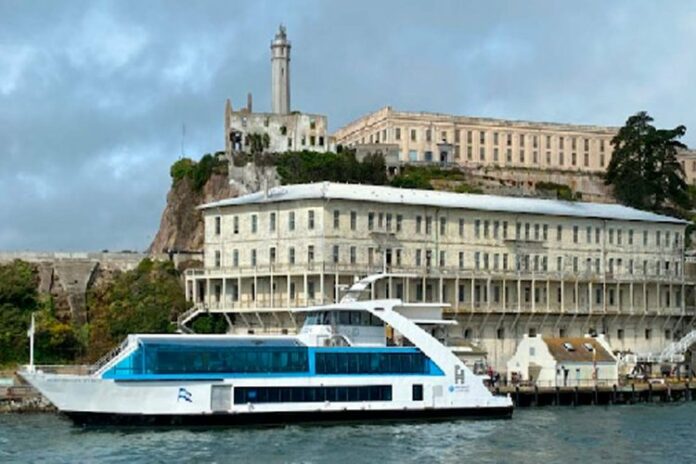
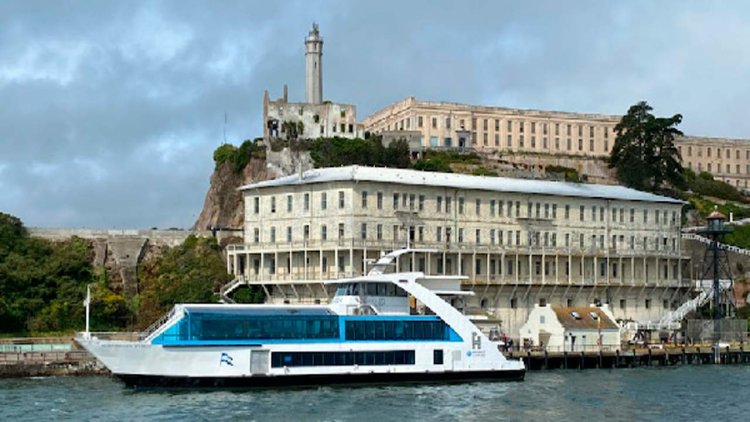
Corvus Energy has been selected by Alcatraz City Cruises to supply the battery system for the Hornblower Hybrid NY passenger ferry. 

Two vessels, the Alcatraz Flyer and the Alcatraz Clipper, currently offer transit to Alcatraz Island in the San Francisco Bay. Completing multiple rounds per day, the operation carries thousands of passengers daily and nearly 1.7M total annually powered by electric propulsion. Both vessels use a Corvus Energy battery system. 

Following the success of Alcatraz City Cruises’ hybrid vessels, City Experiences introduced the first hybrid passenger ferry service on the East Coast and expanded its hybrid vessel program to other US locations. City Experiences reports the Hornblower Hybrid design “reduced fuel consumption by 75%” and estimates their hybrid fleet annually saves “over 235,000 gallons [of fuel],” which is “equivalent to taking 450 cars off the road or planting 718 acres of trees” each year.

The Hornblower Hybrid NY, a vessel retrofit project requiring a 1,627KWh battery energy storage system (ESS), will be the third City Experiences vessel in California with a Corvus ESS onboard. Corvus Energy will deliver the system from its newly established, US based manufacturing facility in Bellingham, Washington. Delivery is expected by September 2023.

“We are very pleased to be chosen by Alcatraz City Cruises for the Hornblower Hybrid NY project” says Ole Jacob Irgens, Corvus Energy Executive Vice President. “City Experiences were amongst the early adaptors in the United States – leading the way in US marine sector electrification, decarbonization, and greenhouse gas reduction initiatives.”

New hybrid straddle carriers operational at HHLA Tollerort

0

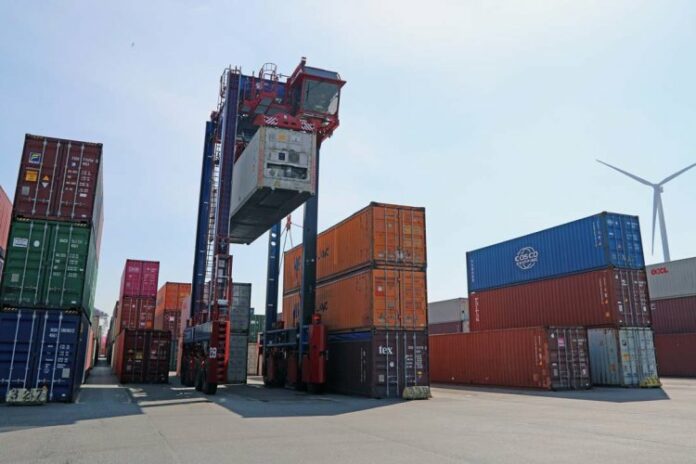
The renewal of the straddle carrier fleet at Hamburger Hafen und Logistik AG’s (HHLA) Container Terminal Tollerort (CTT) is moving forward: in April, eight new straddle carriers with hybrid drive went into operation and have since been transporting containers in a more environmentally friendly way between ship, yard, rail terminal and truck gate. 

Including these eight new units, the hybrid straddle carrier fleet at CTT now totals 18 units. The principle of the technology used is simple: the straddle carrier stores surplus energy, which is for example generated during braking or while the load is being lowered, in a high-performance lithium-ion battery. As it drives, the vehicle uses this energy from the battery. This significantly eases the load on the combustion engine.

Each hybrid straddle carrier thus saves over 30 percent fuel per operating hour compared to the diesel-electric previous models. This means that the eight new hybrid straddle carriers can save about 200,000 litres of diesel per year. CO2 emissions are also greatly reduced by around 530 tonnes per year.

Commenting on the new hybrid straddle carrier fleet, CTT Managing Director Robin Steyer says:

“With the modern hybrid straddle carriers, we are cutting our energy costs and reducing emissions at the same time. They are further proof that HHLA consistently relies on state-of-the-art technology and intelligent solutions. This benefits the company, the environment and the employees.”

Beforehand, HHLA tested the equipment itself in demanding 24/7 port operations under all weather conditions: The first two prototypes of hybrid straddle carriers started test operations at CTT back in January 2019. At the time, they were a further step by HHLA towards converting its large-scale equipment to increasingly environmentally friendly technologies.

Damen delivers new Multi Cat 2309 to Atlantic Towage & Marine Ltd

0

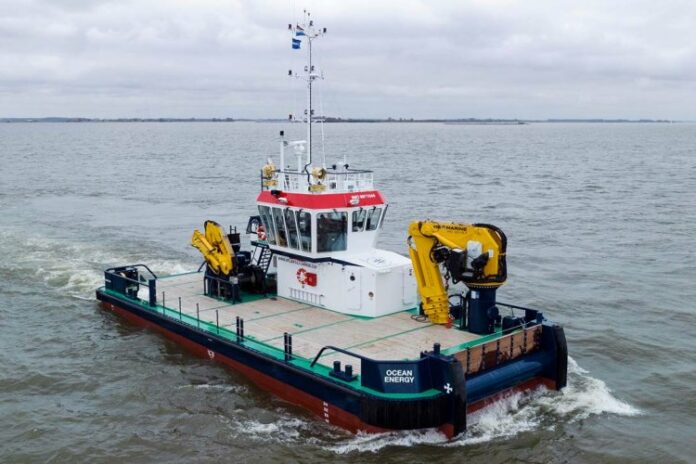
To optimise the vessel for its role, Atlantic Towage has specified a larger forward deck crane AKC 185 HE4 and an AK34 aft deck crane from HS Marine. A DP1 system from Kongsberg synchronizes twin screws aft and a bow thruster for optimum manoeuvrability. Other deck gear includes anchor-handling, towing and tugger winches. Accommodation is for up to seven crew across five cabins.

Ocean Energy is IMO Tier II compliant and the engineering space is pre-prepared for the retrofit of a Damen Marine NOx Reduction System. This uses selective catalytic reduction (SCR) technology to raise a vessel to Tier III compliance and, with the necessary space already available, it can be efficiently fitted when required. While this is the most efficient way to be future-proofed for IMO Tier III, Damen also offers a range of retrofit options to suit most requirements. Additional customisations have been implemented to optimize the vessel for her various roles.

The handover ceremony took place at Damen Shipyards Gorinchem, where the MuC 2309 was fitted out  following the build of her hull and superstructure at Damen Shipyards Koźle. The Lady Sponsor was managing director Sean Harrington’s eight-year old daughter Kyla Harrington.

Atlantic Towage was founded in 2008 by Sean Harrington and today operates a fleet of ten vessels that includes tugs, dive support vessels, and multipurpose workboats. This variety allows the company to offer a wide range of services. Ocean Energy will now begin a contract in Danish waters to assist with cable installations.

“I would like to thank all the Damen team for the superb vessel they delivered,” said Sean Harrington. “They were a pleasure to deal with and we would have no hesitation in returning to them for our next new vessel.”

“Damen is proud to have cooperated closely with Sean during the design phase and build phase” says Frederik van der Linde, Damen’s UK and Ireland sales manager. “We look forward to seeing this vessel in operation, supporting the renewables industry. We wish its owner and crew safe passages and every success.”

Huisman and Siemens Gamesa launch solution for controlled blade installation

0

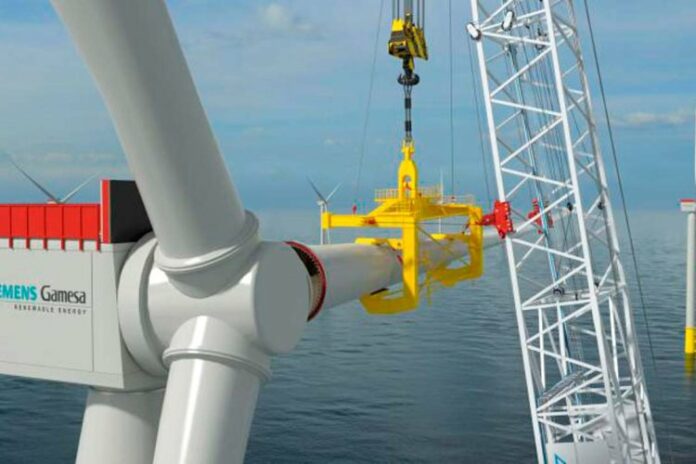
Huisman and Siemens Gamesa have combined their engineering and operational expertise in the development of a solution to stabilise wind turbine components during installation, especially blades, but also nacelles and tower segments.

Controlling the movements of the relatively light blades of a turbine when suspended from a crane, has proven to be an installation challenge due to wind load. To mitigate operational downtime and increase the integrity of the delicate wind turbine components, Huisman and Siemens Gamesa developed the Travelling Load Stabilising System, for universal application in heavy lifting cranes. 

The system consists of a combination of two pairs of tuggers working in unison to control to position of the load. One pair is fitted on independent trolleys that can travel along an integrated rail along the crane’s stiff boom. The trolleys automatically follow the main block to maintain an optimal tugger line configuration. The second pair of tugger lines is deployed from the crane tip providing a force perpendicular to the first pair of tuggers. By approaching the load from two different directions, the system provides significantly more control than a conventional single pair of tuggers.

A specially designed control system holds the actual position of the load, resulting in a much stiffer restraint, and therefore a higher position accuracy compared to conventional tugger systems that rely on constant tension. In case of an unexpected overload, the system will give way but will return to its position setpoint when the force drops below the threshold again.   

The Travelling Load Stabilising System functions as an integral part of the crane and could, therefore, be operated from the crane’s cabin as well from an optional walk around box (WAB). 

Jesper Moeller, Chief Engineer Execution at Siemens Gamesa:

“This is crucial for the technical readiness of next-generation offshore wind turbine installations, even under challenging wind conditions. The resulting increase in installation uptime will be accompanied by a positive effect on the operational activities in general, as well as increased on-site safety. Siemens Gamesa sees the system as a potentially new industry standard with benefits for the whole wind industry, providing more productive vessel days, while at the same time reducing 

Hence, Siemens Gamesa will consider the availability of the new Travelling Load Stabilising System on installation vessel cranes as a significant factor in decision making when selecting/hiring appropriate installations vessels in the future.” 

David Roodenburg, CEO of Huisman:

“The only way to accelerate the energy transition is through innovation enabled by the joint forces of industry partners. We have done this by combining the operational knowledge and experience of Siemens Gamesa with the technical equipment knowledge of Huisman. With the Travelling Load Stabilising System, we are very proud that together we can offer installation companies an efficient solution to reduce weather downtime, a challenging and delaying factor of wind turbine installation.”

Final jacket foundation installed on Seagreen

0

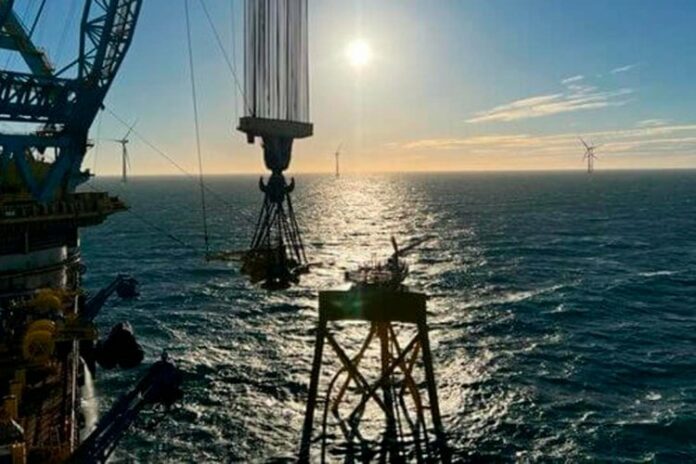
The 114th jacket foundation was successfully installed late afternoon on Thursday 13th April by the Saipem 7000 crane vessel, which was used to lift each of the 2,000-tonne foundations into place.

As the main contractor, Seaway7 has managed the engineering, procurement, construction, and installation of the wind turbine generator foundations and is installing approximately 300km of associated inner-array cables.

This major milestone followed soon after the installation of the world’s deepest wind turbine foundation which was achieved on Easter Sunday. Seagreen topped its own record from October 2022 by installing foundation number 112 at a depth of 58.6 metres.

Seagreen’s Project Director, John Hill, said:

“Installing all 114 jackets is one of the most significant milestones in the project. The Seagreen team have now installed more suction caisson foundations than any other offshore wind farm and pushed forward the boundaries of this technology. The Seagreen team and Seaway7 have excelled in the delivery of this complex scope of work which has resulted from outstanding effort on the installation phase by teams including those at Ramboll, Saipem and Global Energy Nigg. A huge thanks on behalf of SSE and Totalenergies shareholders for this achievement.”

Lloyd Duthie, Vice President UK, Ireland and Asia at Seaway7 said:

‘We are immensely proud to be playing a significant role in the construction of the momentous Seagreen offshore wind farm. This achievement is the culmination of more than three years of hard work since the contract award to Seaway7 in June 2020, and sets a new benchmark for jacket fabrication and transportation of this scale in the offshore wind industry.’

David Mitchell, Seagreen Project Director at Seaway7 said:

“This is a significant milestone for Seagreen and Seaway7. Good collaboration between all parties has been instrumental in the safe and timely execution of this complex and challenging project. We look forward to the completion of the cable installation in the coming months to conclude our full EPCI scope”.

Each foundation will support a Vestas V164-10 MW turbine. When complete, the 1.1GW wind farm will be capable of generating around 5,000 GWh of renewable energy annually which is enough clean, secure, sustainable electricity to power more than 1.6m UK homes.

Seagreen Offshore Wind Farm is a joint venture between SSE Renewables and TotalEnergies.

Saab Seaeye Leopard system supplied to Spanish Navy

0

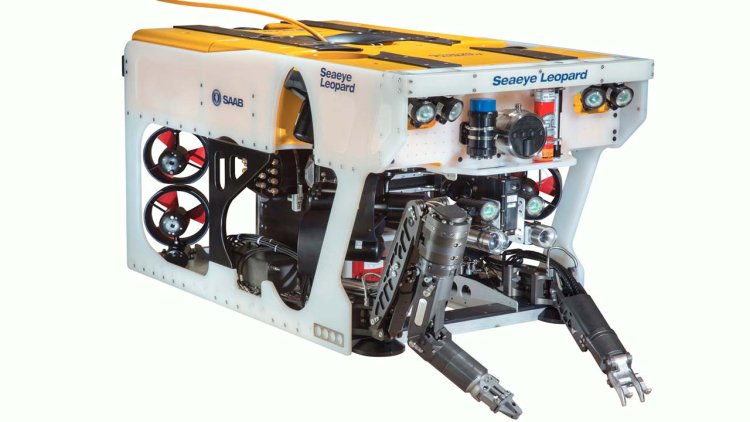
The NATO Support and Procurement Agency (NSPA) acquired the Seaeye Leopard electric remotely operated robotic vehicle system for the Spanish Navy to fulfil the responsibilities of the International Submarine Escape and Rescue Liaison Office and provide diving support.

It is the first codification by NATO for a remotely operated vehicle meeting their standards. The Leopard also met the Spanish Navy’s full ISO/IEE 15288 standards for remotely operated vehicles, along with their standards for the control cabin.

The Leopard can locate and survey a distressed submarine using its array of sonar systems and cameras to provide both colour zoom and low-light black and white video images for rescue planners. In urgent rescue situations the Leopard can work tirelessly 24 hours a day, for days on end in challenging conditions.

According to the information provided by the Spanish Navy through NSPA the Leopard will also contribute enormously to the Spanish Navy underwater intervention capability, especially in the areas of salvage operations, underwater search and reconnaissance and diving support activities.

Assisting in the procurement process has been Saab Seaeye’s Spanish-based distributor, Marine Vision, who will also engage in on-going support.

To help keep the crew alive, the Seaeye Leopard can transport and insert pods carrying emergency life support stores into the submarine — and attach ventilation hoses. For debris clearance the Leopard has powerful work-class manipulators, along with a six-inch rotary disc cutter and a 38mm anvil cutter.

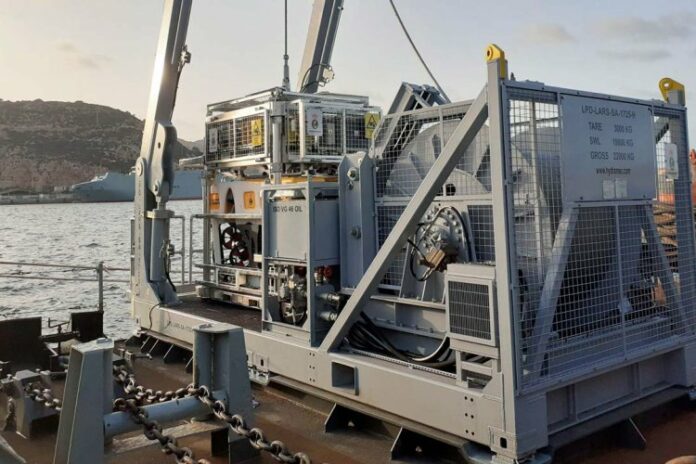
The complete package includes a tether management system which acts as a subsea garage for the Leopard and from which it is flown when reaching the operational depth. The Leopard was chosen over its hydraulic alternative as the Leopard is typically 50% more efficient, 30% more compact and 50% lighter than an equivalent hydraulic vehicle.

Umbilical cables and handling systems are also significantly smaller and lighter, leading to lower deck loading requirements, smaller deck footprints, smaller vessel requirements and smaller transportation needs.

Included is a pilot’s control cabin and the entire system, or relevant free-swimming or tether-management configurations, is in the process of being certified for air transportation aboard an Airbus A400M to fulfil a global role in rescue operations.

The most powerful of its size in the world, the Seaeye Leopard has 11 powerful thrusters and with its iCON™ intelligent control is more highly manoeuvrable in strong currents than a hydraulic vehicle and, being acoustically quieter, can produce more accurate sonar data.

Saab Seaeye’s intelligent control system offers pilots better handling characteristics — including pitch and roll stabilisation — for best quality survey data, whilst delivering stable flight even when fitted with large tools and transporting heavy loads.

Importantly, iCON™ gives clear and enhanced information to the operator and pilot whilst independently managing each device on the vehicle, including auto redundancy, ensuring the vehicle keeps working even with multiple equipment damage.

Included in the procurement is a complete simulator system for pilot training that will simulate the operation of the Leopard during a rescue mission.

Van Oord takes next step in implementing more sustainable fuels

0

Recently Van Oord christened two new dual fuel trailing suction hopper dredgers, which are built to run on the more sustainable LNG.
Now Van Oord takes another big step towards implementing the fuels of the future. 

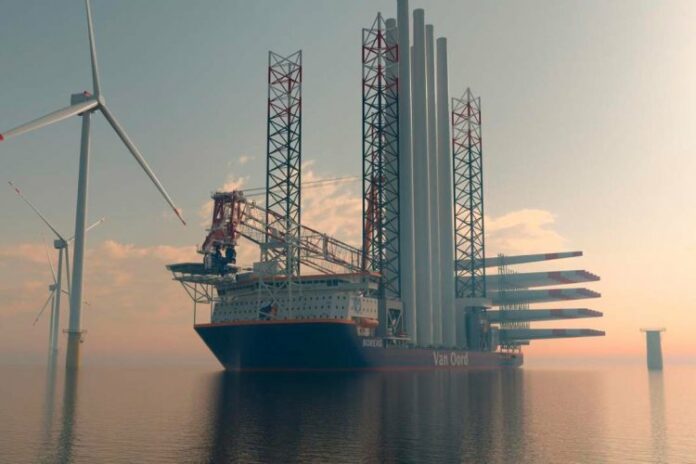
The Wärtsilä 32 Methanol engines have successfully passed their Factory Acceptance Tests (FAT) and have been handed over to the Yantai CIMC Raffles Shipyard (YCRO) in China. They are now on their way to the shipyard where the mega vessel is currently being built. The Boreas will be able to transport and install the next generation of 20 MW offshore wind turbines and is expected to be commercially available in 2025.

Van Oord is committed to reducing carbon emissions and to becoming carbon-neutral by 2050, in line with the Paris Agreement. Approximately 95% of Van Oord’s carbon footprint is linked to its fleet. Most progress can therefore be made by investing in decarbonisation of its vessels, as well as in green vessels and alternative fuels. The Boreas is an example of the energy transition within Van Oord. The vessel is the first of its kind to run on the future fuel methanol. Running on methanol reduced the ship’s carbon footprint by more than 78%.

Harold Linssen, Director Ship Management Department at Van Oord, said:

‘Van Oord is committed to lowering its impact on climate change by reducing our emissions and becoming net-zero. Our equipment roadmap focuses on low-carbon fuels and energy efficiency. We see methanol as one of the alternatives to meet the industry’s goals to reduce its environmental impact. The delivery of these methanol engines is a major achievement and a result of successful collaboration.’

Methanol is a clear, colourless liquid that is soluble in water and is biodegradable. It comprises four parts hydrogen, one part oxygen, and one part carbon, and is the simplest member of a group of organic chemicals called alcohols. As a marine fuel, methanol has many advantages. Methanol is relatively inexpensive to produce, widely available and easy to store. Green methanol is an even better choice because of how it’s made. The best option would be E-methanol: produced from hydrogen from renewable-sourced electricity and recaptured carbon, making it carbon neutral. Green methanol is among the potential and most promising future fuel candidates. It is expected that the global supply infrastructure of green methanol will develop substantially.

Lars Anderson, Director Product Management and Sales Support at Wärtsilä, said:

‘We congratulate Van Oord on their vision and commitment to a decarbonised future. At Wärtsilä we are actively supporting this commitment with heavy investments in engine technologies capable of operating with alternative clean-burning fuels. The Wärtsilä 32 engines for this vessel, fuelled with methanol, showcases that shipping is entering an era of greater sustainability.’

NYK upgrades its fleet with Orca AI technology to enhance navigation safety

0

As one of the world’s leading shipping and transport companies, finding a safety system that could enable and empower NYK’s crews to make better real-time decisions while navigating congested oceans was the aim, according to Captain Jun Nakamura, manager of the autonomous ship team at NYK Group. 

The company also wanted to develop its understanding of navigational challenges facing the fleet and how they were being managed.

Capt. Nakamura said:

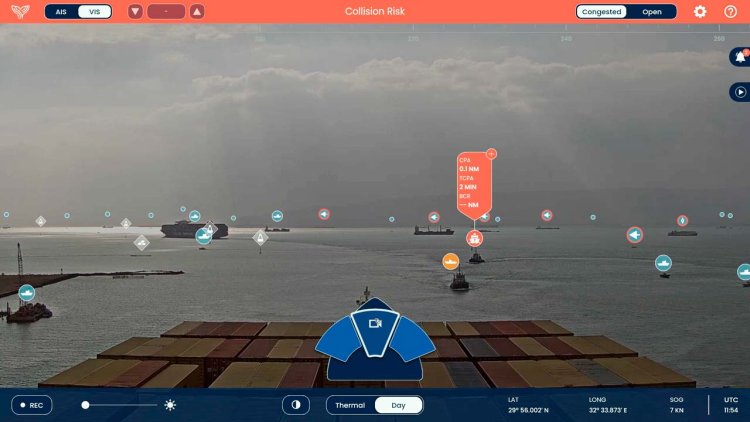
“Orca AI demonstrated that the safety of shipping operations can be improved by automating the task of target detection in low visibility in congested waters. The platform serves as an automated lookout and recognizes dangerous targets and other vessels that may be overlooked by the human eye, reducing the probability of incidents at sea.”

Mr. Yarden Gross, CEO and Co-founder of Orca AI, added:

“We are excited to partner with tech leaders such as NYK, deepening our collaboration with the company and supporting its ongoing aim to be a central player in the shipping industry’s digital revolution.” 

The partnership began in August 2020 when NYK and MTI Co., Ltd, installed a trial version of Orca AI’s platform on a ship operated by the NYK Group. Since then, the NYK Group and Orca have also completed a successful autonomous voyage trial in congested waters near Japan’s east coast through the Designing the Future of Full Autonomous Ships (DFFAS) consortium, which includes 30 Japanese firms. 

The NYK trial – known as the MEGURI2040 Project and supported by the Nippon Foundation – was carried out on Suzaku, a 749 gross tonne autonomous containership fitted with Orca’s artificial intelligence and deep-learning technology. Traveling from Tokyo Bay to the port of Tsumatsusaka in the Ise Bay, the vessel achieved 40 hours of navigation with complete autonomy for about 98% of the voyage.

The vessel automatically carried out 107 collision avoidance maneuvers and avoided up to 500 ships using Orca’s safety navigation system. The platform provided real-time detection, tracking, and range estimation through 18 cameras with panoramic views operating 24/7 in any conditions.