-8.4 C
New York
Home Blog Page 270

Ocean-based negative emissions technologies: A governance framework review

0

The ocean will play a key role in efforts to tackle the climate crisis, according to scientists and IPCC. The use of “negative emissions technologies” to enhance carbon sequestration and storage in the ocean is increasingly being discussed. In a study published in the journal Frontiers in Marine Science, RIFS researchers Lina Röschel and Barbara Neumann describe the challenges that these technologies present.

The existing regulatory and institutional frameworks are inadequate for the governance of these emerging technologies, they conclude. Instead, an approach is needed that integrates foresight mechanisms, considers the potential unintended impacts, and engages with diverse stakeholders.

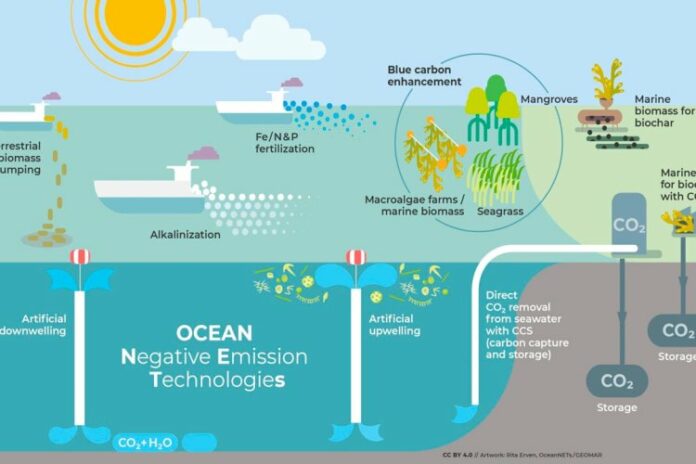
According to scientists, the ocean’s capacity to remove and store carbon dioxide from the atmosphere could be enhanced by various means, including the addition of alkaline substances such as olivine into the upper ocean, for example. This process, also known as alkalinization, harnesses chemical processes to alter the geochemistry of seawater and thereby increase the uptake of carbon dioxide from the atmosphere. Other potential methods rely on restoring or expanding coastal ecosystems such as mangrove forests, which can absorb and store carbon dioxide in underlying sediments.

In their study, which was conducted as part of the research project OceanNETs, the RIFS researchers offer an overview of the potential impacts of eight ocean-based negative emissions technologies on the marine environment and ecosystem services. Building on this, they analyze the existing governance framework and the demands that the deployment of these technologies would place on it.

The study also examines the potential unintended impacts of the selected technologies. Due to ocean currents, these could unfold far from initial deployment sites.

“This aspect must not be disregarded in decision-making processes. What is needed is a broader perspective that considers how the potential impacts of negative emissions technologies will interact with the objectives of existing agreements governing marine environmental protection, biodiversity conservation or even socio-economic issues relating to sustainable development—in addition to international agreements that explicitly address, promote, or restrict their use,” explains Lina Röschel.

The current international governance system, with its diverse agreements and regulations, institutions and responsibilities, is too fragmented to meet the complex requirements, according to Röschel.

According to the researchers, a foresight-oriented approach is needed in order to comprehensively and effectively regulate the use of these technologies in the future. “It is important that political, scientific, and societal actors engage with these issues today and develop approaches for the control and regulation of negative emission technologies—even if they are still under development in many cases, and their potential impacts cannot be precisely quantified,” says co-author Barbara Neumann, who argues that trade-offs should be minimized, and benefits maximized and distributed fairly across the globe.
Norwegian-German collaboration on green energy

0

EnBW Energie Baden-Württemberg AG (EnBW) has entered into an Investment Agreement with one of Europe’s most advanced project for emission-free ammonia production, Skipavika Green Ammonia (SkiGA), in Western Norway. This is a step in the direction towards realizing the EU’s, Germany’s and Norway’s climate goals by developing climate neutral Hydrogen products.

The Investment Agreement underscores EnBW’s strong commitment, allowing exclusive long-term offtake rights to green ammonia and reflecting this through a 10% equity stake in the project. This commitment by EnBW will play a crucial role in expediting the project’s path to a financial investment decision.

Green Ammonia is a key building stone in stepping up the Hydrogen (H2) market and Decarbonization efforts in industry and energy sector. Ammonia can be either converted to hydrogen for combustion in heat and power generation or directly used for this purpose. Therefore it is well suited for carbon-neutral electricity generation. With this, EnBW will be equipped to offer green ammonia for both internal decarbonization initiatives and their customers, including the local and international maritime sector. The agreement is made on commercial terms and marks a breakthrough in the effort to commercialize H2 products such as green ammonia. Green H2 products are a key component in EUs Green Deal.

“EnBW is committed to becoming a carbon-neutral power generation leader. Our collaboration on green ammonia, aligned with German, Norwegian and the EU goals, signifies a strategic investment in carbon-neutral solutions. The Nordic region is poised to be a top supplier to Europe’s carbon-free energy landscape, complementing its existing position as a reliable, stable energy partner of choice for Europe. This agreement underscores the potential of Norwegian-German collaboration in green energy and industry”, says Peter Heydecker (Executive Director Trading) of EnBW.

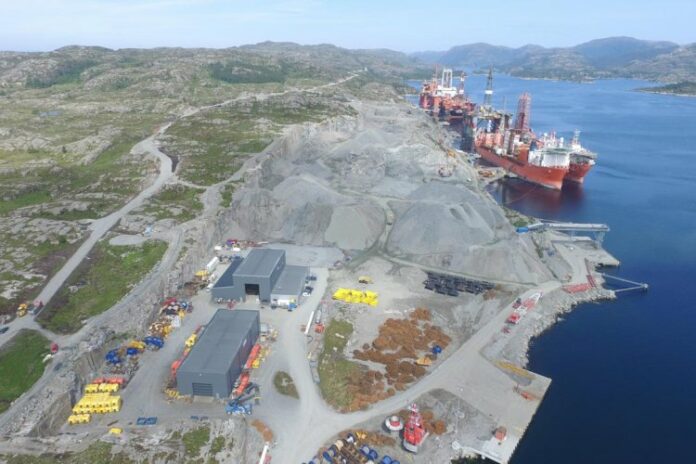
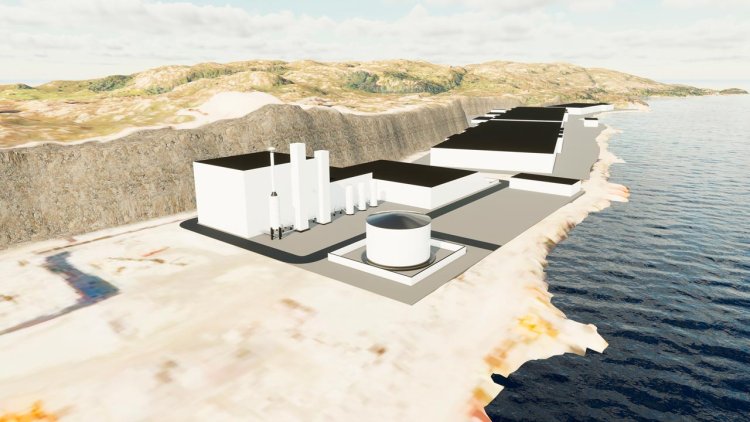
Skipavika Green Ammonia facility will be in Gulen municipality, near the Mongstad refinery on the west coast of Norway. Once completed in 2026, it will be Europe’s inaugural emissions-free ammonia production site. The project has secured grid connection and is in advanced talks for Power Purchase Agreements.

“The agreement with EnBW ensures the development of the plant as EnBW will play a crucial role in commercializing the green ammonia sourced from SkiGAs production for long term offtake.”, says Cornel Russi, CEO of SkiGA. Hence, it marks a milestone in the use of green ammonia as part of a future carbon free energy system”, he adds. SkiGAs plant will have an annual production capacity of 100,00 tonnes.

The development of the SkiGA is led by the Norwegian project developer, Fuella AS, specializing in Hydrogen and Ammonia projects. Notably, Allianz Capital Partners, on behalf of Allianz insurance companies committed to provide funding of EUR 20 million to support Fuella’s project pipeline towards execution and to accelerate the business development, reinforcing the project’s significance.

“Fuella convinced us as partner with their hands-on approach, their industry expertise, and their great network with other strong partners, e.g. Allianz. We in EnBW want to be a long-term partner for Norway’s ambitions to develop the future energy mix, both offshore wind, green hydrogen and ammonia. I believe this project will have substantial effects on local, national, and international scales. We are very excited to be part of this project”, adds Heydecker of EnBW.

ABB to supply ice-classed Azipod® propulsion for new polar research vessel

0

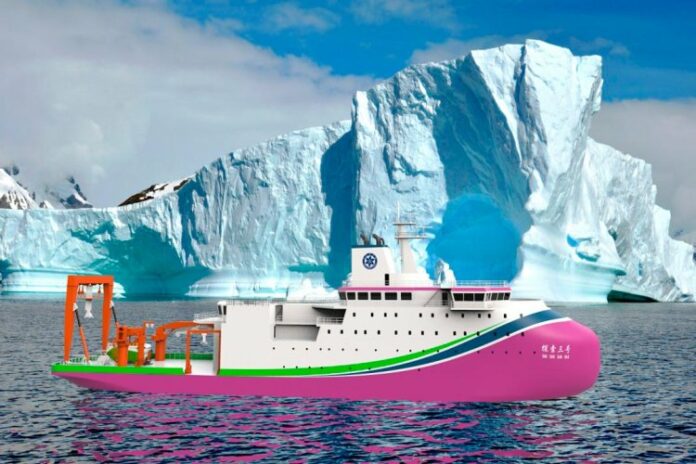
ABB has received an order from the Guangzhou Shipyard International to supply Azipod® DI propulsion system for the new compact icebreaker of China’s Institute of Deep-sea Science and Engineering. The ship is expected to be delivered in 2025, after which it will begin to carry out operations in the Arctic and Antarctic Ocean.

A complete electric propulsion system including two 4.5 MW Azipod® units will drive the vessel through harsh weather and thick first-year ice to enable research on behalf of the Chinese Academy of Sciences. The 103-meter vessel will have a maximum speed of 16 knots, draft displacement of about 9,200 tons, and icebreaking capacity of 1.2 meters ice and 20 cm snow at the continuous speed of two knots. The ship is designed to operate both bow first and astern in ice with an enhanced Polar Class 4 (PC4) ice-breaking level. With a capacity of cruising range of 15,000 nautical miles, it can accommodate a crew of 80 people.

The new research vessel will be equipped to China Classification Society (CCS) LEVEL 2 notation standards on digitalization and fulfill Underwater Rated Noise SILENT A notation. SILENT A notation covers vessels that are ‘acoustically sensitive’, whose underwater noise emissions are controlled to benefit data capture and minimize ecological impact. The criteria are designed to limit high frequency noise while mitigating the practical challenges of reducing low frequency noise from propellers and the main engine.

Mr. Guangwei He, Vice Chief Engineer of Guangzhou Shipyard International Company Limited, said:

“ABB has extensive experience and a strong local presence in delivering propulsion products, systems and support we can trust. Polar Class vessels represent a growing area of expertise for GSI, and we are delighted to work with a reliable partner whose reference list for proven technology in this demanding segment is unrivalled.”

Kerry Yang, Local Division Manager, ABB Marine & Ports China, said:

“We are honored to have been chosen to cooperate with GSI again. This marks the 20th year since ABB Marine & Ports established itself locally in China and we continue to take great pride in localizing our products and services to meet regional requirements in the best possible way.”

The propulsion units supplied will represent ABB’s compact Azipod® DI range, which has been developed for both robustness and simplicity, and to offer strength and reliability in the most challenging ice conditions.

ESVAGT and Hvide Sande Shipyard collaborate on innovative transfer boat

0

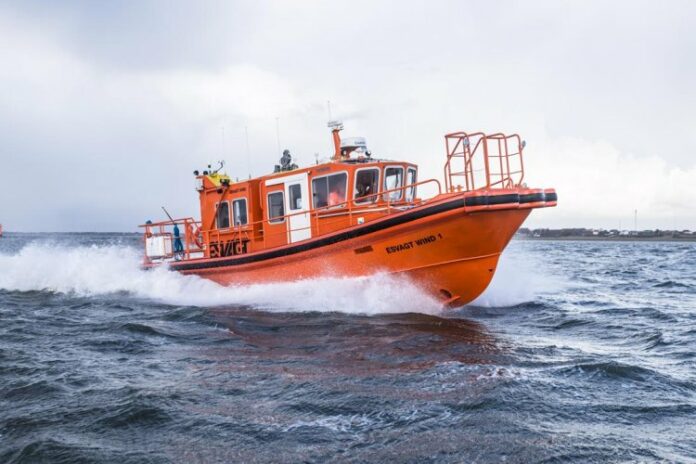
ESVAGT, together with Hvide Sande Shipyard, is developing a new boat STB15. The STB15 is designed in collaboration with OSK design, who also designed the STB12.

“Our SOV concept with transfer boats has shown its potential and created the need for solving even more tasks with the STBs,” says Søren Westphal, Senior Project Manager at ESVAGT and responsible for boat development at the company.

ESVAGT has agreed with Hvide Sande Shipyard, with the task of developing the new boats. Hvide Sande Shipyard also built the predecessor, the STB12:

“In our experience, Hvide Sande Shipyard is an innovative, competent and quality-conscious supplier. We look forward to working together to develop a boat that brings even more value to renewable energy production,” says Søren Westphal.

COO Jeppe Hoff from Hvide Sande Shipyard is both ‘proud and honored’ to collaborate on the project:

“We are pleased to build on a good and trusting agreement with ESVAGT to develop the next generation of STBs for the wind industry. The collaboration with ESVAGT on the predecessor STB12 was a mutually benefitting and developing process – ESVAGT is very keen to incorporate the experience of seafarers’ everyday life into the boat design, which makes the task interesting for all of us,” he says.

The STB15s will be used to transfer technicians, move cargo, and spare parts, and sail to shore for supplies and personnel changes. Not least, they will be able to transfer cargo and technicians to higher seas than before, which will expand the potential of using the boat for even more. The boat will have room for more people and more cargo.

Technicians need to be on board the STB15 for longer, and the boat needs to be operational in more difficult weather conditions without technicians getting seasick. Therefore, the STB15 also has a stabilizer system, which moderates the boat’s movements and is highly effective.

Equinor acquires stake in Bayou Bend CCS Project

0

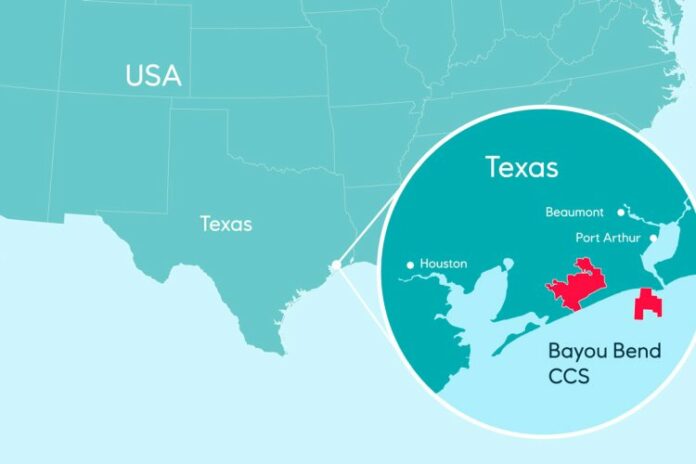
Equinor has acquired a 25 percent interest in Bayou Bend CCS LLC, positioned to be one of the largest US carbon capture and storage projects located along the Gulf Coast in Southeast Texas.

“Commercial CCS solutions are critical for hard-to-abate industries to meet their climate ambitions while maintaining their activity. Entering Bayou Bend strengthens our low carbon solutions portfolio and supports our ambition to mature and develop 15-30 million tonnes of equity CO2 transport and storage capacity per year by 2035. Our experience from developing carbon storage projects can help advance decarbonization efforts in one of the largest industrial corridors in the US,” said Grete Tveit, senior vice president for Low Carbon Solutions in Equinor.

Bayou Bend is positioned to be one of the largest CCS solutions in the US for industrial emitters, with nearly 140,000 gross acres of pore space for permanent CO2 sequestration and gross potential storage resources of more than one billion metric tons. The Bayou Bend total acreage includes nearly 100,000 gross acres onshore in Chambers and Jefferson Counties, Texas, and approximately 40,000 gross acres offshore Beaumont and Port Arthur, Texas.

“We look forward to working together with our partners to further mature this exciting project. Bayou Bend is Equinor’s first announced low carbon solutions project on the Gulf Coast. Alongside our upstream production and offshore wind developments, we’re strengthening our position as a broad energy company and expanding our footprint in the Gulf region,” said Chris Golden, senior vice president and US Country Manager. “Bayou Bend is a significant milestone towards growing our low carbon portfolio in the US.”

Bayou Bend is a joint venture between Chevron U.S.A. Inc., through its Chevron New Energies division, Talos Energy Inc., through its Talos Low Carbon Solutions division, and Equinor. Equinor acquired its 25 percent share through the purchase of Texas Carbon 1 LLC, a subsidiary of Carbonvert. Chevron is the operator with 50 percent interest, and Talos holds 25 percent interest.

“Delivering lower carbon solutions to harder-to-abate industries is fundamental to Chevron New Energies’ mission, and as a Southeast Texas native, I know how vital these industries are to our local communities and their economies,” said Chris Powers, vice president, CCUS, Chevron New Energies. “We thank Carbonvert for its work on the project, and we look forward to Equinor bringing its expertise and resources to Bayou Bend as it joins the partnership.”

The project’s location near major industrial corridors in the Houston Ship Channel and Beaumont / Port Arthur area will provide a potential decarbonization option for industries such as refining, cement, steel, chemicals, and manufacturing. Industrial emissions in the Texas Gulf Coast region are estimated to be approximately 100 million metric tonnes of CO2 per year.

“We continue to make significant progress in developing Bayou Bend, which we believe will be a premier regional carbon storage hub solution for Texas’ largest industrial region. Equinor is a welcomed addition to the partnership. Their experience and track record further enhance the joint venture, which is committed to developing safe, reliable, cost-effective lower carbon solutions while enabling continued economic growth,” said Robin Fielder, executive vice president – Low Carbon Strategy and Chief Sustainability Officer of Talos.

MOL to study liquefied CO2 transport by vessel in JOGMEC call for advanced CCS projects

0

The initiative, falling under the umbrella of a carbon dioxide capture and storage (CCS) project, will span the northern to the western coast of Kyushu. ENEOS Corporation (ENEOS), Electric Power Development Co., Ltd. (J-Power), and JX Nippon Oil & Gas Exploration Corporation are the primary executors of the project, which is facilitated and endorsed by the Japan Organization for Metals and Energy Security (JOGMEC).

JOGMEC has positioned projects with large-scale potential as “Advanced CCS Projects” for CCS promotion and expansion with the goal of achieving carbon neutrality by 2050 and is supporting the entire value chain from CO2 separation and capture to transport and storage in an integrated manner. The offshore northern to western Kyushu CCS project will be the largest among candidate projects in JOGMEC’s advanced CCS projects with an annual CO2 storage capacity of about 3 million tons.

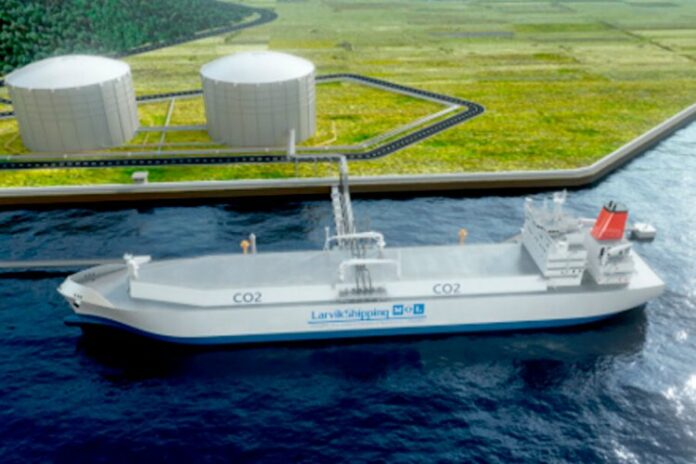
MOL will conduct an initial study of the voyage plan, estimate marine transport costs, and identify risks and issues related to the use of a liquefied CO2 carrier (liquefaction conditions: low temperature and low pressure, medium temperature and medium pressure) collected at J-Power’s thermal power plants and ENEOS’s refineries in Western Japan to the potential storage sites.

Through this study, MOL will contribute to the start of domestic CCS by FY2030, and ultimately to the realization of a carbon-neutral society.

Drought-hit Panama Canal to restrict access for one year

0

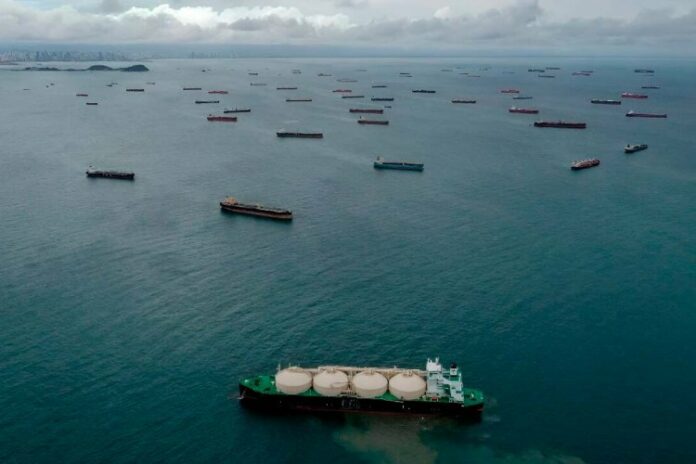
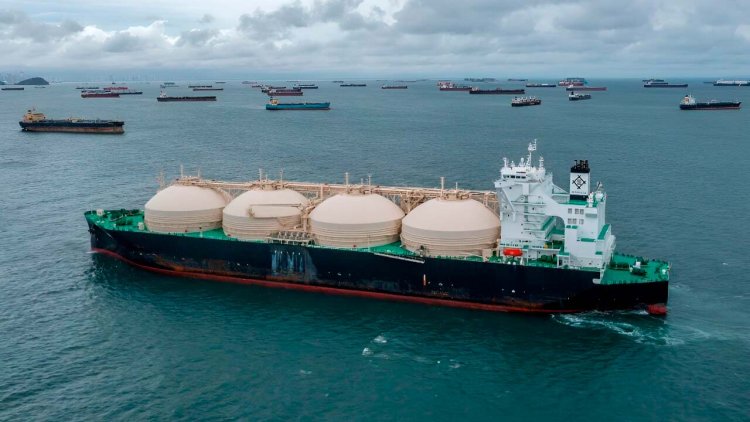
The drought-hit Panama Canal will maintain restrictions on the passage of ships for one year, a measure that has already led to a marine traffic jam as boats line up to enter the waterway linking two oceans.

The canal’s sub-administrator Ilya Espino, told AFP that unless heavy rains fall in the next three months, “we are looking at a period of one year” of restricted access.

That period will give clients “a year to plan” how to adapt, she said late Thursday.

Each ship moving through the canal requires 200 million liters of freshwater to move it through the locks, provided by two artificial lakes which also supply drinking water to half the country of about 4.2 million people.

However, Panama is facing a biting drought, made worse by the El Niño warming phenomenon, which has forced canal administrators to restrict the waterway to ships with a draft (water depth) of 13.11 meters (43 feet).

In 2022, an average of 40 ships crossed through the canal a day, a number which has now dropped to 32 to save water.

The measures have caused a back-up of ships waiting to enter the 50-mile (80-kilometer) byway, which is mainly used by clients from the United States, China, and Japan.

On Thursday, some 130 boats were waiting, compared to around 90 usually in the queue.

Waiting times, usually between three and five days, have gone up to 19 days at times, although they currently stand at around 11 days.

Earlier this month canal operators said the restrictions were likely to result in a $200 million drop in earnings in 2024 compared to this year.

To pass through the canal, vessels can reserve a slot in advance, or try and buy one via an auction process. For those unable to secure a slot, there is a long wait.

“We easily handle a queue of 90 ships” waiting, but “130 or 140 ships cause us problems and delays,” said Espino.

This week Panama President Laurentino Cortizo was forced to deny an assertion by his Colombian counterpart Gustavo Petro that the canal was closed.

Mexican President Andres Manuel Lopez Obrador, also referred this week to the “special” situation facing the waterway.

“We have a restriction in Panama as we have had on other occasions, but it is not true that the Panama Canal is closed,” said Cortizo.

The canal opened in 1914 after a monumental construction project through dense jungles and mountains, with workers suffering tropical diseases, intense heat and rain.

Since then, more than a million vessels have transited through the canal, saving them a lengthy journey around the tip of South America.

“The big disadvantage that the Panama Canal has as a maritime route is that we operate with freshwater, while others use seawater,” canal administrator Ricaurte Vasquez told AFP earlier this month.

“We have to find other solutions to remain a relevant route for international trade. If we don’t adapt, we are going to die.”

Due to the draft restrictions, some merchant ships are forced to unload their containers and send the lighter vessel through the canal, while the goods traverse Panama by rail before being reloaded.

Source

The world’s largest floating offshore wind farm officially opened

0

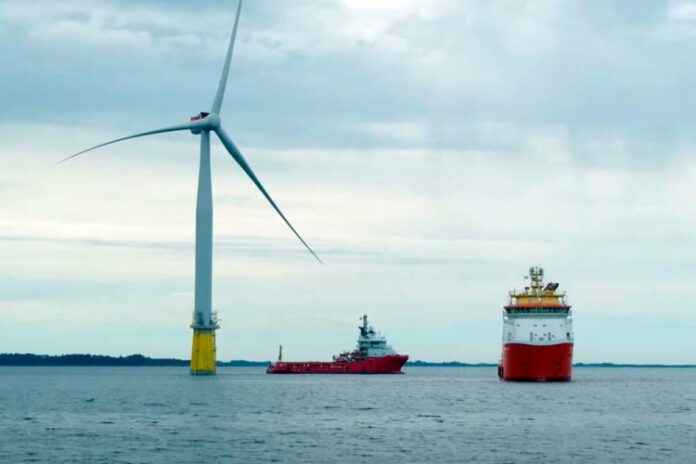
The Hywind Tampen wind farm was opened by Crown Prince Haakon of Norway. Gullfaks and Snorre are the first oil and gas fields in the world to receive power from offshore wind, reducing CO2 emissions. 

“Hywind Tampen is expected to reduce CO2 emissions with 200,000 tonnes annually from key oil and gas producers in the North Sea. It is a bold investment in a pioneering project from the Gullfaks and Snorre partnerships and Enova. The project has given us and the supplier industry valuable experience that will be important when we work together to develop offshore wind further in Norway and globally, scaling up for the future.I would like to thank everyone who has contributed, this is an industrial development we can be proud of,” says Kjetil Hove, executive vice president for the Norwegian continental shelf in Equinor.

The wind farm consists of 11 wind turbines based on the floating Hywind concept, developed by Equinor. Hywind Tampen has a system capacity of 88 MW and is expected to cover about 35 per cent of the annual need for electricity on the five platforms Snorre A and B and Gullfaks A, B and C. The wind farm is managed from Equinor’s office location in Bergen.

“40 years ago, Gullfaks was Equinor’s major qualifying test in field development on the Norwegian continental shelf. Today marks a new milestone. With Hywind Tampen, we have shown that we can plan, build and commission a large, floating offshore wind farm in the North Sea. We will use the experience and learning from this project to become even better. We will build bigger, reduce costs and build a new industry on the shoulders of the oil and gas industry,” says Siri Kindem, head of Equinor’s renewables business in Norway.

In five years, the project has gone from the drawing board to completion. 60 percent of the contract values in the project have been awarded to Norwegian suppliers. This has contributed to new activity, green jobs, local spin-offs and technology development for future floating offshore wind projects in a growing industry.

Enova and the Norwegian Business Sector’s NoX fund have supported the project with NOK 2.3 billion and NOK 566 million respectively to stimulate technology development within offshore wind power and emission reductions.

The investment forecast for the project is now about NOK 7.4 billion. When the plan for development and operation was submitted, the development cost was estimated at about NOK 5 billion. The increase is due to a combination of COVID-related costs, delayed deliveries, quality issues with some deliveries and knock-on effects. In addition, increased market prices, currency effects and supplier compensation for COVID-19 effects have contributed. At the same time, the expected CO2 tax and gas price have increased, which has a positive effect on the project economy.

The project has significant cost improvements compared to the Hywind Scotland floating offshore wind farm, which was the world’s first floating offshore wind farm. Adjusted for price developments since 2016/2017, the investment cost for Hywind Tampen is about 35 percent lower per installed MW.

Port of Savannah receives four new electric ship-to-shore cranes

0

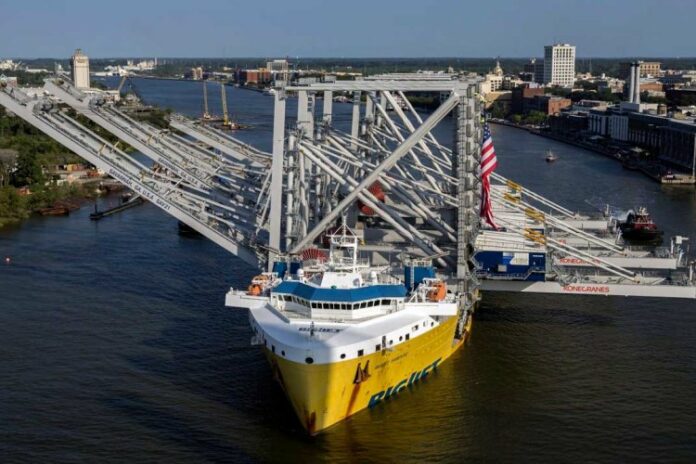
The Port of Savannah received four Super Post-Panamax ship-to-shore cranes Thursday, Aug. 24, upgrading the crane fleet to 34 machines at Garden City Terminal after four older cranes are retired and recycled.

“Along with the completion of our project to improve Berth 1, these cranes will help deliver faster turn times to our ocean carrier customers, including the largest vessels calling on the U.S. East Coast,” said Griff Lynch, Georgia Ports Authority president and CEO. “No other terminal in the nation can bring more cranes to bear, or match the efficiency, productivity and global connectivity of the Port of Savannah.”

Designed by Konecranes of Finland, the all-electric cranes arrived on the vessel BigLift Barentsz.

Two of the cranes will be 295 feet tall and two will be 306 feet tall at the highest point when fully assembled. The reach of the cranes will be 22 and 24 containers wide, respectively. The taller cranes will be offloaded at Berth 1 at Garden City Terminal, the others will be installed on the upriver end of the terminal, at Berth 9.

Ship-to-shore cranes are the workhorses of container port operations, unloading and loading cargo from the container ships that call on the port.

GPA received a previous batch of four cranes in February to work the recently renovated Berth 1, which is now capable of serving vessels with a capacity of 16,000+ twenty-foot equivalent container units. The cranes and improved dock increase Garden City Terminal berth productivity by 25 percent or 1.5 million TEUs of annual capacity.

The new equipment is part of GPA’s $1.9 billion infrastructure improvement plan to keep pace with future supply chain needs.

“The ratio of GPA’s economic impact equates to roughly one job per nine TEUs moved,” said Stacy Watson, director of economic and industrial development at GPA. “By expanding our annual capacity by 3 million TEUs over the next three years, GPA is also increasing its job-supporting capability by more than 300,000 jobs for Georgians.”

Kongsberg Digital and Shell Marine deepen their collaboration

0

Currently used by Shell Marine Lubricants customers, LubeMonitor will become available to shipowners and operators through Kongsberg Digital’s marketplace for maritime applications, an ecosystem of numerous powerful applications supported by Vessel Insight SaaS-based data infrastructure.

The marine industry faces significant uncertainty as it navigates the energy transition. A focus on engine condition and reliability is key to supporting customers in managing this safely. LubeMonitor combines the data from onboard oil testing, engine operating conditions, Shell LubeAnalyst laboratory results, engine inspection photos and measurements. These are used to deliver insights based on OEM recommended guidance at a total fleet, vessel or cylinder level, supporting better management of reliability and informed decision-making for customers.

Last year, Kongsberg Digital and Shell Marine penned a Memorandum of Understanding (MoU), signifying their shared commitment to expedite decarbonisation initiatives and support the maritime industry’s energy transition.

Anders Bryhni, Vice President Maritime Products in Kongsberg Digital, says:

“This strategic collaboration expands the range of applications available to industry professionals on our marketplace and consolidates our collaboration with Shell. We are proud to work together with Shell, sharing a passion for digital innovation and commitment to decarbonisation. Offering Kongsberg Digital clients Shell’s LubeMonitor app is a testament to our close collaboration.”

Hariharasudhan Ramani, GM Digital Innovation at Shell, says:

“Through this agreement we are not only broadening our collaboration, but also merging our digital innovation capability with industry expertise from both companies.”

Adding LubeMonitor to the app ecosystem is an initial step of a continuous shared innovation between Shell and Kongsberg Digital, who plan to develop and introduce further marketplace applications in the future.