-11.1 C
New York
Home Blog Page 255

METIS adds EU-ETS to Total Emissions Management functionality

0

As well as supporting IMO’s Data Collection System metrics for a ship’s Average Efficiency Ratio and Carbon Intensity Indicator, and EU monitoring reporting and verification, the new capability means that METIS can help owners manage the complexities of carbon allowances.

Expanding to include maritime transport from next year, the EU-ETS will apply 100% for EU-EU voyages and 50% for EU-Non EU voyages. It aims to cut greenhouse gasses using a combination of emissions trading and emissions allowances for ships. Cargo and passenger ships of 5000 GT and above must account for emissions from January 1, 2024, in order to ‘surrender’ (or use) their first trading allowances by 30 September 2025. The ETS will also cover offshore ships from 2027.

To comply, shipping companies need to monitor emissions under a revised plan that has been assessed by a verified organisation and approved by the administering authority. Once per year, companies submit an emissions report for each ship and aggregated data into the ETS. The progressively more stringent scheme requires ships to surrender emissions allowances, starting at 40% of emissions in 2024, rising to 70% in 2026, and reaching 100% thereafter.

Capturing CO2 emissions data and reporting with the accuracy per voyage and cumulatively on which the ETS relies, METIS also allows users to establish the monetary value of equivalent allowances based on current EU carbon market rates. In addition to determining the number of allowances required, METIS will help to assign costs to the charterer or the manager based on the ‘polluter pays’ principle.

“Accurate data capture is crucial for ETS reporting, but METIS Total Emissions Management is also a comprehensive digital tool for emissions management that provides the framework for the predictive insights to help owners take evidence-based, effective decisions,” said Eleni Polychronopoulou, CEO, METIS Cyberspace Technology. “The solution allows owners to bring emissions management into the day-to-day decision-making for optimising vessel performance.”

As a cloud-based solution, the METIS platform is also highly adaptable to changing market and regulatory needs of shipping, added Polychronopoulou.

“Functionality can be continuously developed to add value for the end customer. Our expectation is that, as the ETS unfolds, customer feedback will stimulate further enhancements in functionality to reflect the realities of the scheme.”
WinGD to power EXMAR LPG’s first ammonia-fuelled vessels

0

Swiss marine power company WinGD will deliver ammonia-fuelled X-DF-A engines for a series of two 46,000m3 LPG/ammonia carriers to be built for EXMAR LPG BV, a joint venture of EXMAR and Seapeak, at Hyundai Mipo Dockyard. 

The two 52-bore X52DF-A engines will be delivered in Q2 2025 and will be among the first of WinGD’s ammonia-fuelled engines to enter service.

The order represents WinGD’s entry into an emerging market for ammonia-fuelled gas carriers. Such vessels have traditionally been early adopters of new power technology using their cargoes as fuel, and the ammonia transport market is projected to surge over the next few years as global demand for the carbon-free fuel and hydrogen carrier accelerates.

WinGD Director of Sales, Volkmar Galke said:

“Ammonia is set to become a mainstream sustainable marine fuel and energy carrier by mid-century, and we are delighted to be working with EXMAR to ensure that the vessels carrying the cargo will be among the first to use it. Thanks to close cooperation with the owner, shipyard, engine builder Hyundai Heavy Industries and other stake holders, WinGD’s X52DF-A will be available soon – not just for ammonia carriers but also for a range of other vessel types that can benefit from ammonia as a fuel.”

EXMAR’s Deputy Director Shipping, Carl-Antoine Saverys said:

“As global leader in maritime ammonia and LPG transportation we have a long history of innovative ship designs and floating infrastructure platforms. With four decades of experience in handling ammonia cargoes we are confident in our ability to safely and effectively use this innovative zero-carbon shipping fuel. This journey continues to shape the maritime industry, and we’re pleased with the strong collaboration with WinGD and the other partners to drive sustainability forward.” 

The X-DF-A range will feature high-pressure ammonia injection supplemented by a low targeted dose of pilot fuel, around 5%. Its performance and fuel efficiency will be similar to that of WinGD’s equivalent sized diesel-fuelled X-Engines, in both ammonia and diesel mode. No after-treatment for N2O emissions is foreseen, with selective catalytic reduction assuring Tier III NOx compliance on either fuel.

The X-DF-A range will span WinGD’s entire portfolio, with early orders also received for the 72-bore variant. The entire range has been approved in principle by Lloyd’s Register, meaning that owners can already incorporate X-DF-A engines into their newbuilding plans today.

TECO 2030 launches safe marine fuel cell system

0

The FCM400 has already an Approval in Principle from DNV and currently undergoes type approval process for maritime and heavy-duty applications. FCM400 is inherently gas-safe to accommodate easy integration onboard a ship for zero emission energy generation.

TECO 2030 has developed hydrogen fuel cells that enable ships and other heavy-duty applications to become emissions-free, and the company is in the process of establishing Europe’s first Giga production facility for hydrogen PEM fuel cell stacks and modules in Narvik, Norway. Production of fuel cell stacks is already underway, and the commencement of module production is expected to start within the next few months. TECO 2030’s fuel cell stacks employ unique technologies developed together with technology partner, AVL, a forerunner in hydrogen applications, enabling industry-leading power density and performance.

TECO 2030’s world-class fuel cell system is a technologically advanced clean energy generation system. The attributes of the modular 400kW fuel cell system includes industry leading energy efficiency, inherent safety concept, leading dimensions and component design, lifetime, and rapid dynamic load response.

Safety is always the key priority. TECO 2030’s fuel cell system has been developed along with an inherent safety concept, this means that the design and operation of fuel cells minimize consequence of potential hazards. This includes a separate and independent safety system, venting arrangement, certified and field proven components, and robust containment systems.

The FCM400 system has the lowest footprint on the market when calculating power output per unit volume, meaning that there is no other supplier of similar energy density for marine and heavy-duty applications. Real estate onboard a ship or similar sites is limited so the importance of energy density is key to many of TECO 2030’s clients and partners. The FCM400 has a dynamic load which relates to the ability of the fuel cell to rapidly respond to changes in power demand, which is important for mobility and grid applications were power requirements can change swiftly.

Tore Enger, Group CEO at TECO 2030, says:

“Our system is a standard and fully customizable fuel cell system that can be used in various applications such as marine main- or auxiliary engines, construction sites, stationary shore power applications and other energy intensive applications. TECO 2030 is at an exciting pivotal point in its development and are continuously looking for new potential partners, employees, and investors to work with, so we together can realize a common zero-emission future.”

Van Oord completes work on Saint-Brieuc offshore wind farm

0

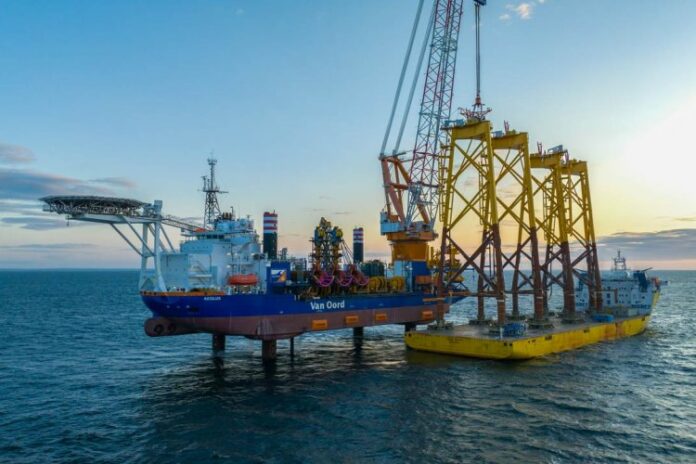
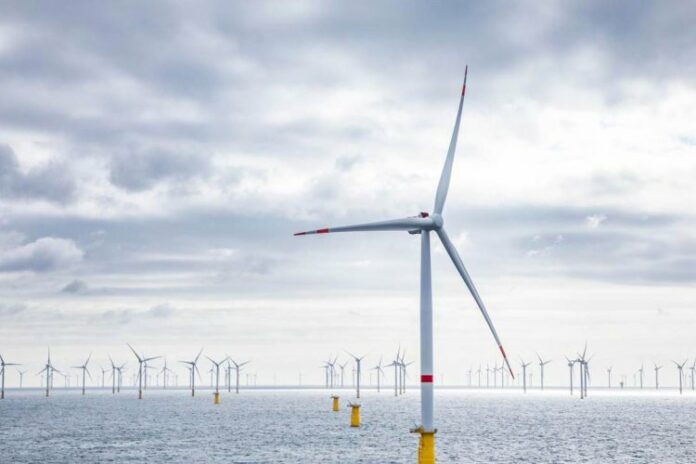
Van Oord has completed the installation of 62 jacket foundations at the Saint-Brieuc offshore wind farm. Once operational, the 496MW wind farm will generate enough clean energy for 835,000 inhabitants. 

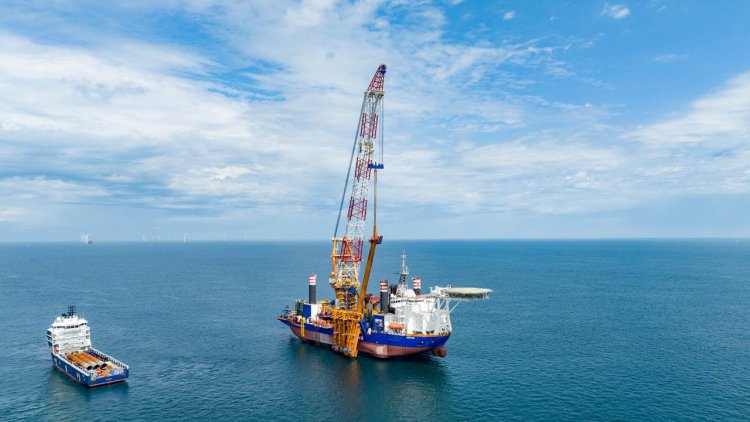
Ailes Marines, owned by Iberdola, contracted Van Oord for the transport and installation of 62 jacket foundations for the wind turbines (3 pin piles each) and the 4 foundation pin piles for the offshore substation. Van Oord deployed its offshore installation vessel Aeolus to install the 190 pin piles and teamed up with other industry partners to install the jackets. 

Conditions for building a wind farm in the Bay of Saint-Brieuc have been challenging. The extremely hard and rocky seabed and Atlantic environmental conditions challenged our equipment and expertise. The Aeolus was therefore upgraded and an extensive spread of project-specific installation equipment was engineered, constructed and utilised on the installation vessel.

To ensure that the Aeolus could be safely jacked above sea level, the feet of the jacking system were modified with a flex-pin construction. Due to the geotechnical conditions at the site, an innovative drilling method was used to install the foundations. Project-specific drills were jointly engineered and constructed with our partner Bauer Spezial Tiefbau and a newly designed and state-of-the-art drilling template functioned as a positioning and casing drilling tool to ensure the precise placement of the pin piles.

Ivar Daemen, Project Director Van Oord:

‘After executing a variety of projects in France, Van Oord reached a huge milestone by completing our very first highly complex offshore wind project here. Thanks to the great collaboration between our client Iberdrola, partners and dedicated project team, we have now finished our work on the Saint-Brieuc project. We’re proud to have contributed to France’s energy transition.’ 

Maersk signs deal with Starlink for its Ocean fleet

0

Maersk’s more than 330 own operated container vessels will have Starlink installed, enabling high-speed internet with speeds over 200 Mbps. 

The service is a leap forward in terms of internet speed and latency which will bring significant benefits in terms of both crew welfare and business impact.

The agreement comes after a successful pilot phase where crew members on more than 30 Maersk vessels have had the opportunity to test the Starlink technology – resulting in very positive feedback.

Leonardo Sonzio, Head of Fleet Management and Technology at A.P. Moller – Maersk, said:

“We are excited to announce our journey with Starlink to provide state of the art connectivity to our sea going colleagues. The highspeed connectivity will enable our seagoing colleagues to stay connected with their loved ones while at sea. It will also propel the expansion of seamless cloud solutions, enabling our vision to digitalise our vessel operations.”

Besides obvious benefits from highspeed internet resulting in seamless streaming and high definition videocalls for crew members, high-speed, low latency internet will also facilitate cost saving measures by moving business critical applications into the cloud and by strengthening remote support and inspections of the vessels.

Starlink has been changing the game to provide reliable and high-speed internet across the globe with its state-of-the-art satellite network. Its vision is to create a globally connected world where opportunities are not limited by geography – making it a great fit to solve the challenges of staying connected on the high seas of the world.

Jonathan Hofeller, SpaceX’s Vice President of Starlink Commercial Sales, said:

“A.P. Moller – Maersk’s vessels are key to global trade, and Starlink’s high-speed broadband through the world’s most advance satellite internet constellation will help boost efficiency through seamless connectivity no matter where in the world they are.”

Aker BP joins UN program for reduction of methane gas emissions

0

The source to Aker BP’s methane emissions are cold ventilation, incomplete combustion of natural gas and diesel, and leaks from process plants. The emissions are monitored, quantified and reported to the environmental authorities on an annual base in accordance with national industry standards.

Through membership in OGMP 2.0, Aker BP will join forces with Equinor, BP and other major oil and gas companies and commit to monitoring and reducing global methane emissions in accordance with best practice.

“Through even better monitoring, we will be able to uncover leakage points and identify source streams where it is possible to reduce emissions of methane. Reducing our methane emissions is an integral part of our climate efforts”, says Axel Kelley.

Methane is a powerful greenhouse gas that contributes to warming of the atmosphere, and is the second most important greenhouse gas from human activity after carbon dioxide. Annually, around 1,000 tons of methane are released from Aker BP’s production platforms and drilling rigs. This figure must be reduced.

“We have set a long-term goal of limiting the methane intensity to less than 0.05%, which is far more ambitious than the goal for upstream activities of 0.2%. It aligns well with our plan to reduce our greenhouse gas emissions by 50% by 2030 and close to zero by 2050,” says Kelley.

“It is becoming increasingly important for the industry to handle methane emissions in a responsible manner and to have transparent and accurate reporting”, says Marit Blaasmo, Senior Vice President for People & Safety at Aker BP.

“The capital market is also pushing for change. OGMP 2.0 is the gold standard in methane measurement, reporting and target setting, and is globally recognized. Membership in OGMP 2.0 provides comprehensive guidance for our strategy for reducing methane emissions and helps us meet the expectations of external stakeholders”, says Blaasmo.

DEME secures cable contract for first offshore wind farm In Poland

0

DEME Offshore has secured a substantial cable contract for Baltic Power, the first offshore wind farm to be constructed in Poland, together with its consortium partners NKT and TFKable Group. This is also the first offshore wind project for DEME Offshore in Poland.

The wide-ranging scope includes the engineering, procurement, construction and installation of both the inter-array and export cables for the wind farm. Providing more than 1.5 million households with renewable energy, the Baltic Power wind farm is being jointly developed by ORLEN Group and Northland Power, with construction expected to start in 2024 and operations in 2026. 

Set to be the largest offshore wind project in Poland, the 1.2 GW wind farm will be located 23 km off the coast of the Polish Baltic Sea coast, near Łeba.

Representing approximately 130 km of export cables and 127 km of inter-array cables, DEME Offshore will execute the contract with consortium partners NKT, a leading power cable supplier in the energy sector, and TFKable Group (TELE-FONIKA Kable and JDR Cable Systems), a leading supplier of cables for offshore and onshore wind energy. DEME’s share in the contract represents a substantial contract.

Philip Scheers, Business Unit Director at DEME Offshore said:

“We are delighted to partner with Baltic Power and secure our first offshore wind farm project in Poland. Combining the extensive expertise and innovative solutions of the consortium, we are excited to make a meaningful contribution to this pioneering project and support Poland’s transition to clean energy.”

China’s first hydrogen-powered ship makes maiden voyage

0

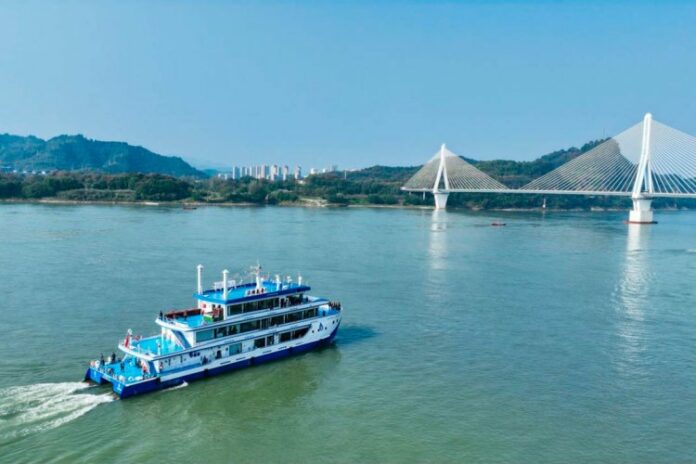
The “Three Gorges Hydrogen Boat No. 1”, China’s first hydrogen-powered ship,made its maiden voyage in Yichang City in central China’s Hubei Province on Wednesday morning, marking a breakthrough in the country’s application of hydrogen fuel cell technology in inland waterway vessels.

The vessel has a steel-aluminum composite structure with a total length of 49.9 meters, a beam of 10.4 meters, and a draft of 3.2 meters. Powered by a 500 kW hydrogen fuel cell, the ship has a maximum cruise range of 200 kilometers.

After delivery, it is used for transportation, patrol and emergency response in the Three Gorges reservoir area and between the Three Gorges-Gezhouba dams.

The ship is jointly developed by companies like China State Shipbuilding Corporation, China Yangtze Power Corporation and Jianglong Shipbuilding, and institutions like Wuhan Changjiang Ship Design Institute and the Three Gorges Navigation Authority. It’s also the first hydrogen-powered boat certified by the China Classification Society.

In recent years, the application of new energy power propulsion technology has become a key focus for developing green ships. Hydrogen energy is pollution-free, renewable and highly efficient, and hydrogen fuel cells can boost energy efficiency, achieve zero emissions and improve cruise comfort, making them ideal power propulsion devices for green ships.

Compared with traditional fuel-powered ships, the hydrogen-powered vessel is expected to replace 103.16 tons of fuel oil and reduce carbon dioxide emissions by 343.67 tons each year.

The vessel can have energy supplied at the green electricity and green hydrogen demonstration station of the Three Gorges located at the Yangjia Bay in the lower reaches of the gorges.

As China’s first inland dock-type hydrogen production and refueling station, it uses the clean electric energy generated by the Three Gorges power station to electrolyze water to produce hydrogen, which will be directly supplied to hydrogen-powered ships after compression, storage and filling. The station can supply 240 kilograms of hydrogen per hour.

Damen Naval contracts ABB to supply solutions for ASW Frigates

0

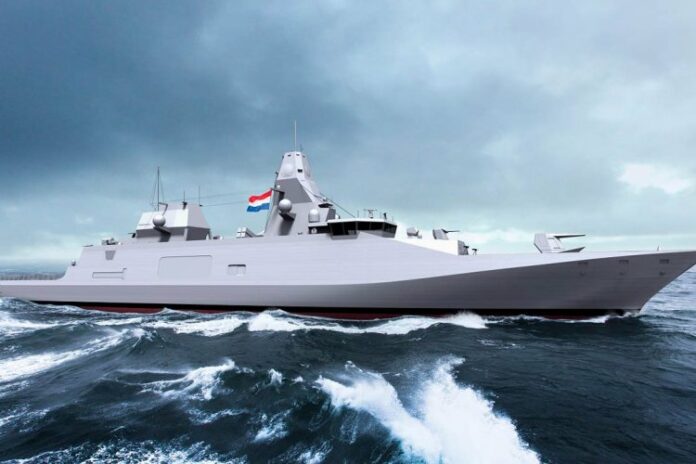
Damen Naval has chosen ABB to supply its Onboard DC Grid™ integrated power and distribution system to the new Anti-Submarine Warfare (ASW) Frigates. 

The Vlissingen-based shipbuilder is building four state-of-the-art frigates, two for the Royal Netherlands Navy and two for the Belgian navy. It is the second collaboration between Damen Naval and ABB; in early 2022, the Norwegian division of company was contracted for the F126 Frigate project for the German Navy.

“It is a testament to the positive cooperation between our two companies and the quality of their systems that we have now also signed an agreement for the ASW project,” explains Joop Noordijk, ASWF Project Director at Damen Naval. “ABB’s Onboard DC Grid™ provides the operational efficiency and sustainability that the Dutch and Belgian navies demand from their new frigates.”

The ASW Frigates will replace the current generation of Karel Doorman-class Multipurpose frigates and can be deployed for multiple tasks. The emphasis will be on anti-submarine warfare, and they will be designed to sail as quietly as possible to avoid detection by submarines as much as possible. 

ABBs Onboard DC Grid™ is a versatile and flexible electrical distribution system. For the ASW Frigates, the system will include energy storage, transformers, motors and generators, and enables reduced emissions and an increased operational range. The system has been ruggedized for naval operations in harsh environments and conditions.

“Securing a second order with Damen Naval is a clear indicator that the shipyard – and the naval market in general – has full confidence in the ability of Onboard DC Grid™ to facilitate the highly demanding operations of military vessels,” said Sindre Satre, Business Line Manager, ABB Coast Guard & Navy. “ABB is uniquely positioned to support navies in their efforts to enhance the operational performance and reduce the environmental impact of their ships in line with the requirements of the IMO.”

The first ASW Frigate is expected to be delivered by Damen Naval in 2028.

ICS launches its Carbon Intensity Indicator Data Collection System

0

CII is a rating system developed by the International Maritime Organization (IMO) to measure the energy efficiency of ships, above 5,000 gross tonnage and trading internationally, and came into effect on 1 January 2023. It is currently in an experience building phase, with a formal review running in parallel, until 1 January 2026.

Following the IMO’s invitation during the Marine Environment Protection Meeting (MEPC80) in July, for interested Member States and international organisations to collect data and submit information and proposals, ICS has developed a system that enables shipowners and managers to submit data, including fuel consumption, transport work, and the trial metrics. Such information will enable a clearer understanding of how fairly and effectively the CII system is functioning and provide the necessary input to the IMO for system improvement.

Chris Waddington, Technical Director of the International Chamber of Shipping and lead on the ICS CII Data Collection System commented:

“At the International Chamber of Shipping we wish to engage constructively to the current experience building phase of the CII review, to ensure that the system is fit-for-purpose and effective. The ICS Data Collection System offers shipowners and managers the opportunity to contribute data that will improve the rating system in the future.”

“We encourage shipowners to utilise the system in order to offer first-hand insights into what works well and possible challenges within the system. This data will be shared with the IMO and keep dialogues open for how best to meet our 2030, 2040 and 2050 net zero carbon emissions targets.”