-10 C
New York
Home Blog Page 203

CLdN launches new services between Rotterdam and Ireland

0

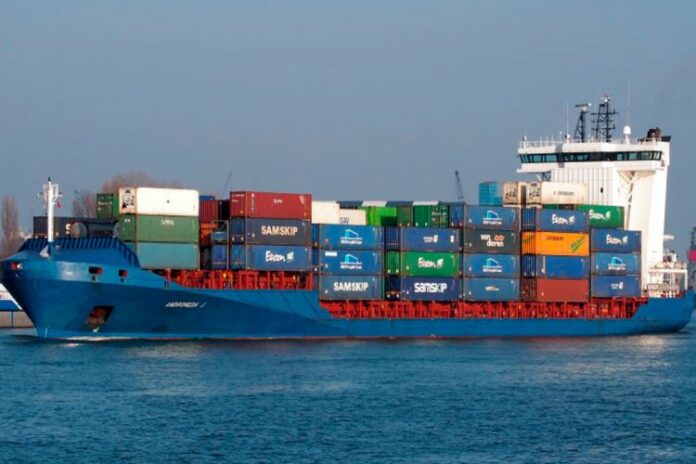
CLdN has chartered two 962 TEU lift-on / lift-off (LoLo) cargo vessels (M/V Pavo J and M/V Andromeda J) that will ship container cargo between the recently acquired Distriport terminal in Rotterdam and Dublin and Cork.   

The introduction of the new LoLo services will also enable an optimisation of CLdN’s roll-on / roll-off (RoRo) fleet deployment, thereby increasing capacity on the routes between Rotterdam and the UK.

The addition of the new services responds to high levels of customer demand to move freight between Ireland and mainland Europe. The two additional weekly LoLo sailings complement the three RoRo sailings operated by CLdN each week to and from Dublin. These RoRo services will continue to operate from CLdN’s RoRo terminal in Rotterdam.  The LoLo service to Cork complements the existing RoRo service operated by CLdN from its Zeebrugge terminal. The new services will be operational as from the week commencing 18th March.  

CLdN has grown its presence on the Irish trades significantly since the inception of its first cargo service to Ireland in 1999, with the most recent expansion being announced in December last year when an additional 3.5 hectares of terminal area were added in Dublin.  Today, CLdN ships some 500,000 cargo units a year to and from Ireland, making it the largest mover of ferry freight between Ireland and mainland Europe / Great Britain. 

In addition to the above direct sailings, CLdN offers extensive transhipment possibilities to the East coast of England (London, Killingholme and Teesport), Spain, Portugal, Denmark and Sweden. CLdN also operates 11 weekly sailings between Heysham (GB) and Warrenpoint (Northern Ireland).

Commenting on the additional capacity, Florent Maes, CEO of CLdN, said:

“The addition of these services is a direct benefit of the recent Distriport acquisition and an example of CLdN’s ability to find innovative and timely solutions for its customers. The trade flows between Ireland and mainland Europe are significant and CLdN is pleased to be able to further expand its offering in this area.”

Van Oord and Van Aalsburg sign collaboration agreement

0

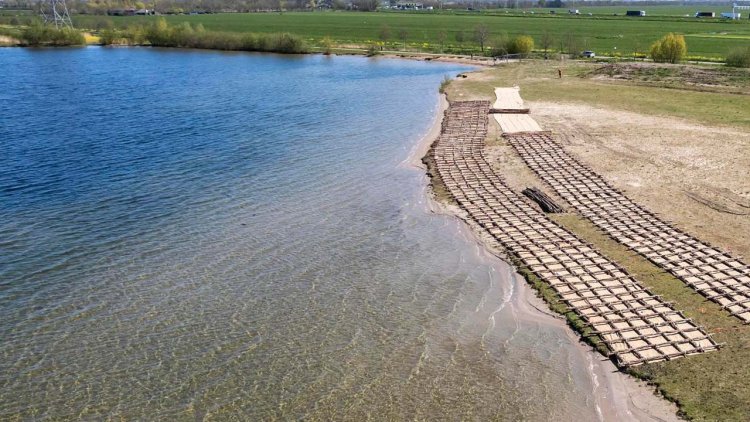
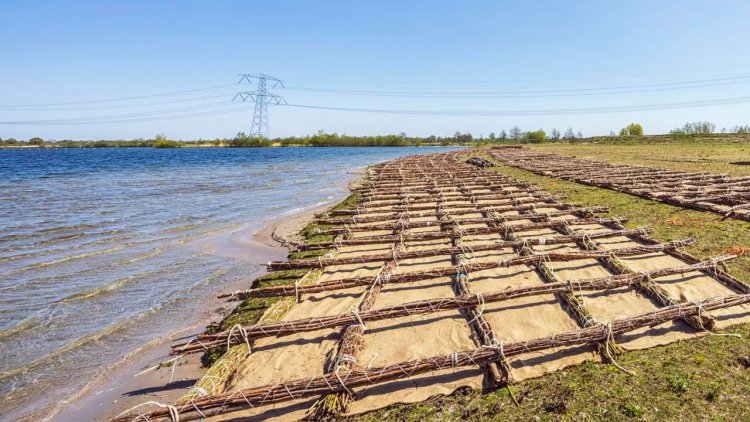
Van Oord has signed a collaboration agreement with Van Aalsburg. The aim of the collaboration is to further develop, construct and apply fascine mattresses made entirely of circular material. Fascine mattresses are mats of twisted willow that play an important role in maintaining embankment stability, preventing land degradation and protecting waterways from erosion.

At present, fascine mattresses often consist of geotextile cloths that contain microplastics. That is why Van Aalsburg, which specialises in sustainable willow products, developed a natural alternative: fascine mattresses with jute cloth. In this construction, bundles of twisted willow, called faggots, are tied to jute cloth.

This fabric is as strong as geotextiles and by using it, the fascine mattresses are made entirely of circular material. Van Oord and Van Aalsburg have been working together for many years on projects using fascine mattresses, such as on the Afsluitdijk. Based on a shared sustainability ambition, the two companies have now joined forces to further develop circular fascine mattresses. For example, research is being carried out on the required strength of circular fascine mattresses and the non-woven applications.

The signing of the collaboration agreement is in line with Van Oord’s vision to create a better world for future generations through Marine Ingenuity and innovative customisation. In the context of ‘Building with Nature’, Van Oord strives to create sustainable solutions using natural materials. Circular fascine mattresses are an example of this and could be used in future soil and embankment defence works.

Carlos Mollet, Commercial Director Dredging & Infra at Van Oord:

‘At Van Oord we work a lot with fascine mattresses. Examples include dyke reinforcements and port and waterway development. The fascine mattresses prevent the erosion of beds and embankments. It is important to carry out research and invest in circular materials. The collaboration allows us to take a step towards a more sustainable future for future generations and apply them on a larger scale.’

Wärtsilä supplies its simulator technology to Sharjah Maritime Academy

0

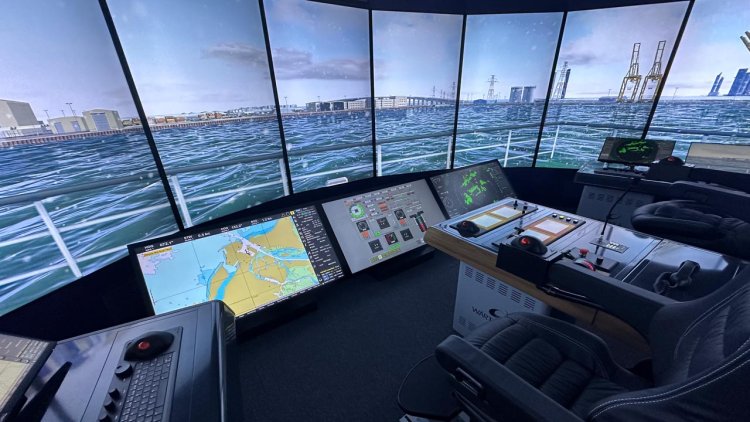
Technology group Wärtsilä has supplied its latest simulator technology to the prestigious Sharjah Maritime Academy. 

Located in Khorfakkan, United Arab Emirates, the academy, is one of the region’s leading providers of quality maritime studies, training and research. The advanced simulation facility, which was recently inaugurated, represents a sustainable development that serves to strengthen the position of the Sharjah Maritime Academy as a global maritime centre for training, innovation, research and development.

“Our aim is to create both a scientific and practical environment for students and to provide the capabilities that qualify them to reach the highest standards of quality in the field of maritime transport,” says Dr. Hashim Abdullah bin Sharhan Al Zaabi, Chancellor of the Academy. “For this we need the latest simulator technology to enable us to conduct training to the highest international standard and offer a platform for collaboration with other leading maritime organisations, which is why we have partnered with Wärtsilä to deliver this for us.”

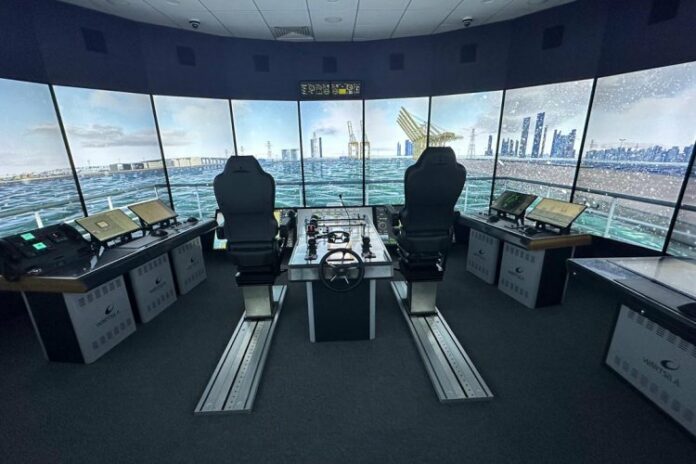
The comprehensive suite of navigation, engineering, communications and Vessel Traffic Services (VTS) simulators includes full mission, part task and classroom trainers for all levels of training and research, as well as modelling and content creation tools to enable the highly skilled maritime faculty team to offer a complete range of services to national and international clients. The scope includes two full mission navigational bridge simulators with 360-degree visualisation, state-of-the art offshore specific bridge systems, and the first installation of Wärtsilä’s new simulation bridge equipment configuration which represents the very latest and highest digital navigation operational standards.

The advanced simulation facility also features the world’s first commercial maritime mixed reality chromakey vessel handling application in the form of two integrated offshore vessel and tug simulators with motion platform for absolute immersion in the synthetic learning environment.

“We are truly honoured to have been selected by the Sharjah Maritime Academy to support their vision of establishing a maritime centre of excellence, and to deliver world class teaching, professional development, and lifelong learning to their students, graduates and maritime’s future leaders. As our industry’s digital and decarbonisation transformation gathers pace, facilities such as this can lead the development of new training standards and methodologies using the latest simulation technologies from Wärtsilä,” comments Neil Bennett, General Manager, Global Simulation Sales – Wärtsilä Marine.

The simulation facility was inaugurated by H.E. Dr. Sheikh Sultan bin Muhammad Al-Qasimi, Chairman of Sharjah Maritime Academy, Ruler of the Emirate of Sharjah, and Member of the Federal Supreme Council of the United Arab Emirates in February 2024.

Damen to deliver two ASD Tugs 3010 ICE to Norway’s BOA Group

0

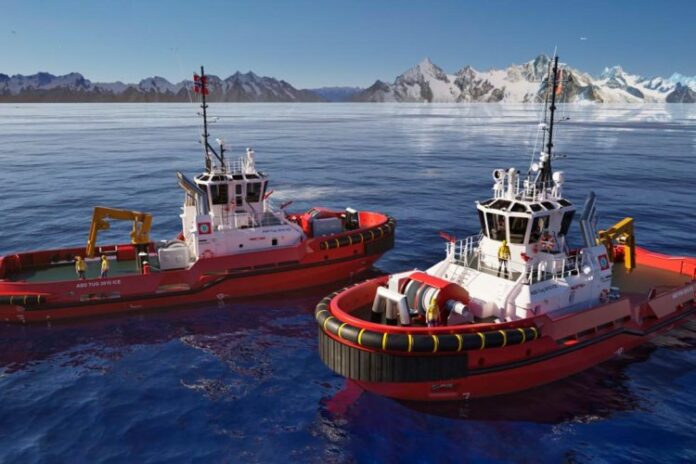
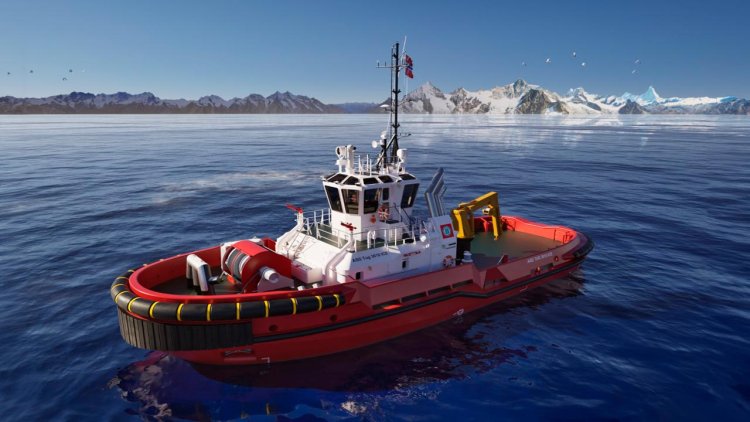
On February 20th Damen Shipyards Group signed a contract with BOA Group for two ASD Tugs 3010 ICE. Due to Damen’s practice of constructing vessels in series for stock, the tugs were already under construction at the time of order and will be delivered later this year.

BOA’s fleet consists of specialised offshore vessels, semi-submersible barges and harbour tugs. The order for these two Damen tugs is a part of the Norwegian company’s strategic fleet renewal and aims at modernising the fleet while lowering fuel consumption.

BOA CEO and shipowner Ole Torberg Bjørnevik explains, “There are a number of advantages to reducing the fuel consumption of our vessels. For one, it lowers costs, which helps us become more competitive. Crucially, it also allows us to pursue our goals of increased sustainability.”

In this, BOA is aligned with Damen, which has set itself the goal to become the most sustainable maritime solutions provider.
To ensure that the tugs met the requirements of BOA, Damen worked closely with its client, considering its operational profile in great detail. BOA serves multiple ports, some of which are a considerable distance from one another, requiring up to 10 hours steaming, followed by harbour assistance.

“To ensure a good match, we considered a wide range of tugs, from various shipbuilders. I am confident that we have found the right vessel with Damen. The ASD Tug 3010 ICE represents the complete package for us. It’s got the fuel economy, the right draught, ice classification and availability of spare parts. It was very important for us that we had something that was proven – and with Damen you certainly get something proven,” says BOA Fleet Director Tugs and Salvage Eskil Bjørnevik.

The two tugs will feature a range of options that ensure their suitability to BOA’s needs. This includes a Heila HLRM 65 – 4s crane with 3.3 ton lifting capacity at 12.65 metres, an aft winch, a modular oil recovery system, and a shore heating system.

The vessels will be the first Damen newbuilds in BOA’s fleet. The two family-owned companies have, however, enjoyed a close relationship for many years already. This includes BOA’s repeated utilisation of Damen Shiprepair & Conversion yards. An example of this is the recent extension of the Boabarge 33 undertaken by Damen Shiprepair Rotterdam in preparation for BOA’s scope in a contract with TM Edison in Belgium.

In keeping with company tradition, the tugs will receive names associated with Norse mythology. They are to be named BOA Hugin and BOA Munin (thought and memory, respectively, in Old Norse) for the two ravens said to fly around the world gathering information for Odin. 

Damen Sales Manager for Scandinavia Martin Verstraaten says,

“It has been a pleasure to be in contact with such a knowledgeable client. I’m very pleased that we have been able to find a solution that matches BOA’s wide-ranging operational profile. It’s been quite a journey assessing the requirements and the possible solutions, but it’s gone smoothly and always been filled with warmth. I’m looking forward to the continued development of our relationship in the future.”

Alfa Laval signs the first MoU for OceanGlide installations with KSB

0

Alfa Laval has signed a Memorandum of Understanding (MOU) with a reputed Korean shipyard, K Shipbuilding (KSB) for collaboration with respect to entering Alfa Laval OceanGlide Air Lubrication System in KSB’s potential newbuilding projects such as MR and LR1 Tankers.

Through this business agreement, KSB seeks to leverage the benefits offered by OceanGlide to achieve its objective of improving a vessel’s energy efficiency, and performance by reducing the vessel’s frictional resistance while sailing by using air lubrication technology.

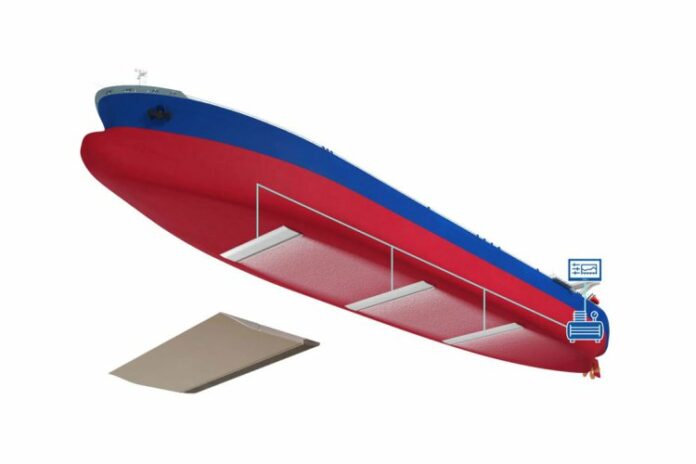
OceanGlide serves KSB’s efficiency goals by utilising intelligent integration of fluidics with air lubrication to enhance the vessel’s propulsion power savings by up to 12%. This translates to lower fuel consumption, reduced CO2 emissions and improved EEDI, EEXI and CII compliance.

“We are proud to work with KBS as our business partner in Korea. This agreement signifies the market’s growing trust in Alfa Laval as a reliable partner. It also highlights the recognition of our solutions as being innovative and efficient,” says Rajiv Sarin, Head of Air Lubrication, Alfa Laval.

“OceanGlide is an innovative solution that helps improve ship operation efficiency, and we expect it to align well with our goals of developing and building competitive ships,” says Tae-Hyun Koh, CTO, K Shipbuilding.

OceanGlide, using fluidic technology, creates highly streamlined airflow sections on a vessel’s flat bottom. Each section has an independently regulated fluidic band that produces a controlled air layer. This feature ensures optimal efficiency, maximum coverage, and reduced compressor power. The system’s high efficiency in controlling air flow not only ensures an effective air layer with fewer compressors but also provides the added advantage of conveniently positioning them anywhere on board.

This technology contributes to energy conservation and enables adherence to environmental regulations, marking a significant step towards sustainable maritime operations.

Aerial surveys reveal mass coral bleaching event unfolding on the Great Barrier Reef

0

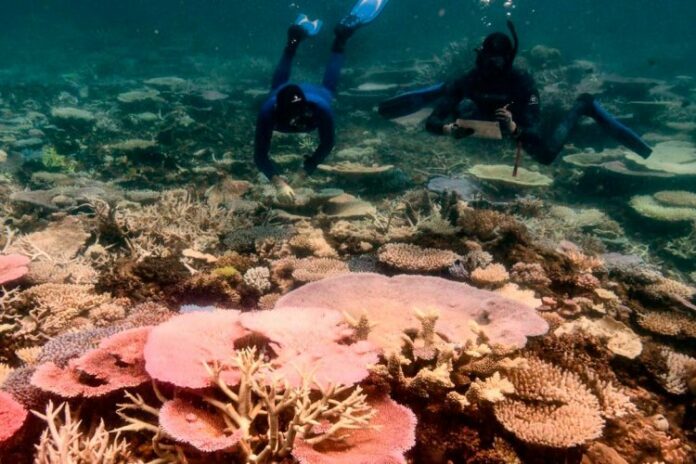
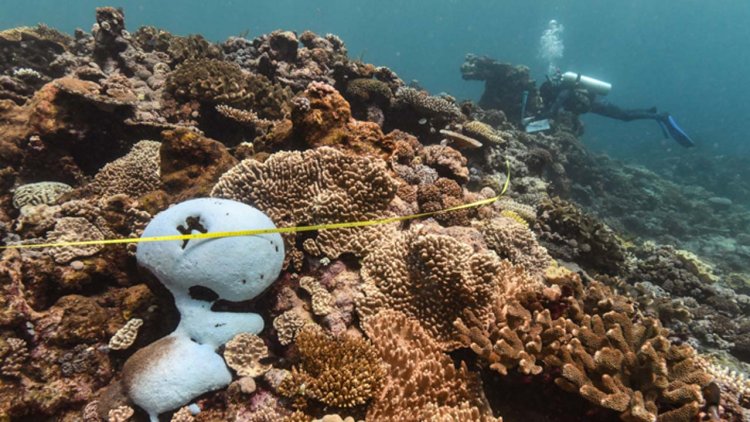
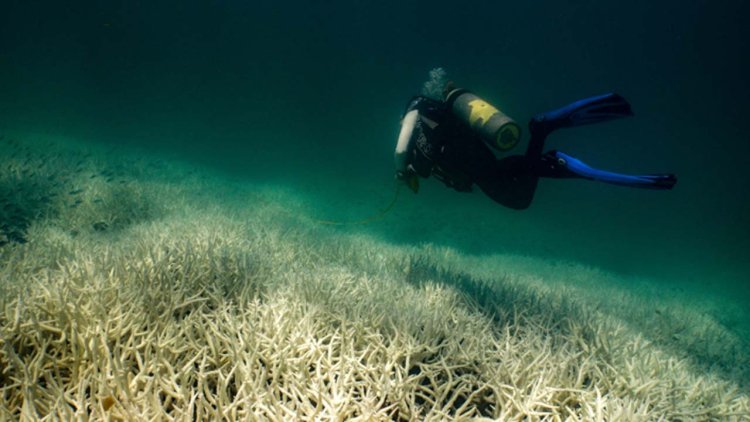
The Australian Institute of Marine Science (AIMS) in collaboration with the Great Barrier Reef Marine Park Authority have observed extensive coral bleaching caused by elevated sea temperatures during aerial and in-water surveys of the Reef.  

This information confirms that a mass coral bleaching event is taking place on the Great Barrier Reef which is the fifth such event since 2016. 

The aerial surveys have so far covered almost two-thirds of the Great Barrier Reef Marine Park. 

AIMS Senior Research Scientist Dr Neal Cantin, who led the aerial surveys, said observations had been collected from over 300 inshore, midshelf and offshore reefs, in the southern and central regions up to Cape Melville north of Cooktown. 

“When bleaching becomes common across many sectors of the Great Barrier Reef, including both inshore and offshore reefs, it becomes a mass bleaching event,” he said. 

“As the Great Barrier Reef ecosystem is so large, the size of Italy, the heat stress across it isn’t uniform. As a result, we are seeing differences between reefs with respect to the number of corals that are completely white. This pattern largely follows the pattern of accumulated heat stress seen over the past few months.  

“Until both the aerial and in-water surveys have been completed and the data analysed, we cannot predict the potential impacts that will follow this year’s mass bleaching event. 

“These surveys will continue to document the prevalence and severity of coral bleaching across a range of habitats and depths until the end of March.  They will complete our full assessment of the spatial extent of coral bleaching into the remaining remote inshore and offshore regions of the Great Barrier Reef.” 

More aerial surveys of the offshore southern region, far northern region and the Torres Strait Islands will be completed when wind and weather conditions become more suitable. 

Mass bleaching events are a modern phenomena, caused by ocean warming due to climate change. Previous mass bleaching events on the Great Barrier Reef have occurred in 1998, 2002, 2016, 2017, 2020 and 2022.  Prior to these years, there is no evidence of such widespread events in the Great Barrier Reef’s 500-year coral record history. 

AIMS Research Program Director Dr David Wachenfeld said that climate change has contributed to elevated sea surface temperatures on the Great Barrier Reef, driving the widespread bleaching event. 

“We acknowledge this is distressing news for everyone who loves and depends on the Reef,” he said. 

“In the last northern hemisphere summer there was record breaking heat stress in the Caribbean and the Eastern Pacific, causing severe and widespread coral bleaching. This mass coral bleaching event on the Great Barrier Reef is part of a global pattern of extreme heat, caused by climate change,” Dr Wachenfeld said. 

“The Great Barrier Reef has seen increases in coral cover to high levels in recent years, indicating it is still a resilient system. But this resilience has its limits. While some areas have continued to gain coral cover even through other bleaching events, others have failed to recover to this extent. 

“The differences between the reef communities and between coral types due to disturbances, especially coral bleaching, are important to understand. 

“AIMS is currently focused on providing the science necessary to monitor and understand the effects of heat stress on coral reefs, the adaptation potential and recovery rates on reefs around Australia, and use this to guide management and future restoration efforts.  

“Climate change remains the biggest threat to coral reefs globally. It causes more frequent and severe marine heatwaves, leading to shortened windows of recovery for corals from bleaching and other disturbances. Recent gains can be lost in a short amount of time, as recorded in our long-term monitoring of the system. 

“The Great Barrier Reef experiences many different conditions across its 3000 reefs. This is why we need data from all our surveys before we can make an assessment of the severity and potential impacts of this mass bleaching event.” 

Dr Wachenfeld stressed that

“to protect coral reefs like the Great Barrier Reef from climate change, we need strong global emissions reduction to stabilise temperatures, best practice management of local issues, and the research and development of interventions to help boost climate tolerance and resilience for coral reefs.” 

AIMS scientists and managers from the Reef Authority will apply data from the observations from both aerial and in-water surveys within the new bleaching impact framework developed in collaboration with the Reef Authority and James Cook University assess the extent, severity and prevalence of this coral bleaching event. 

As well as monitoring the bleaching prevalence, AIMS science teams are currently in the water examining the effects of heat stress on corals along the length of the Reef. They are also seeking to identify heat tolerant corals within bleaching reef communities to investigate adaptation and support future restoration activities.


Singapore and Australia formalise collaboration to establish green and digital shipping corridor

0

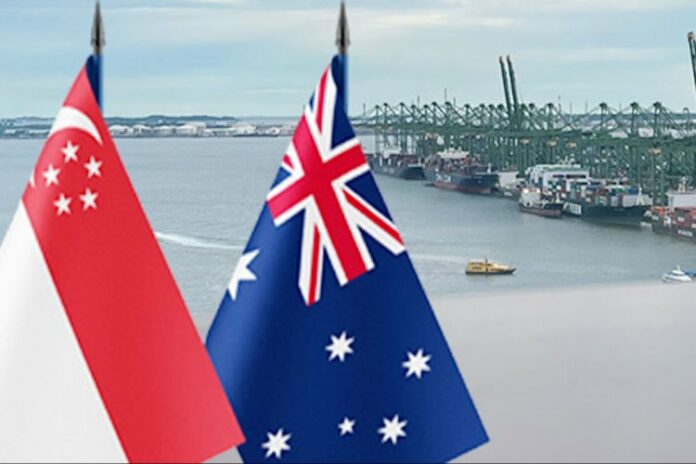
Singapore and Australia have signed a Memorandum of Understanding (MoU) to formally collaborate on establishing the Singapore-Australia Green and Digital Shipping Corridor (GDSC).

Signed by Mr Chee Hong Tat, Singapore’s Minister for Transport and Second Minister for Finance and the Hon Catherine King MP, Australian Minister for Infrastructure, Transport, Regional Development and Local Government, the MoU will accelerate maritime decarbonisation and digitalisation.

Under the MoU, both countries will work with interested partners to explore opportunities to develop zero or near-zero greenhouse gas (GHG) emission fuel supply chains for the maritime industry, including building necessary infrastructure, formalising standards, and developing and implementing the training requirements.

The MoU will also explore facilitating digital information exchange to enable efficient port clearance, port calls and flow of vessels between Singapore and Australia, and facilitate collaboration between the Maritime and Port Authority of Singapore (MPA), Australian federal, state and territory governments, as well as industry stakeholders.

Australia holds great potential to be a key producer of green marine fuels, and Singapore is the world’s largest bunkering and busiest transshipment hub port with a vibrant research and innovation ecosystem.

The collaboration is expected to help catalyse the development and uptake of zero or near-zero GHG emission technologies and the adoption of digital solutions to enhance the resilience, efficiency and sustainability of global maritime supply chains.

Singapore’s Minister for Transport Mr Chee Hong Tat said:

“The MoU affirms the shared commitment of Singapore and Australia to pool our expertise and resources to develop scalable green and digital solutions for the maritime sector, and upskill our workforce to support the energy transition.”

Australian Minister for Infrastructure, Transport, Regional Development and Local Government Catherine King, said:

“This is an important partnership for a sustainable global maritime future. Australia is committed to supporting the decarbonisation of international shipping, which plays an important role in economies across the globe.

“This collaboration will place Singapore and Australia amongst the leaders in contributing to the international maritime community’s objectives, while supporting Australia’s exports of clean renewable energy.”

Dutch shipyard Padmos introduces multifunctional fishing “vessel of the future”

0

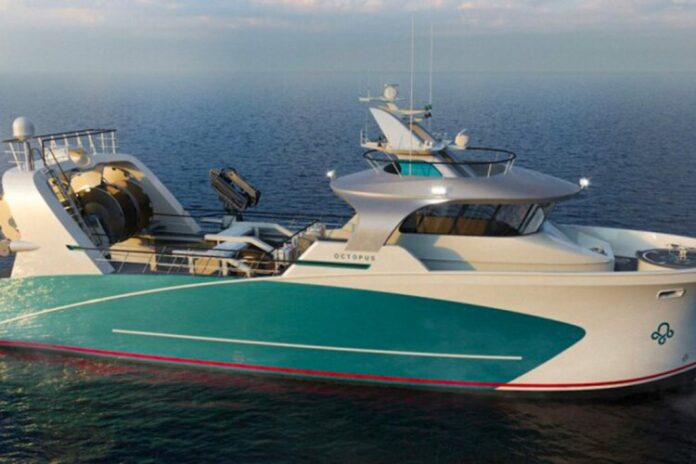
Dutch shipyard Padmos has shared the first images of its multifunctional Octopus project, which it is touting as a fishing “vessel of the future.”

Walter van Harberden, a naval architect and one of the directors of the shipyard, led the development of the Octopus, which has diesel-electric-powered engines that can be converted so it is entirely powered by another energy source thanks to the vessel’s modular structure. The boat will have a bare hull with removable containers for storing batteries or hydrogen, according to Hook and Net Magazine.

“Like a real octopus, the vessel will have several strings to its bow. It can be adapted to different fishing techniques: fly-shooter, single-trawl, or twin-rig trawl,” he said. “The containers will allow fish to be chilled or frozen, and unloading products will be less tedious thanks to the use of a crane.”

The vessel’s modularity will also enable it to be used for storage or other uses in the fishing offseason, according to van Harberden.

“When the fishing season is over, we can replace the containers for storing fish with containers for other types of equipment,” he said.

The construction of the first Octopus will begin August 2024, with Jacob Brands, a Dutch fisherman, having placed the first order. Brands’s project will cost around EUR 6 million to EUR 8 million (USD 6.5 million to EUR 8.7 million) for the almost 100-foot vessel, depending on his chosen features. 

The Padmos Shipyard specializes in the construction of fishing boats and repairs on fishing vessels and workboats and previously developed the cutting-edge E-Pusher 1 – the first modular, zero-emission, all-electric inland waterway tugboat. Padmos Managing Director Leon Padmos said the Octopus project gives him hope that the fishing industry can stay relevant and profitable in a fast-changing world.

“It’s very futuristic, and it’s a modular and tailor-made boat,” Padmos Managing Director Leon Padmos said. “We like innovation. If possible, we always stay one step ahead.”

Padmos said the Dutch government is reviewing the Octopus design, and he’s hoping to gain full approval and backing for the project soon.

“Discussion with the Dutch authorities are ongoing, knowing that the fishing industry is changing and that the industry needs to find answers to concerns such as the shortage of resources and the ecological transition,” Padmos said. “There will always be fishing activity.”

Source: seafoodsource

Sientists believe aquaculture needs its own specialised robotics

0

Norway is world leading in the use of robotics in the fish farming industry. But how does the technical equipment affect the fish? 

Surprisingly much, says cyberneticist Eleni Kelasidi.

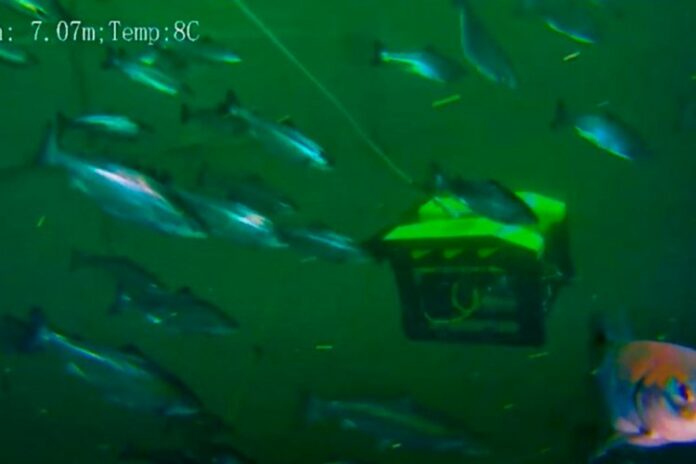
“I thought it would be quite simple and straight forward to use the same technology in aquaculture as in oil and gas, but I got a serious wake-up call during my first visit to a fish farm,” says Eleni Kelasidi. She had a PhD in snake robotics for the oil and gas industry, when she became a researcher at SINTEF Ocean’s aquaculture department.

“I didn’t really understand how much it changes the premises for operations that everything is moving and that the work area is full of living animals. It’s completely different having a robot work in the open sea with stagnant, dead metal on pipelines or turbines,” she explains. After robotics made its way into the fish farming industry, aquaculture has largely adopted equipment developed for the oil and gas industry. Kelasidi believes aquaculture needs its own specialised robotics and has researched which solutions are least disturbing to the fish.

The fish’s own safety distance

“When we talk about interaction between humans and robots, it goes without saying that human needs and safety have the highest priority. The same principle forms the basis of the Fish-Machine Interaction project. We want to contribute to better robots that can work quickly and efficiently, but they must of course take the fish’ needs and safety into account,” she says.

Eleni Kelasidi, PostDoc Qin Zhang from NTNU and the rest of the team, have collected and analysed data in various fish cages associated with SINTEF ACE over a three-year period. They have collected data from different locations, at different times of the year and life stages of the fish.

“We have conducted several different measurements per case, so we have an extensive data collection,” says the senior researcher.

The study provides some very clear answers, including how large a safety distance the fish keeps to an object.

“The ratio between the size of fish and the distance they keep to foreign objects is actually linear, which surprised us all. The smaller the fish, the smaller the distance,” says Kelasidi.

Equipment that is lowered into the water blocks more volume than the actual equipment itself; and the safety distance that the fish keep, has consequences for how cramped the cage becomes during various operations. Based on this study, breeders can know which distance the fish will keep to the equipment they put down. Five-kilo fish for example, keep a distance of three metres. The fact that younger and smaller fish operate with a more modest safety distance means in practice that more equipment can be placed in the cage for young fish without affecting their swimming routines and behaviour, compared with older fish.

Colour, size, speed and sound are important

“When we know what disturbs or affects the fish, we can say something about which adaptations technology producers should make,” says Kelasidi, who has found out more about what the fish reacts to and what it overlooks. The researchers made objects in different shapes, colours, and sizes, to see and quantify any changes in the fish’s response. It turns out that shape does not matter: the fish reacts the same way whether it is a cylinder or a cube.

However, they keep a greater distance to large objects than to small ones, and they keep a greater distance to yellow equipment than to white. Colour and size are therefore important factors. As is sound and speed, as previous studies have shown.

“We hope technology providers will make use of this knowledge when they develop new equipment. For us researchers, the next goal is to develop technology that enables autonomous robots to adapt their behaviour to the fish’s reactions, to disturb the fish as little as possible. If, for example, the robot’s sensors pick up that fish are avoiding the robot or show something that the robot can recognize as changed behaviour and therefore a potential stress factor, it can slow down and operate in a less disruptive manner for the fish,” Kelasidi explains.

Self-adapting robots

“Today, we don’t know if it is stress-related that the fish swim away from the equipment, or if it can be compared to children who, in a game of tag, run away from the chaser. We need more research,” says Kelasidi, but points out that it is useful to know what behavioural response the fish have to various elements.

If you need to do work in the fish cage that requires that the fish keeps its distance, it is useful to know which colour makes them stay away. And if you want to come close to them, perhaps with a camera, it is good to know which colour make them feel comfortable.

So far, the researchers have only tested yellow and white, because these are the colours used on today’s equipment. In coming research, they will also investigate how the fish reacts when the robot turns or moves, how speed affects it, and whether it makes any difference whether the movement is horizontal or vertical, or with or without light. Kelasidi’s goal is to carry out autonomous robot operations with as little disturbance as possible. 

“The Norwegian aquaculture industry is a pioneer in adopting technology, and we hope to contribute with knowledge that enables the industry to continue to maintain its position as a world leader in the field. Robotics that takes fish welfare into account does not touch upon the most pressing problem facing the industry today, but it lays the foundation for better fish welfare in future aquaculture,” says Kelasidi.

The research project is funded by the Research Council of Norway, and SINTEF and NTNU have worked closely together to develop new knowledge that may be relevant to current and future challenges in the aquaculture industry.

Norwegian Hydrogen establishes large hydrogen production facility at Port of Hirtshals

0

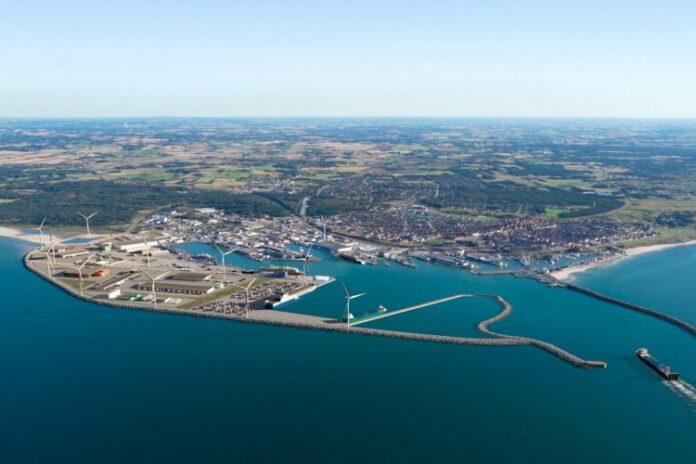
The Norwegian company Norwegian Hydrogen will establish a hydrogen production facility at Port of Hirtshals. This comes after a consortium received a grant of approximately DKK 67 million from the EU’s research and innovation programme Horizon Europe. The goal is to produce at least 500 tonnes of green hydrogen per year.

Norwegian Hydrogen will lead the CONVEY project, aiming to establish an integrated hydrogen ecosystem at Port of Hirtshals. The project will utilize renewable energy from local wind turbines to produce green hydrogen, thereby contributing to carbon removal from energy production. The project includes the construction of a 5 MW electrolysis plant, a large refuelling station for heavy transport, and distribution networks for hydrogen, oxygen, and heat. By focusing on circularity principles, the project ensures that all elements of the process are efficiently and sustainably utilized.

“Norwegian Hydrogen is setting a benchmark for the development of green hydrogen development in the Nordic region. Through the CONVEY project, we aim to significantly contribute to the transition towards a low-carbon economy throughout in the entire region, reinforcing our commitment to innovation and environmental stewardship in the hydrogen sector,” says Jens Berge, CEO of Norwegian Hydrogen

Port of Hirtshals has been working towards establishing hydrogen production on-site, and it is therefore particularly gratifying that Norwegian Hydrogen will build a facility at the port.

“We have a clear ambition to become a hub for the production and consumption of green energy. Therefore, the establishment of a large hydrogen facility at the port aligns perfectly with our strategy. The agreement with Norwegian Hydrogen signifies another step towards becoming the greenest port in Europe”, says Per Holm Nørgaard, CEO of Port of Hirtshals.

In addition to Norwegian Hydrogen and Port of Hirtshals, several other partners are involved in the collaboration on hydrogen production project in Hirtshals. Each partner will contribute their expertise in hydrogen production, logistics, transport, and energy system optimization.

At the EU’s Clean Hydrogen Partnership, which aims to accelerate the development and implementation of green hydrogen technologies in Europe, there are also high expectations for the new facility in Hirtshals and the interdisciplinary collaboration. The experiences gained from Hirtshals will be leveraged for similar projects in the future.

Port of Hirtshals is actively planning for the upcoming port expansion, aiming to attract more companies specializing in the production of environmentally friendly fuels for shipping, Power-to-X, or other green technologies.