-7.5 C
New York
Home Blog Page 182

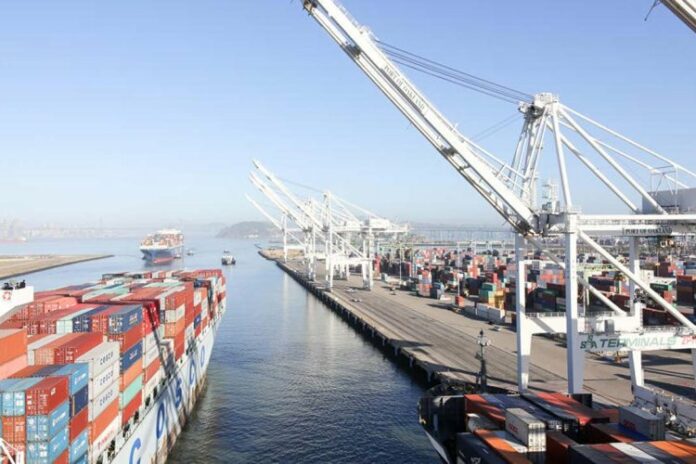
Port of Oakland celebrates hydrogen-powered trucks project

0

The NorCAL ZERO project is a $53 million collaborative effort to deploy 30 Hyundai XCIENT Class 8 hydrogen fuel cell electric trucks (FCETs) in Northern California.

The trucks, which have a range of more than 400 miles on a single fill of hydrogen, primarily operate in drayage service hauling freight and cars to destinations in the Bay Area and the Central Valley.

“The Port of Oakland is pleased to be a part of this innovative, clean energy project that puts Oakland at the forefront of addressing global climate change,” said Port of Oakland Executive Director Danny Wan. “This hydrogen fuel station and these fuel cell trucks represent a strong option for the future of trucking in California. They also support our efforts toward a zero emissions seaport.”

The NorCAL ZERO project introduces the Hyundai XCIENT Class 8 FCET into the U.S. market. Hyundai Motor Company designed and manufactured the vehicles, which are operated by G.E.T. Freight, a division of Glovis America, hauling Port of Oakland containers and Port of Richmond vehicles.

The trucks refuel at the recently opened, high-capacity and high-throughput liquid hydrogen fueling station built and operated by FirstElement Fuel. The hydrogen station has a storage capacity of 18,000 kilograms, which will support more than 200 trucks a day.

Funding for the project includes:

  • $11.98 million from California Air Resources Board’s (CARB’s) California Climate Investments Program;
  • $9.89 million from the California Energy Commission’s (CEC’s) Clean Transportation Program;
  • $3.64 million from Alameda County Transportation Commission (ACTC)’s Clean Freight Program; and
  • $3.36 million from the Bay Area Air Quality Management District (BAAQMD).

Papé Trucks maintains the trucks at its San Leandro facility, where technicians receive in-depth training from Hyundai on how to service the trucks. With engineering and design support from the Fiedler Group, Papé Trucks also upgraded its maintenance facility with hydrogen detection and ventilation equipment to safely service the trucks.

Additionally, the University of California, Berkeley, and the West Oakland Environmental Indicators Project are helping with data collection, community outreach efforts, and communication.
Valenciaport runs pilot test for RENEWPORT

0

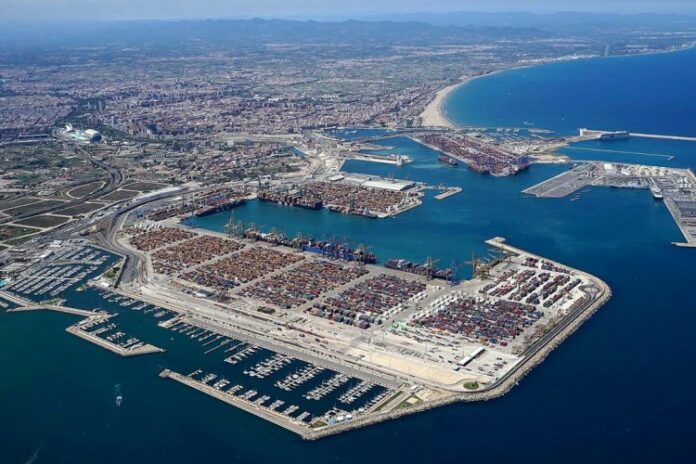
The European project RENEWPORT (Harnessing RENEWable energy potential for clean energy transition of MED PORTs) is already underway in the Valencian docks.

The participation of the Port Authority of València (PAV) consists of the installation of innovative renewable energy generation systems for self-consumption in the port of Valencia. These innovative systems use existing free surfaces in the port for their “energisation” through the installation of solar panels.

From this pilot test and once the results of the implementation of the installation are obtained, it will be possible to obtain the knowledge for the massive implementation of this technology both in the ports managed by the PAV and by the other ports participating in the RENEWPORT project, as well as other ports outside the Euro-Med environment.

The PAV’s budget for this project is 280,000 € and will last until 2026.

The Port Authority of València is part of the RENEWPORT project together with other partners from Italy, France, Slovenia, Croatia, Montenegro, Albania and Greece. This project, whose first meeting was held on 26 January this year, is funded by the European Union through its Interreg Euro-Med programme and has a budget of €2,995,300.

In addition to the Valenciaport Foundation, the PAV and the Autorità di Sistema Portuale del Mare Adriatico, 7 other entities participate in the RENEWPORT project: Autorità di Sistema Portuale del Mar Tirreno Settentrionale, Chambre de commerce et d’industrie du Var, Port of Koper, Port Authority of Rijeka, Port of BAR JSC, Durres Port Authority and Piraeus Port Authority.

Ukrainian Navy tells how it named two Estonian boats handed over to Ukraine

0

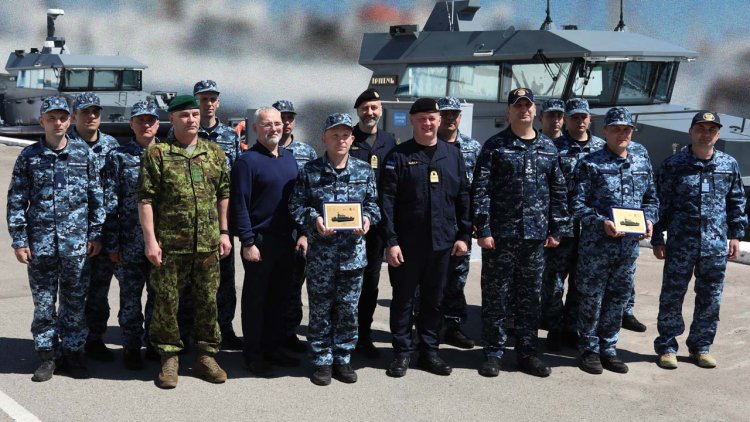
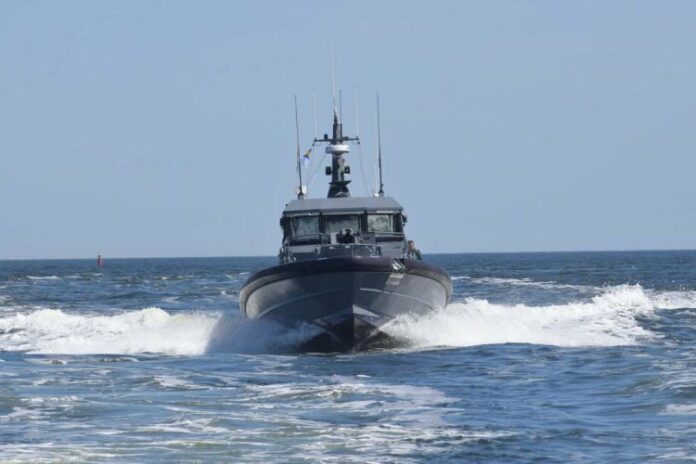
Two boats donated by Estonia have been commissioned into the Ukrainian Navy: they were named in honor of the Ukrainian hero city of Irpin and the city of Reni, whose port is closest to the Republic of Estonia

This was reported by the Ukrainian Navy. 

It is stated that the boats Reni and Irpin, which were previously named P01 Roland and P02 Risto, raised the naval flags of the Ukrainian Armed Forces. The ceremony was attended by the Commander of the Ukrainian Navy Vice Admiral Oleksiy Neizhpapa, sailors and the Estonian delegation led by Commodore Jüri Saska, Commander of the Estonian Navy.

“The names of the boats P01 Roland and P02 Risto, which were handed over to Ukraine this year in excellent condition, almost new, by the Estonian Navy, were assigned by order of the command of the Ukrainian Navy in honor of the hero city of Irpin and the city of Reni, whose port is the closest to the Republic of Estonia,” the statement said. 

The 17.25 m long boat is powered by two Volvo Penta D13-1000 diesel engines, providing a top speed of 33 knots (61 km/h).

The Irpin and Reni boats will perform combat missions, including the protection of civilian shipping.

Sources: Espreso, Militarnyi

Renewable energy project powers Port of Long Beach with hydrogen

0

The Tri-gen system uses biogas to produce renewable electricity, renewable hydrogen, and usable water, and was built to support the vehicle processing and distribution center for Toyota Logistics Services at Long Beach, Toyota’s largest North American vehicle processing facility, which receives approximately 200,000 new Toyota and Lexus vehicles annually.

“FuelCell Energy and Toyota’s collaborative effort signifies technological innovation and also positions Long Beach at the forefront of global leadership in renewable energy solutions,” said Long Beach Mayor Rex Richardson. “This transformative initiative solidifies our city’s status as a trailblazer in green initiatives and shows our dedication to a cleaner, more sustainable future for our community and beyond.”

“The dawn of the renewable hydrogen era is upon us, thanks to our collaboration with Toyota, FuelCell Energy and their innovative Tri-gen system,” said Port of Long Beach CEO Mario Cordero. “The green power generated by the Tri-gen system, and similar projects, is part of our multilayered strategy to fuel our goal to become the world’s first zero-emissions Port.”

FuelCell Energy’s Tri-gen system opened last fall, producing green hydrogen, renewable electricity and usable water converted from biogas at California landfills.

The system is capable of generating up to 1,200 kg/day of hydrogen for fuel cell electric vehicles – the Toyota Mirai – imported to the terminal, and to supply an adjacent hydrogen refueling station to support Toyota Logistics Services and heavy-duty drayage trucks operating in the port complex.

“The goal of our collaboration with FuelCell Energy was to find sustainable solutions for the TLS vehicle processing facility here at the Port of Long Beach as part of our goal to remove carbon dioxide emissions from our operations,” said Group Vice President of Sustainability and Regulatory Affairs at Toyota Tom Stricker. “This groundbreaking facility shows that there are ways to reduce our emissions and burden on natural resources with scalable technology based on hydrogen.”

The water byproduct of hydrogen generation can produce up to 1,400 gallons of usable water, which is being repurposed for Toyota’s car wash operations for vehicles that come into port before customer delivery, helping to reduce the demand on local water supplies by approximately half a million gallons per year.

The combustion-free process is a first of its kind nationally, reducing more than 9,000 tons of carbon dioxide emissions and avoiding 6 tons of nitrogen oxide emissions.

“Tri-gen demonstrates that hydrogen-based energy benefits businesses, delivers zero-emission transportation for light- and heavy-duty transportation, supports improved air quality in local communities, reduces water usage, and delivers immediate and long-term benefits to the environment,” FuelCell Energy CEO and President Jason Few said. “As a company, we are living our purpose when we enable visionary customers like Toyota to decarbonize their operations and harness the energy solutions offered by hydrogen — all while leaving communities with cleaner air and easing the strain on power grids and water supplies.”

Van Oord’s heavy lift installation vessel reaching for the sky

0

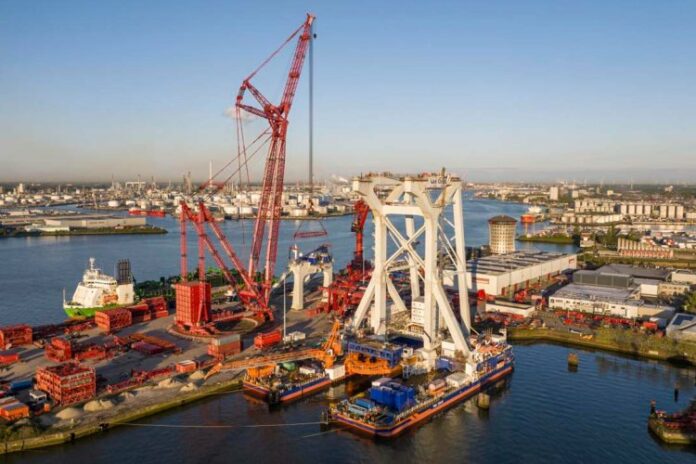
The operation increased the total height of the Svanen to 125 metres, making it one of the largest heavy-lift vessels in the world. 

The extension had been constructed by Holland Shipyard. One of the largest cranes in the world was used for the installation at Mammoet Schiedam. Besides the gantry extension, the upgrade includes a modernisation of the lifting hooks that will increase the lifting capacity of the vessel from 3,000 tonnes to 4,500 tonnes, an improvement of the gripper to handle increased loads and a modification of the structure of the vessel to accommodate the latest hammer size. The improved Svanen will be ready for operation in the third quarter of 2024. 

Due to the worldwide demand for renewable energy, wind farm technology is progressing swiftly, with turbines continually increasing in size. This major upgrade is preparing the Svanen to handle the next generation of monopile foundations for offshore wind projects.

Marco Hoogendoorn, Commercial Director at Holland Shipyards:

‘We are immensely proud to have constructed one of the largest steel structures in our history for the extension of Van Oord’s Svanen, including the provision of new accommodation units. This project required not only exceptional precision in engineering but also presented us with significant logistical challenges. Thanks to the extraordinary dedication and collaboration of all teams involved, we have successfully realised this technical milestone. We are honoured to have played a crucial role in enhancing the capabilities of the Svanen, thereby contributing to the future of renewable energy and offshore wind projects.’  

Maarten Loman, Project Manager Svanen modification at Van Oord:

‘I’m proud to be part of a dedicated project team giving the Svanen yet another life. Originally deployed for bridge construction, the vessel has been contributing to offshore wind construction since the start of the energy transition. Following a significant upgrade in 2017, it is now undergoing further enhancements to continue installing many more foundations for offshore wind farms in the years ahead.’ 

Five European countries open their doors to cross-border CO2 storage

0

Carbon capture and storage is a tool that can capture some of the emissions that are very difficult to prevent – and capturing those emissions is necessary in order to reach European climate goals. That makes carbon capture and storage an essential climate tool.

In 2021, Norway and the Netherlands signed an arrangement on energy cooperation around the North Sea, including carbon capture and storage. Similar arrangements are in place between Norway and Belgium (2022) and Denmark (2023), as well as a joint declaration with Sweden in 2022. In addition, in 2022 and 2023 Denmark, Belgium (the Federal State, Flanders and Wallonia) as well as Netherlands signed arrangements for the transport and storage of captured carbon across borders.

On April 15, Denmark, Belgium, the Netherlands and Sweden each established an arrangement on cross-border transport of CO2 with Norway. Sweden and Denmark concluded a similar arrangement, too. This removes some of the obstacles on the way to a well-functioning carbon capture and storage-market in the wide North Sea region.

In order to decarbonize hard-to-abate sectors, we need carbon capture and storage. In order to reach climate neutrality by 2050 in Europe, we need carbon capture and storage in a larger, international scale. Today’s arrangements are two great steps in the right direction. It’s all hands on deck – and I’m glad to see both Norway and Sweden joining our work towards an international industry for carbon capture and storage – said Danish Minister for Climate, Energy and Utilities Lars Aagaard.

Beside extensive mitigation, the capture and storage of CO2 will be necessary to curb the climate crisis. CCS and BECCS will play a key role towards EU:s objective for climate neutrality 2050 and negative emissions thereafter. Sweden has a great potential för BECCS and we already have projects underway. These agreements are essential for Sweden and its industry in realizing a fossil free future – said Sweden’s Minister for Climate and Environment Romina Pourmokhtari.

Several Baltic ports are involved in projects related to the storage and transport of liquid CO2 and that this is a potential business area in which the ports will be involved. For some industrial sectors, such as cement production, Co2 capture and storage is the only path to decarbonization.

Trafigura orders four dual-fuel ammonia powered vessels from HD Hyundai Mipo Dockyard

0

The vessels will be built at HD Hyundai Mipo Dockyard in Ulsan, South Korea.

The vessels will carry LPG or ammonia and the first ship will be delivered in 2027. Each vessel, when delivered, will be equipped with a dual-fuel low-carbon ammonia engine, supporting Trafigura’s commitment to reduce the carbon intensity of its own shipping fleet by 25 percent by 2030.

As a member of the Global Maritime Forum’s Getting to Zero coalition and a founding member of the First Movers Coalition, Trafigura is also committed to helping to develop the low-carbon fuels and vessels required to decarbonise global shipping. Today’s announcement marks an important next step in these efforts.

“We are excited to embark together with HD Hyundai Mipo on this ambitious project which supports our commitments to decarbonising shipping and will help us to develop the global low-carbon ammonia bunkering infrastructure needed for zero-carbon shipping to become a reality,” said Andrea Olivi, Head of Wet Freight for Trafigura.

Trafigura is one of the world’s largest charterers of vessels, responsible for more than 5,000 voyages a year with around 400 ships currently under management. The company has led the industry in calling for a global price on carbon to reduce emissions and is continually looking for ways to further reduce emissions from its fleet.

The company is one of the few operators to have tested a full range of alternative shipping fuels including LNG, methanol, LPG and biofuels on its owned and chartered vessels. It has co-sponsored the development of a two-stroke engine by MAN Energy Solutions that can run on green ammonia and is also investing in on-board carbon capture technology.

Investments are also being made in wider efficiency measures such as silicone hull coating, wake equalising ducts, ultrasonic propeller antifouling technology, and continuous underwater hull cleaning and propeller polishing.

Trafigura is a founding member of the Sea Cargo Charter, an industry coalition established to collect, assess and report shipping emissions, a key member of the Global Maritime Forum’s Getting to Zero coalition and a founding member of the First Movers Coalition.

GHG Emissions quantification project completed at FPSOs in Brazil

0

MODEC and JGC Corporation have announced the completion of a project to measure and quantify emissions of methane and other greenhouse gases (GHG) from floating production, storage, and offloading systems (FPSO) off the coast of Brazil, chartered and operated by MODEC1. 

This represents a significant milestone for both companies, and this is the first time that Japanese companies gain precise insights into the amount of major GHG emissions from methane, nitrous oxide, and hydrofluorocarbons (HFCs) from active FPSOs.

Project background

In its Mid-term Business Plan 2024-2026, MODEC states that one of the initiatives under Vision 2034 is to be the world’s best FPSO builder and operator, achieving the smallest carbon footprint alongside safety and high uptime. As a first step in decarbonizing the MODEC’s core FPSO business, MODEC is actively involved in measuring and reporting FPSO GHG emissions. In addition to carbon dioxide emissions, this project also addresses methane, nitrous oxide2, and HFCs, which have a very high greenhouse effect.

JGC Corporation is engaged in mitigating GHG emissions from oil and gas production facilities in part by leveraging technical engineering expertise and extensive plant construction experience to provide HiGHGuard® GHG emissions measurement service for methane and other GHGs using the MRV3 methodology. In the absence of globally standardized measurement methods, JGC offers highly reliable measurement and quantification in line with plant operations and these conditions, as well as low-carbon/decarbonized solutions based on this knowledge.

Building upon this expertise, MODEC and JGC Corporation have decided to combine their strengths to implement a project aimed at accurately identifying methane, nitrous oxide, and HFCs emissions from FPSOs.

Project overview

A quantification of emissions of the three GHGs – methane, nitrous oxide and HFCs – was carried out from July to September 2023 at two MODEC-chartered FPSOs off the coast of Rio de Janeiro.

While the need for emission prevention measures, particularly for methane, has increased in recent years, methane emissions vary widely from facility to facility, and because desktop calculations with common coefficients are not accurate enough; there has been a strong international recommendation that emissions should be determined by actual measurements. 

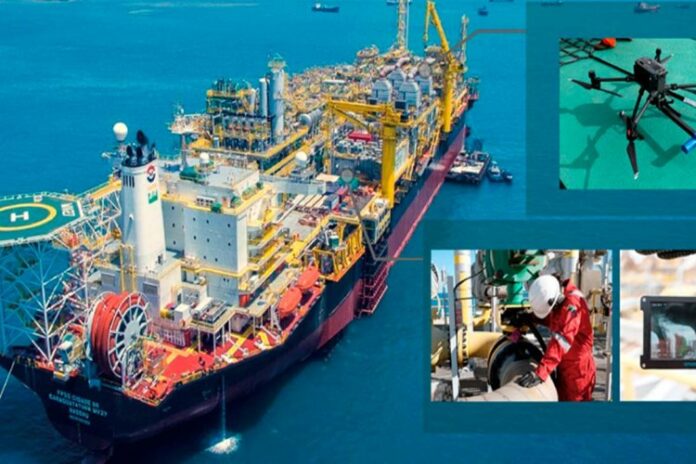
Therefore, MODEC and JGC selected two methods of on-site measurement: a bottom-up approach using hand-held sensors and infrared cameras, and a top-down approach using drones (See Figure. 1 below). The bottom-up approach measures approximately 15,000 potential methane emission points in the FPSO, and the latter approach captures the methane potential of plant-wide emissions from flying the drones around the FPSOs.

Some examples of project results are as follows:
 ・ Determination of methane and other GHG emission levels with much greater precision than conventional desktop calculations.
 ・ Establishment of a highly reliable methodology for measuring methane emissions by combining multiple measurement technologies.
 ・ Identification of individual methane emission points on FPSOs, with results leading to specific emission prevention measures.

DARPA’s autonomous ‘Manta Ray’ drone can glide through ocean depths undetected

0

Engineers have assembled an autonomous underwater drone that the U.S. Defense Advanced Research Projects Agency (DARPA) plans to use for long-range missions in the ocean, pictures show.

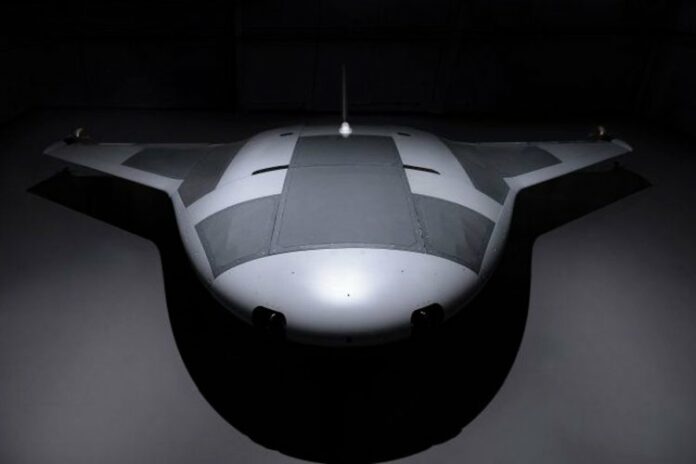
Dubbed “Manta Ray,” the drone is modeled after filter-feeding fish of the same name with diamond-shaped bodies and wing-like fins. The prototype, designed and built by the aerospace and defense company Northrop Grumman, is an extra-large glider capable of operating long-duration, payloaded missions without needing on-board human support and maintenance. 

Once deployed, the drone could also save energy by anchoring itself to the seabed and hibernating in a low-power mode.

“I’m excited to repost one of the first pictures of Manta Ray fully assembled in our Annapolis facility,” Todd Leavitt, the vice president of naval and oceanic systems at Northrop Grumman, wrote in a LinkedIn post resharing the company’s announcement. 

DARPA launched the Manta Ray program in 2020 to improve underwater vehicle design, including developing techniques to increase payload capacity and conserve energy. The agency initially selected three contractors — Northrop Grumman, Martin Defense Group LLC and Metron Inc. — but the latter dropped out in late 2021. Since then, Northrop Grumman and Martin Defense Group LLC have each developed unique prototypes of the drone for in-water demonstrations and testing.

Northrop Grumman’s Manta Ray prototype integrates several unique features to support DARPA’s vision of creating “strategic surprise,” the company said on its website. These include autonomy, carrying capacity for equipment to support different missions, energy-saving functions and modularity — meaning the design can be taken apart and reassembled. The drone also fits into five standard shipping containers, meaning it can be transported and deployed worldwide.

Source: Live Science

Tristar Eships’ vessels to benefit from Wärtsilä’s Decarbonisation Services

0

Wärtsilä’s Decarbonisation Services will initially be applied to two tankers in the company’s fleet and is tailored to create a significant reduction in their carbon emissions.

“We are committed to finding efficient solutions to reduce our emissions footprint. Wärtsilä’s Decarbonisation Services is an important tool in helping us achieve this goal. Partnering with Wärtsilä will increase our depth of knowledge and understanding of the technologies required to raise efficiency levels, and therefore reduce emissions,” says Tim Coffin, CEO of Tristar Eships.

When it comes to decarbonising operations in the marine industry, there are many challenges around selecting and employing the right solutions and technologies efficiently, economically and at the right time. Wärtsilä’s Decarbonisation Services involve a careful analysis of a ship’s operating profile, following which recommendations are made as to how efficiency and energy saving improvements can be made.

The analysis to be undertaken for the first two Tristar Eships vessels, includes Wärtsilä’s EnergoFlow, EnergoProFin, optimised propeller, shaft generator and the capability to operate on biofuel.

“With increasing pressure to decarbonise, knowing which solutions and technologies will deliver the most cost-optimal route to decarbonisation today, and in the future, is important,” comments Rajan Khanna, Head of Sales, Middle East – Wärtsilä Marine. “Our Decarbonisation Services are an integral part of our overall decarbonisation strategy, meaning we can best support customers, like Tristar Eships, with effectively managing their carbon footprint.”

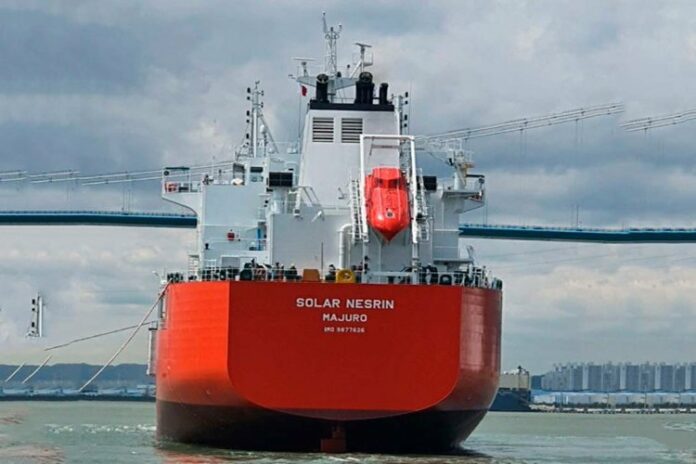
The two vessels to benefit from Wärtsilä’s Decarbonisation Services are the ‘Solar Nesrin’ a 169-metre long chemical tanker, and the ‘Silver Muna’, a 183-metre long oil tanker.