-3.8 C
New York
Home Blog Page 177

Hy2gen and OCE to collaborate on GW-scale hydrogen projects

0

Hy2gen USA Inc., the US subsidiary of global green hydrogen producer Hy2gen, and offshore wind energy developer, Ocean Connect Energy Inc. (OCE), have executed a Memorandum of Understanding (MoU) for the mutual investigation of the potential to power renewable hydrogen production from offshore wind. 

The MoU formalises a collaboration between the two companies to identify, evaluate, and develop favourable locations to power Hy2gen’s renewable hydrogen and e-fuel production from the gigawatt-scale offshore wind energy generation that OCE develops in the USA and worldwide. 

Hy2gen and wind energy experts OCE have formed a 10-month working group to identify and mature high-capacity offshore wind energy areas where project development may be held back by constrained grid transmission, low electricity demand, or other factors.

“Where green hydrogen production can be built near the point of interconnect from offshore wind energy generation, we have the potential to create predictable and lasting demand for the energy. This makes the need for new grid transmission less urgent and the need for infrastructure investment less substantial, while accelerating wind energy project execution,” said David White, president of Hy2gen USA Inc. “Green hydrogen can change the paradigm of where offshore wind is developed,” added Kevin Banister, chief executive officer of Ocean Connect Energy. 

The research is part of Hy2gen’s strategy embracing the clean hydrogen regulatory framework established by the 2022 Inflation Reduction Act and subsequent guidelines anticipated from U.S. Dept. of Treasury. Hy2gen is committed to producing renewable fuels meeting the highest standards established for the new industry. To address the three pillars of temporality, additionality, and regionality, integrated co-development of offshore wind energy projects and power-to-X projects provide a solution.

“With its high capacity factor and ability to be built at scale, offshore wind can deliver an excellent energy profile to match the electricity demand of the next key element of the energy transition: green hydrogen production,” said Banister. “Done right, pairing the two can result in efficient project development and capital allocation.” 

Through its global subsidiaries, Hy2gen has set out to become the largest and most reliable renewable hydrogen fuel provider—a powerful accelerator of green transformation. 

“We have a tremendous prospect in our work with Ocean Connect Energy,” White affirmed. “We have laid out concrete benchmarks and time frames to motivate and monitor our progress together. We’re intent on bringing our projects to life as soon as possible.” 
MOL names first of six newbuilding LNG carriers at Chinese shipyard

0

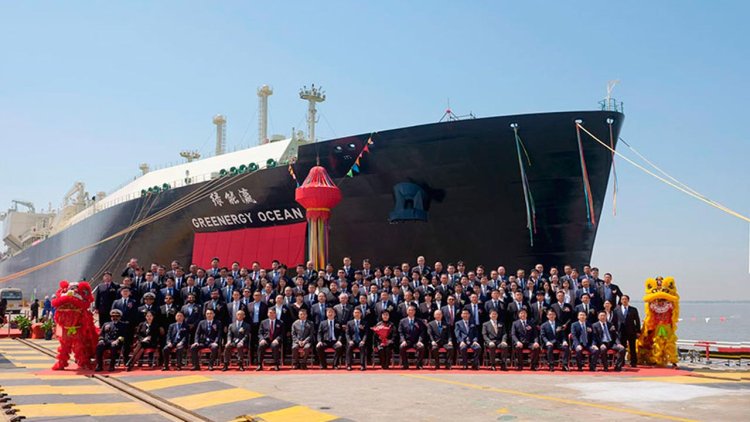
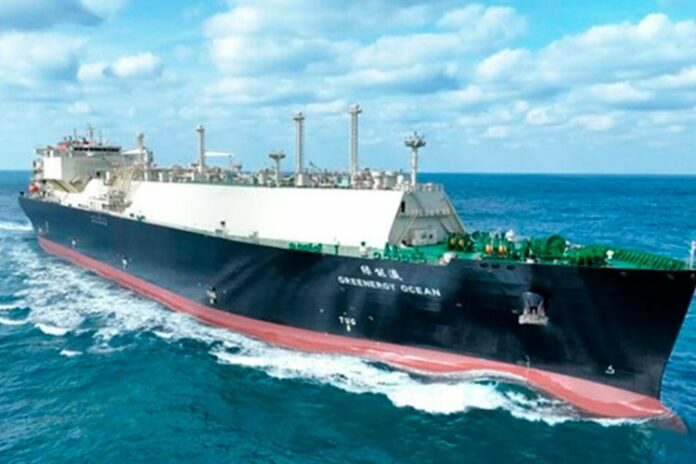
MOL has announced that on May 15 it held a naming ceremony for a newbuilding LNG carrier, the Greenergy Ocean, for CNOOC Gas & Power Singapore Trading & Marketing Pte., wholly-owned by China National Offshore Oil Corporation (CNOOC).

The vessel was named “Greenergy Ocean” while many people who attended the ceremony watched. “Greenergy” is a coined word combining “Green” and “Energy,” and conveys the desire to contribute to the realization of a low-carbon society through safe, reliable transport of LNG.

This is the first vessel to be launched under a long-term charter contract for six newbuilding LNG carriers for CNOOC signed in January 2022 (Note), jointly owned by MOL, CNOOC, and COSCO SHIPPING LNG Investment (Shanghai) Co., Ltd. After delivery at the end of May, the vessel will transport LNG procured by the CNOOC Group from all over the world, mainly to China. The remaining five vessels are scheduled to be delivered in succession between 2024 and 2026.

Under its “BLUE ACTION 2035” management plan, the MOL Group has been promoting a business portfolio transformation that will enable it to increase the weight of businesses with stable earnings and ensure profitability even during downturns in the shipping industry, and the expansion of its LNG fleet, including this project, is part of the group’s initiative. This is also in line with the “MOL Group Environmental Vision 2.2,” which aims to achieve net zero greenhouse gas (GHG) emissions by 2050, and with the group’s aim for “Expansion of low-carbon and decarbonized businesses through the collective strengths of the MOL Group.”

MOL and TotalEnergies sign time charter contracts for two newbuilding LPG carriers

0

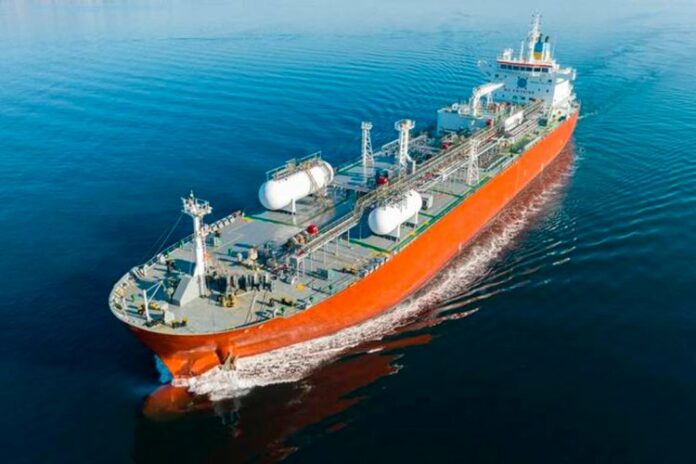
Mitsui O.S.K. Lines have announced that through its group company MOL Energia Pte. it signed a time charter contract for two liquefied petroleum gas (LPG) dual-fuel very large gas carriers (VLGCs) with a subsidiary of TotalEnergies, CSSA Chartering and Shipping Services SA (CSSA). 

The vessels will be built by Hyundai Samho Heavy Industries Co., Ltd. in South Korea and are scheduled for delivery in 2026.

The dual-fuel vessel can run on either LPG or conventional heavy oil, and when LPG is used as fuel, CO2 emissions can be reduced by about 20% and sulfur oxides (SOx,) particulate matter (PM), and so on by about 90% compared to heavy oil. In addition, the specifications allow for the transport of ammonia as well as LPG. Ammonia, which emits no carbon dioxide during combustion, is expected to increase in demand in the future as a next-generation clean energy source.

MOL has built a strong relationship with TotalEnergies in many fields, including the transport of marine fuel oil and long-term charter contracts for LNG carriers and LNG bunkering vessels. It will build an even stronger partnership with TotalEnergies through the conclusion of this charter contract.

Saipem awarded a new offshore contract by Azule Energy for Ndungu Field Project

0

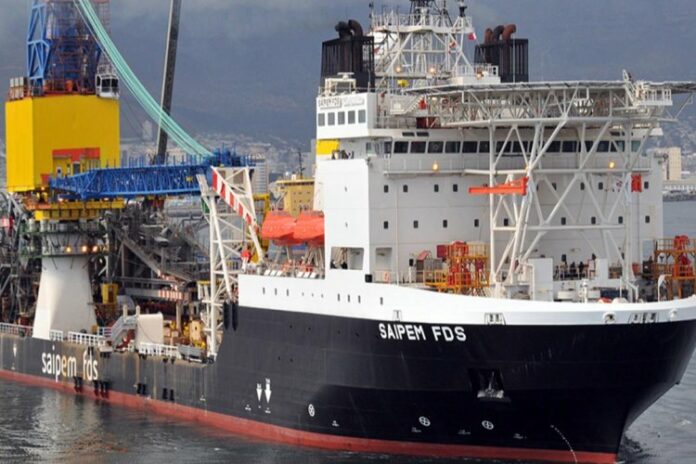
Saipem has been awarded a new offshore contract by Azule Energy Angola S.p.A., subsidiary of Azule Energy Holdings Limited, an incorporated joint venture between Eni and bp, for the development of the Ndungu Field as part of Agogo Integrated West Hub Project, located approximately 180 km off the coast of Angola. 

The value of the contract is around 850 million USD.

Saipem’s scope of work entails the engineering, fabrication, transportation and installation of approximately 60 km of rigid pipelines and of the subsea facilities at a depth of around 1,100 meters, and the transportation and installation of flexible flowlines, jumpers and 17 km of umbilicals. Fabrication activities will be executed at Saipem’s Ambriz yard, in Angola. 

For the offshore installation campaign Saipem expects to deploy its FDS vessel, for the transportation and laying activities of the rigid pipelines. 

Damen teams up with BigLift to bring 11 tugs from East Asia to Europe on one vessel

0

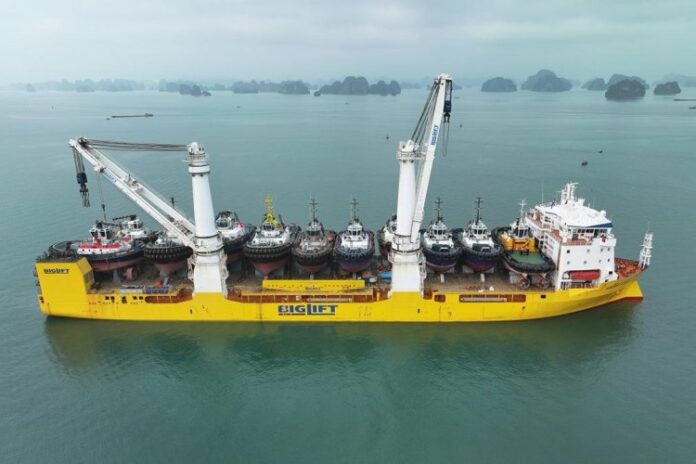
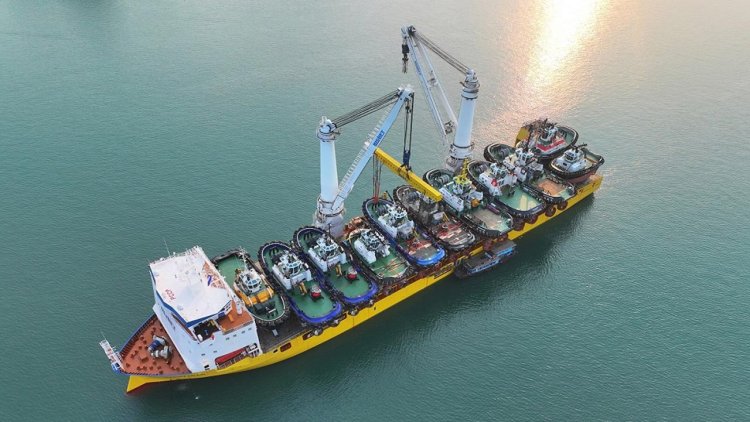
Damen Shipyards and BigLift Shipping have completed a major logistical feat. A single vessel has transported eleven Damen tugs from the shipbuilder’s yards in Vietnam and China to Europe. 

While such voyages usually require six months to plan and organise, this one had less than two months to prepare and ensure that each stage was executed on time. The ship used to transport the eleven Damen tugs was BigLift’s Happy Star, a 156-metre heavy lift vessel equipped with two heavy lift mast cranes of 1100 mt each. 

The Happy Star departed Halong Bay, Vietnam, for Europe on the fourth of April and arrived 38 days later at Vigo, Spain, to unload one vessel before continuing on to Rotterdam. It will arrive there on the 19th of May to unload the remaining ten. 

These mass deliveries do not take place often as it is rare that so many vessels are ready to be despatched at the same time. The last such event occurred in 2015 when Happy Star transported 22 vessels of various types on the same route. However, this brings advantages versus delivering vessels on their own hulls. These include having the vessels and their equipment arriving in pristine condition. The marine environment also benefits from having fewer emissions with just one ship, albeit a larger one, doing all the work. These outcomes align well with Damen’s commitment to sustainability and operational excellence. 

“At Damen we aim to provide our clients with a holistic service that includes not only building their boats but also delivering them to where they are needed with the entire process managed by Damen experts,” says Rimmert Berlijn, Damen Services Heavylift Coordinator. “This is all part of being a total maritime solutions provider. In addition, clients taking advantage of this service also enjoy the peace of mind that comes with knowing that that their vessels are fully covered by Damen’s warranty programme right from the start.”

Sanne Wiegerink, Commercial Manager at BigLift Shipping, describes this voyage as a shining example of Dutch excellence.

“The Happy Star, one of the Netherlands’ premier heavy lift vessels, transporting tugs for a distinguished Dutch shipbuilder, ultimately serving various Dutch clients. We take immense pride in our contribution to this remarkable project.”

ABS and HD Hyundai Group sign MOU to advance medium-voltage power systems on ships

0

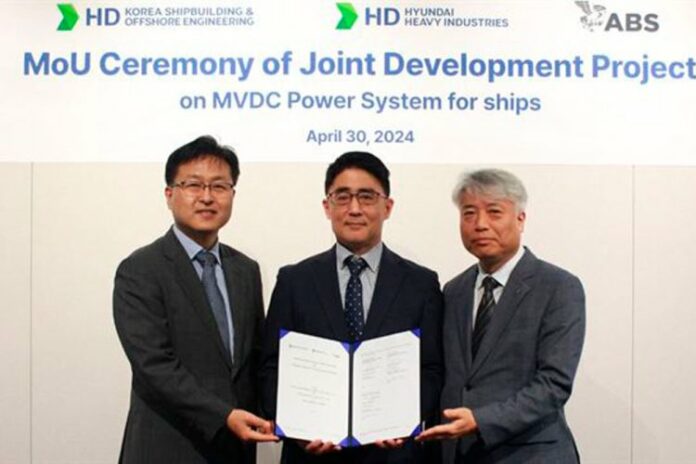
ABS, HD Korea Shipbuilding & Offshore Engineering Co., Ltd. (HD KSOE) and HD Hyundai Heavy Industries, Co., Ltd. (HHI) signed a memorandum of understanding to collaborate on the technical feasibility for medium-voltage direct current (MVDC) power systems on ships.

The agreement opens the door to collaborate on design assessment, new technology qualification as well as the development of rule guidance to provide clear directives on technical requirements, safety standards and regulatory compliance.

“We are proud to partner once again with HD KSOE and HHI. Our companies are equally focused on the safety of the maritime industry while supporting a smooth transition to clean energy. Alternative energy options, particularly electrification, are needed to help the shipping industry achieve net zero by 2050,” said Patrick Ryan, ABS Senior Vice President and Chief Technology Officer.

Byoung-Hun Kwon, head of HD KSOE Electrification Center, said:

“For the electrification/unmanning of large ships and ship systems, marine MVDC technology is essential, not optional, and we have successfully developed a low-voltage direct current power system (LVDC) in many projects, including the Ulsan Taehwa. Based on our experience in delivery, we will lead the large ship electric propulsion market by expanding our technology to the MVDC power system.”

This is the latest stage in a long running program of collaboration between the organizations, with ABS supporting HHI on ammonia carriers, autonomous navigation and green hydrogen production. 
 

NYK to develop wood pellet-powered ship

0

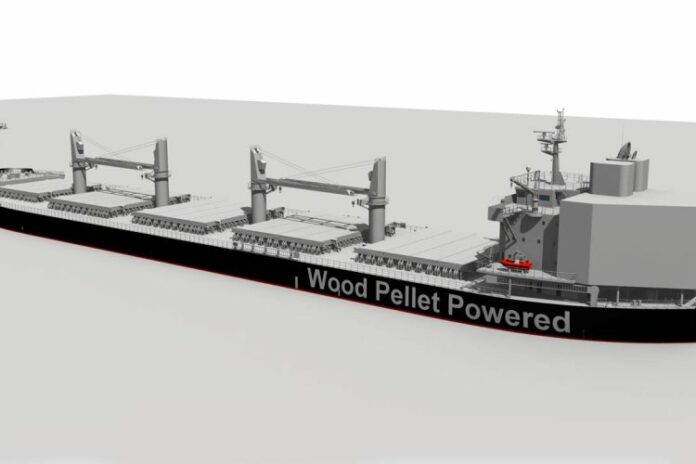
Leading Japanese companies, NYK Line, NBP, TSUNEISHI SHIPBUILDING and British renewable energy business, Drax Group (Drax), have signed a new memorandum of understanding (MoU) to develop both the world’s first biomass-fuelled ship (bioship) and the technology that could power it.

Biomass is playing a growing role in Japan’s transition from fossil fuel power generation to low carbon and renewable electricity, and the country’s demand for biomass pellets, sourced primarily from North America and composed of sawmill and forestry residues, is increasing.

Drax produces biomass pellets in both the US South and Canada. The company has a longstanding relationship with NBP which transports its pellets to Japan.

These pellets are currently shipped through smaller handysize bulkers, which, due to the limited size of their fuel tanks, have proved challenging to switch to lower emission fuels, such as ammonia.

Through the MoU, which was signed at the British Embassy in Tokyo, the companies will initially conduct research to develop the new shipping technology, an on-board biomass fuel plant, which would be required to power a bioship. The four companies are exploring how other renewable technologies could be used to reduce both the emissions and fuel costs of shipping biomass.

The biomass fuel plant would use a gasifier to combust biomass at high temperatures and create and contain gases including carbon monoxide, hydrogen, and methane. These gases would then be used to power a generator which could propel the bioship and also provide a proportion of its internal power.

The installation of a biomass fuel plant could see a 22% reduction in well-to-wake carbon emissions in bioships when compared to using fossil fuels. If this development is successful, the companies will jointly study the possibility of building a bioship by the end of 2029.

Shinichi Yanagisawa, Executive Officer of NYK Line, said:

“This initiative is part of NYK’s long-term target of net-zero emissions of greenhouse gas (GHG) by 2050 for the NYK Group’s oceangoing businesses. The NYK Group is committed to providing its expertise in low-carbon and decarbonised maritime transportation as per this MOU and will utilize the knowledge gained in this research and development to promote initiatives related to various energy-saving technologies. Through our strength in high-quality transportation services, we will continue to co-create value for society with our partners DRAX and TSUNEISHI SHIPBUILDING.”

Paul Sheffield, Drax Group’s Chief Commercial Officer, said:

“Drax aims to be carbon negative by 2030 and decarbonising our supply chain is critical to reaching this goal. This MoU is an important step in the development of the technology required to power and launch the world’s first bioship, which will support Drax’s decarbonisation goals but could also drive the innovation needed to transform shipping and cut carbon emissions and fuel costs in global supply chains.

I’m looking forward to working with our partners NYK, NBP and TSUNEISHI SHIPBUILDING, to explore the potential this technology has to support global efforts to address the climate crisis. We are also exploring the role of other renewable technologies in delivering greener shipping.”

Masashi Suda, NBP’s President, said:

“Drax is a leading renewable energy company, and we are honored to be a part of this symbolic project to use its main products as environmentally friendly fuel in transportation of the products themselves. After study of biomass fuel plant and gasifier system, Drax, TSUNEISHI SHIPBUILDING, NYK and NBP have concluded a memorandum of understanding for the feasibility study on the development of the world’s first wood pellets-powered Super Low-Emission Vessel. This is important step towards decarbonised society for all concerned parties. NBP will continue to contribute to global decarbonisation together with its customers and partners. “

Kenichi Shibata, Managing Executive Officer of TSUNEISHI SHIPBUILDING, said:
“TSUNEISHI SHIPBUILDING focuses on reducing the global environmental impact in the design and construction of our vessels and has declared ourselves to achieving carbon neutrality by 2050. For realising this aim and recognising ourselves to be a frontrunner of environmentally friendly yard, we are driving to develop and construct new fueled vessels which combining environmental impact reduction and economic efficiency.

This project is an attempt to implement ‘Creating the future, today’ as the TSUNEISHI Group slogan, and TSUNEISHI SHIPBUILDING will contribute by demonstrating our function as a shipbuilder for the project members.”

Construction work begins on Germany’s largest offshore wind farm in the North Sea

0

In the first offshore auction held in Germany, EnBW secured the contract for the project back in 2017. The unique thing about this project is that He Dreiht will be built without state funding. Around 2.4 billion euros are being invested in it.

EnBW CEO Georg Stamatelopoulos:

“EnBW will play its part in further accelerating the energy transition in Germany, which is why it wants to invest a total of 40 billion euros in the energy transition by 2030 – the lion’s share of it in Germany. We are investing around 13 billion euros alone in constructing wind farms and solar parks as well as flexibly controllable and hydrogen-ready gas power plants. Our aim is to be a climate-neutral company by 2035. The He Dreiht offshore wind farm will play a significant role in helping us to achieve this aim.”

Peter Heydecker, Board Member for Sustainable Generation Infrastructure:

“After seven years of intensive planning, we are delighted that we are now able to start construction work. The successful development of a project on this scale once again demonstrates the ability of our offshore team to realize cost-efficient offshore wind projects in Germany and Europe. The expansion of offshore wind energy is an important part of our ongoing strategy to considerably increase our installed renewable capacity from 5.7 GW to 10 to 11.5 GW by 2030.”

He Dreiht is being built roughly 85 kilometers northwest of Borkum and about 110 kilometers west of Helgoland. More than 500 employees will work on this large construction site in the middle of the sea at peak times. Over 60 ships are involved in the construction of the wind farm. EnBW’s offshore office in Hamburg is coordinating the major project.

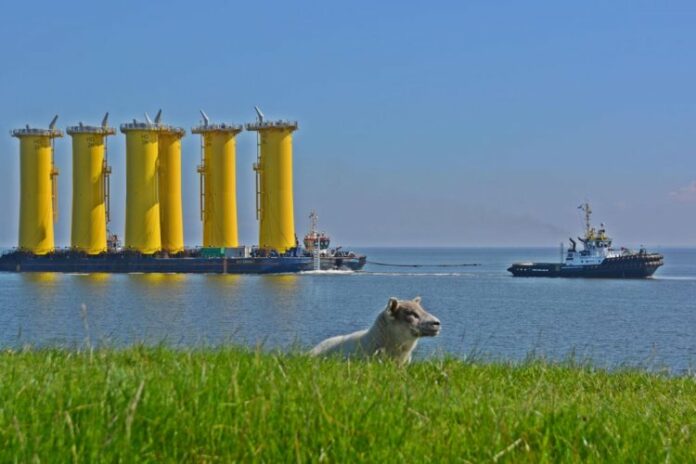
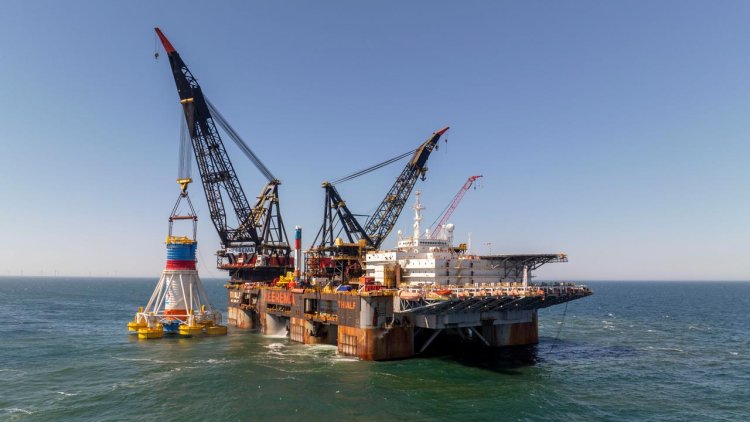
The Thialf, one of the world’s largest floating cranes, will install the first foundations in the seabed in the next few days. A monopile – a 70-meter-long steel foundation 9.2 meters in diameter and weighing around 1,350 metric tons – will be used, upon which a transition piece will be placed, which serves as a connecting element between the tower of the wind turbine and the monopile. The monopiles and transition pieces had previously been loaded onto floating platforms in Eemshaven in the Netherlands and towed to the construction site by tugboats. Work on installing all of the foundations will continue into the summer. The wind turbines and cables are being manufactured at the same time. These will be installed and laid in early 2025. The latest generation of wind turbines from Vestas will be used. One single rotation of a 15-megawatt turbine rotor is enough to supply four households with electricity for a day.

The entire wind farm is scheduled to go into operation at the end of 2025. EnBW will be responsible for the technical and commercial management. Servicing and maintenance work will be carried out from its service base in Emden.

The Dutch-German grid operator TenneT will connect the wind farm to the grid using an offshore converter station and two high-voltage DC export cables. The cables will be laid over a distance of 120 kilometers underwater and 110 kilometers on land. From the landfall point near Hilgenriedesiel, the electricity will be transmitted by buried cable to the future Garrel/Ost converter station in the Cloppenburg area.

Equinor and Petoro agree to harmonise equity interests

0

Equinor will increase its ownership in the Heidrun field and Noatun discovery and reduce its ownership in the Tyrihans field and the Castberg field, as well as the Carmen and Beta discoveries.

“We have a strategy to continue the development and the value creation on the Norwegian continental shelf and expect to maintain a high production with lower emissions towards 2035. Alignment of ownership around the larger production hubs are important enablers for long-term value creation,” says Kjetil Hove, executive vice president for Exploration and Production Norway.

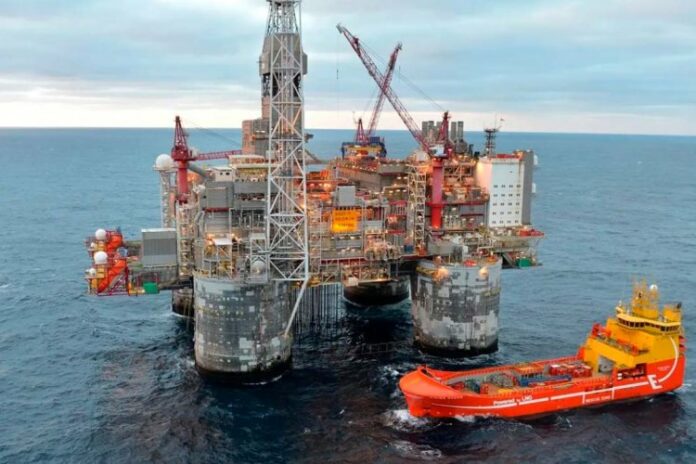
Heidrun and Tyrihans are two of the largest producing fields in the Halten area in the Norwegian Sea. Heidrun is among the fields with the longest remaining life on the Norwegian continental shelf.

“Although this is a value-neutral swap, this alignment of ownership will add more value to all parties from the Halten-area over time. Balanced partnerships will simplify commercial agreements, lower operating costs, and accelerate new developments with added production at a lower cost,” Hove continues.

Currently, Equinor holds a low equity interest in the Heidrun field of 13.0%, while Petoro has an equity interest of 57.8%. For Tyrihans, Equinor’s ownership is high, at 58.8%, while Petoro does not hold any equity.

Following the completion of the transaction, Equinor will own 34.4% in Heidrun and 36.3% in Tyrihans, while Petoro will own 36.4% in Heidrun and 22.5% in Tyrihans. Equinor ownership of Johan Castberg will be 46.3%.

The swap agreement is subject tovarious regulatory approvals andapproval by the Norwegian Parliament. The effective date of the agreement is 1 January 2025.

Port of Antwerp-Bruges launches the world’s first methanol-powered tugboat

0

The project is being financed by the European research programme Horizon 2020 and is part of the FASTWATER project, which aims to demonstrate the feasibility of methanol as a sustainable fuel for the shipping industry.

Methanol is one of the fuels of the future and produces lower emissions, an important factor in the Port of Antwerp-Bruges’ ambition to be climate neutral by 2050. The world’s first methanol-powered tugboat, the Methatug, was unveiled today in Antwerp. Methanol can be produced from renewable sources, is a clean fuel and can be used for both brand-new ships and retrofits because it is liquid under ambient conditions. For the Methatug, the engines from an existing tugboat were converted into ‘dual fuel’ engines, which means that they run on a mixture of methanol and traditional fuel. The 30-metre-long tugboat has a traction force of 50 tons and can store 12.000 litres of methanol, enough for two weeks of tug work.

FASTWATER project

The Methatug is part of the European FASTWATER project, which aims to demonstrate the feasibility of methanol as a sustainable fuel for the shipping industry, and was financed by the European research and innovation programme Horizon 2020. In addition to Port of Antwerp-Bruges, various other partners from the FASTWATER consortium are involved in this project: the Swedish ship design agency ScandiNAOS, the Belgian engine manufacturer Anglo Belgian Corporation, the German company Heinzmann responsible for the methanol injectors, Ghent University for the emission monitoring programme and the Canadian methanol supplier Methanex during the trials. In the FASTWATER project, the conversions to methanol propulsion of a pilot boat in Sweden, a river cruise ship in Germany and a coastguard vessel in Greece are also elaborated. De Wit Bunkering will supply the Methatug with methanol via truck-to-ship bunkering at the Port of Antwerp-Bruges Nautical Operational Cluster (NOC).

This world premier forms part of a comprehensive greening programme for Port of Antwerp-Bruges’ own fleet which strives to systematically integrate the most environmentally friendly technologies available. So far, the Hydrotug 1, the first tugboat to run on hydrogen, and energy-efficient RSD tugboats have already been added to the fleet. Another electrically powered tugboat will follow later this year, as the first in Europe.

As the fifth largest bunker port in the world, Port of Antwerp-Bruges also aims to become a full-fledged multi-fuel port, in which seagoing and inland vessels will be able to bunker, not only conventional fuels, but also alternative, low-carbon fuels, such as methanol, hydrogen or electricity. In early April, the first methanol bunkering with the deepsea vessel Ane Maersk took place in Antwerp, a new milestone in terms of this ambition.

Jacques Vandermeiren, CEO of Port of Antwerp-Bruges:

“Together with our partners, we are pioneering with innovative technologies for the transition to alternative and renewable energy sources. The Methatug is a new and essential step in our efforts to make our own fleet greener and become climate neutral by 2050. Thanks to projects such as this, we are paving the way and hope to be an example and a source of inspiration for other ports.” 

Annick De Ridder, Vice-Mayor of the City of Antwerp and President of the Board of Directors of Port of Antwerp-Bruges:

“The fact we are able to announce another world premier today in the field of clean energy is fantastic news for our port and for the shipping industry in general. Just like with the Hydrotug, the world’s first hydrogen-powered tugboat, this project confirms our pioneering role in the field of energy transition. The ecosystem of our port platform forms an ideal, large-scale testing ground for this.”

Prof. Sebastian Verhelst, Project Coordinator FASTWATER:

“Methanol has everything to become the fuel of the future and play a pioneering role in the greening of the shipping industry. Thanks to the expertise and efforts of the different partners from the consortium, we are now able to take important steps with the Methatug to demonstrate its feasibility.”