-3.8 C
New York
Home Blog Page 178

First Ro-Pax vessel receives DNV Silent(E) notation following successful sea trials

0

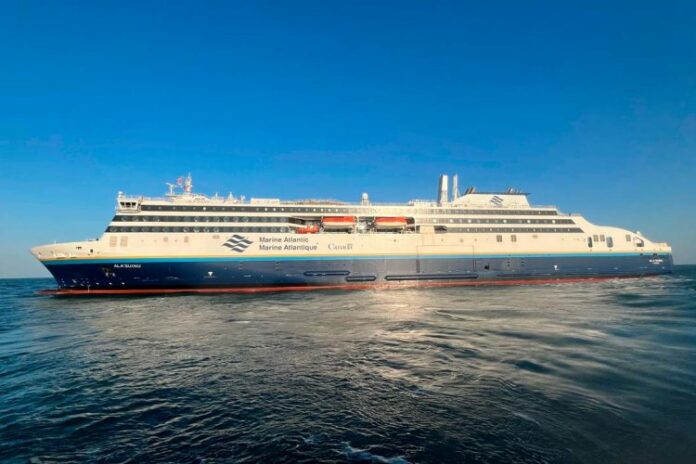
Technology group Wärtsilä has designed and delivered controllable pitch propellers for Stena’s new Ro-Pax vessel, Ala’suinu, which has successfully completed sea trials. 

This environment class notation from DNV was introduced to protect sensitive marine ecosystems, applying to vessels that demonstrate the ability to effectively reduce emissions of underwater radiated noise. 

The Ala’suinu, which was built at CMJL Shipyard (Weihai) in China, is under a 5-year lease to Marine Atlantic, a Canadian operator based in province of Newfoundland & Labrador. Environmental sustainability was a prime consideration in the design of the 203 metres-long ship, which will sail between Nova Scotia and the island of Newfoundland from June 2024. 

“The Ala’suinu is a specially designed vessel for Marine Atlantic. We are fully committed to reducing the environmental impact of our operations, and in this vessel another dimension of sustainability has been added. The dedicated Wärtsilä propeller design enables us to minimise underwater noise for the benefit of marine life off Canada’s coasts,” says Captain Anderson Noel, Marine Atlantic’s Director of Fleet Operations. 

“With this notation, Stena and Wärtsilä are showcasing their commitment to taking proactive steps to reduce shipping’s environmental footprint. Despite Ro-Pax being a challenging ship type from an underwater noise perspective, this innovative machinery configuration has enabled a propulsion plant with sufficiently low noise emissions to satisfy our voluntary class notation Silent(E),” adds Øystein Solheim Pettersen, Head of Section, Noise and Vibration – DNV. 

During the design process of the controllable pitch propeller, Wärtsilä’s industry-leading in-house design experts paid special attention to underwater radiated noise as a key design parameter. This was done without compromising on other important propeller design requirements, such as ensuring optimal performance and efficiency, for example. As well as reducing emissions of underwater radiated noise, Wärtsilä’s propeller ensures that owners and operators gain the benefits of lower operating costs and a reduced environmental footprint through less fuel consumption and fewer exhaust emissions.   

“For this project, we have designed and delivered propellers where vibrations and noise have been given the highest attention, in combination with the vessel design and operations. The vessel being awarded with the Silent(E) notation by DNV after successful testing at sea verifies the environmental benefits. We are proud to be the first on the market to deliver the dedicated propeller for a Silent(E) classed Ro-Pax vessel,” comments Bernd Bertram, Vice President, Propulsion – Wärtsilä Marine.  

In addition to the dedicated propeller, Wärtsilä has also supplied an integrated hybrid propulsion system for this vessel, consisting of Wärtsilä 46DF main engines, Wärtsilä 20DF auxiliary engines, both of which are complimented with Wärtsilä NOx Exhaust gas cleaning system and Wärtsilä LNGPac™, as well as the reduction gear boxes and bow thrusters with motors. Also included in the scope are the Hybrid DC-link Shaft Generator system, Batteries and Energy & Power Management System, Integrated Automation System and Navigation & External Communication System. 
Van Oord’s offshore installation vessel Boreas successfully launched

0

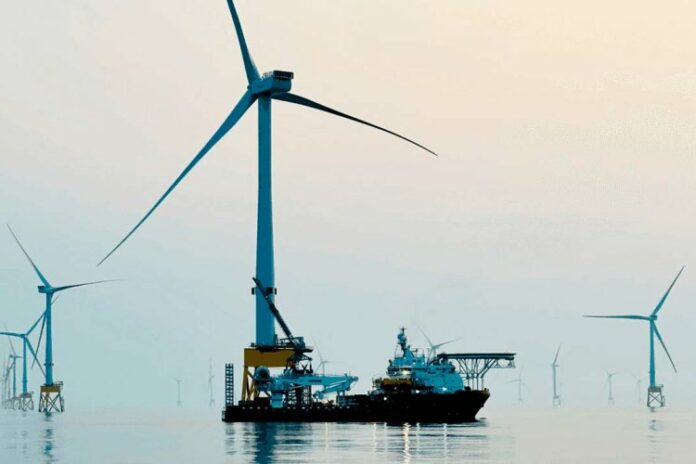
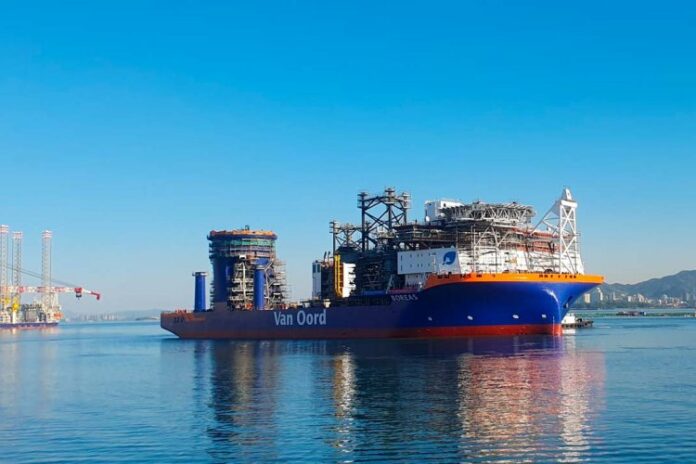
Van Oord’s new offshore installation vessel Boreas was successfully launched at the Yantai CIMC Raffles Offshore Ltd. shipyard in China. 

The Boreas’ dual fuel engine set is able to run on methanol and is purpose-built for the transport and installation of the next generation foundations and turbines at offshore wind farms. Commercial availably is expected in 2025.  

Upon completion, the Boreas will be the largest vessel of its kind. Because of its size, the launch was a challenging job. First, it had to be moved from the construction site to the quay, using the so-called ‘skidding method’. Skidding is a safe and efficient load-out method for the horizontal transport of heavy and oversized objects along a linear track. The vessel was then skidded from the quay onto two pontoons. These pontoons were later submerged in a controlled operation after which the Boreas became afloat. After safely moored alongside, the works on the Boreas will continue with the installation of the main crane and the extension of the legs of the jack-up vessel. Meanwhile the vessel’s technical installation will be further commissioned, after which sea trails will take place to test performance. Subsequently, the Boreas will be handed over by the Shipyard to Van Oord.

Johan de Graaf, Project Manager Shipbuilding at Van Oord, said:

‘The launch of the Boreas is a major milestone for Van Oord. A big thanks to the project teams and all subcontractors and suppliers who worked with great commitment and dedication towards this crucial stage of the construction process. With the Boreas now afloat, we’re entering the final stages of the newbuilding, and we are excited to continue our journey towards successful delivery!’

The Boreas is preparing Van Oord for the increase in scale in the offshore wind industry. The vessel measures 175 metres in length and has a crane with a 155-metre-high boom, able to lift over 3,000 tonnes. Four giant legs, each measuring 126 metres, allow the vessel to be jacked up and work in waters up to 70 metres deep. It will therefore be able to install the next generation of 20 MW offshore wind turbines at sea.

Being an example of the energy transition within Van Oord, the Boreas is the first of its kind to be able to run on the future fuel methanol, reducing the ship’s carbon footprint by more than 78 percent. In addition, the vessel will be equipped with a cutting-edge active emissions control technology (Selective Catalytic Reduction) to reduce the NOx emission to an absolute minimum. A battery pack of about 6,000 kWh can take peak loads and regenerate energy to reduce the fuel consumption and corresponding emissions even further.

ClassNK and StormGeo mark significant collaboration to advance maritime decarbonization

0

The collaboration marks a significant milestone for the two as it establishes the sharing and verification of emission data, to meet the requirements of their shared clients. Shipping companies that use StormGeo’s s-Insight platform will be able to share their validated emissions data to ClassNK MRV Portal via API, for a seamless verification process. 

This process enables shipping companies to maximize their reporting accuracy and accelerate their decarbonization strategy, according to regulations.

Mr. Espen Martinsen, Executive Vice President Sales, StormGeo, said,

“This new agreement to share data for MRV, EU-ETS, and broader decarbonization initiatives is not only a significant stride towards advancing maritime decarbonization but is also a testament to our shared commitment to operational excellence and high data quality. “

Dr. Yoshiya Yamaguchi, Executive Vice President, ClassNK, said, “We expect that this API integration will lead to improved convenience for the clients. ClassNK will continue to contribute to maritime decarbonization by fostering collaborations transcending industry boundaries”
 

ADNOC L&S and SeaOwl sign agreement to design remotely operated marine supply vessels

0

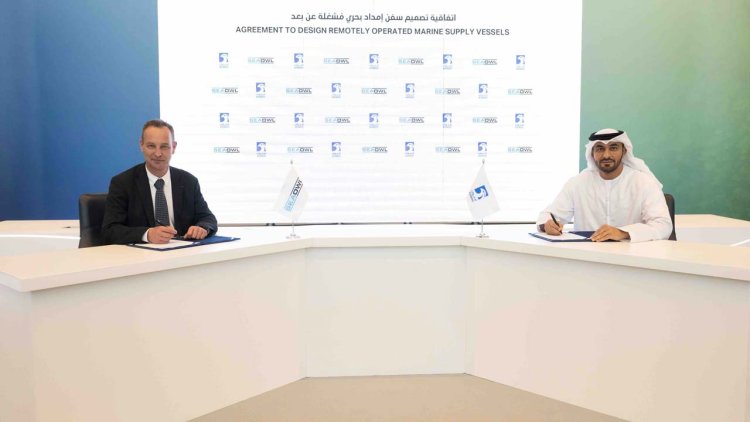
ADNOC Logistics & Services has signed an agreement with SeaOwl for the design of unmanned Remotely Operated Vessels (ROV) capable of transporting vehicles, equipment and supplies to and from offshore sites. 

The agreement was signed by Captain Abdulkareem Al Masabi, CEO of ADNOC L&S and Xavier Génin, CEO of SeaOwl at the UAE Climate Tech Forum organized by the Ministry of Industry and Advanced Technology.

The innovative design of the ROV will reduce carbon emissions up to 30% as the vessel will be lighter and smaller, as facilities for a crew are not required. In addition, the smart automation systems will optimize routing and propulsion, further decarbonizing ADNOC L&S’ offshore operations in support of the UAE’s Net Zero by 2050 Strategic Initiative and ADNOC’s 2030 Sustainability Agenda.

Captain Abdulkareem Al Masabi, CEO of ADNOC L&S said:

“A strategic commitment to sustainability and innovation plays a crucial role in ADNOC L&S’ ability to serve its customers. The vessel is another example of this commitment as we leverage the latest technology to optimize our maritime operations, reduce our carbon footprint and improve safety while increasing efficiency.”

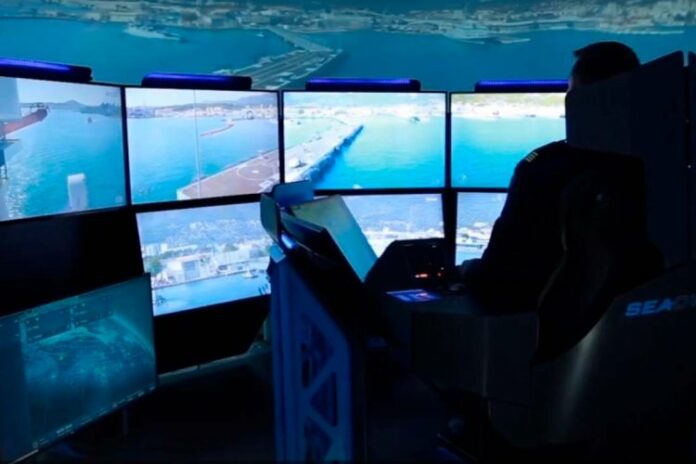
The design for the 55 meters long ROV will allow the vessels to be operated from an onshore control room through a satellite link using the latest automation and self-navigation technology. The design will utilize state of the art artificial intelligence systems to control propulsion, dynamic positioning, remote communication and cyber security.

SeaOwl, a French company specializing in the automation and digitalization of maritime services, will design the vessel, oversee its construction, and facilitate navigation permits. Seaowl will partner with Bureau Veritas (BV), a world leader in testing, inspection, and certification, to facilitate obtaining the necessary navigation permits from the UAE maritime transportation affairs.

Xavier Génin, CEO of SeaOwl said:

“After the success of our Proof of Concept supported by the French Government, we are delighted to join forces with ADNOC L&S to bring a new era of sustainable logistics operations through digital automatization. This project will create strong ties with the UAE industrial landscape, as we plan to engage many other UAE players in this exciting journey.”

This design will improve safety and reduce operational costs as the vessels will be able to operate in harsher conditions with no exposure to seafarers.

Upon construction, the ROVs will join ADNOC L&S’ large and diverse fleet of modern and technologically advanced vessels. Combined with its 1.5 million square meter logistics base in Abu Dhabi and its integrated logistics capabilities, ADNOC L&S is one of the region’s largest shipping and integrated logistics companies.

Yara International and Kongsberg Digital enter collaboration on digital twin technology

0

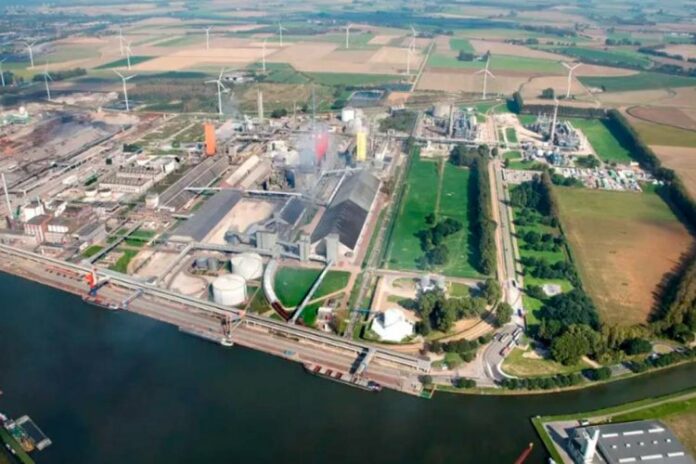
The agreement includes an operational twin for Yara’s production facilities at Herøya in Porsgrunn and a project twin for the carbon capture project in Sluiskil in the Netherlands. The ambition is to deploy the solution to Yara’s production facilities worldwide. 

The operational twin for the production facility at Herøya will utilise industrial data from the factory in combination with technical data and equipment documentation. Based on this, a contextualised work surface with detailed 3D models of the plant and the various units will be created, along with associated maintenance, operational, and facility information gathered from the factory’s sensors and data sources. The work surface will assist users in making the right decision at the right time by providing relevant information. 

“Yara is collaborating with several partners for our digitalisation program. We chose Kongsberg Digital because of its technical solutions and flexible user interface. Yara is the first wholly Norwegian industrial company to use Kognitwin – Kongsberg Digital’s twin technology. With this technology, a significant improvement in the work process is expected, thereby leading to a more efficient workday for engineering, maintenance, and operations,” says Merete Østby, Digital Manager at Yara Porsgrunn. 

“It is a fantastic recognition for Kongsberg Digital to develop and deliver twin technology to Yara. We will build on the already close cooperation between Kongsberg Gruppen and Yara and deliver technology that provides Yara with improved insights and new opportunities to optimise the operation of their facilities. For Kongsberg Digital, this marks a significant milestone as this agreement demonstrates our use of digital twin technology and how we are solving common challenges across the process and chemical industry,” says Shane McArdle, CEO of Kongsberg Digital. 

Twin technology will also be implemented into the carbon capture project at Yara’s facility in Sluiskil, Netherlands, where a new carbon capture unit is being built to convert CO2 gas into liquid before transporting it by ship for injection and storage in reservoirs in the North Sea. The twin technology will play an essential role in this project by contributing to efficient collaboration and preparations for data transfer from project to operation before the plant is operational. The digital twin will establish a “digital thread” through all project phases and into the operation and maintenance phase. 

“With digital twin technology, Yara takes another great stride forward in digitalising our production. This technology has the potential to optimise operations by gathering and visualising large amounts of data and information on a simple and user-friendly platform. Together with Yara’s Digital Production Platform – our industrial IoT platform – this opens up entirely new possibilities for data-driven insights,” says Roar Nilsen, Program Manager Yara International ASA.

Ampelmann signs two E1000 systems to drive growth in Taiwan’s offshore wind market

0

Ampelmann, the Dutch offshore access provider, has signed a new contract for two E1000 systems to work in Taiwan onboard two multipurpose support vessels to provide accommodation and walk to work services for end client Vestas Taiwan. The E1000 systems have been signed to assist in turbine commissioning. 

The first E1000 began work in January 2024 and the second E1000 is due to begin work in May 2024. This combination of the E1000 systems and client’s vessels has a proven track record of operating in Taiwan’s offshore wind farms since 2022 and has successfully worked through two winter seasons. These latest projects contribute to Taiwan’s renewable energy targets and Ampelmann’s commitment to these markets.

The E1000 motion compensated system is based off the proven technology of Ampelmann’s E-type system, but with the added capacity to handle cargo of up to 1,000kg. The system is able to compensate for waves up to 4.5m Hs and has the ability to change from people to cargo transfer mode in less than one minute.

“We look forward to working with our client and Vestas Taiwan on both projects. Ampelmann is committed to providing safe access for personnel and cargo for offshore wind projects in Taiwan,” says Ramesh Namasivayam, Business Development Manager Asia Pacific.

QatarEnergy to acquire two new exploration blocks offshore Egypt

0

Under the terms of the agreement, which is subject to customary approvals by the government of Egypt, QatarEnergy will acquire a 40% working interest in each of the “Cairo” and “Masry” Offshore Concession Agreements, while ExxonMobil (the Operator) will retain the remaining 60% working interest.

Commenting on the signing of this agreement, His Excellency Mr. Saad Sherida Al-Kaabi, the Minister of State for Energy Affairs, the President and CEO of QatarEnergy said:

“I am pleased with our entry into the Cairo and Masry offshore exploration blocks as they expand QatarEnergy’s presence in the Arab Republic of Egypt and extend our ambitious exploration program in-country.” 

His Excellency Minister Al-Kaabi added,

“We look forward to working with our valued long-term strategic partner ExxonMobil, as well as with the Egyptian Natural Gas Holding Company (EGAS) and the Egyptian Ministry of Petroleum and Mineral Resources, in this promising and prospective region. I would like to take this opportunity to thank the Egyptian authorities and our partners for their valuable support and cooperation.”

The Cairo and Masry offshore exploration blocks were awarded to ExxonMobil in January 2023 and cover an area of approximately 11,400 square kilometers in water depths of 2,000 to 3,000 meters. 

​​​​

MoU signed between Panama and UAE offers benefits for vessels of Panamanian Registry

0

The Panama Maritime Authority signed a Memorandum of Understanding (MOU) with the Ministry of Energy and Infrastructure of the United Arab Emirates (UAE) by which the vessels of the Panamanian Registry will have access to new incentives.  

The Memorandum aims to establish a collaboration framework between both parties for the development of the “Blue Pass” project, which pursues the creation of a platform that gathers the main actors of the maritime industry of the UAE, together with partners and interested parties to offer a series of privileges and facilities to the main shipping companies and shipowners visiting the ports and waters of the UAE. 

The project also seeks to offer incentives and concessions to the yachts and recreational ships docking in the country´s regional waters and to enhance the integration and facilitate mutual services between the suppliers and the participant companies. 

With this initiative, the ships of the Panamanian Registry will receive a series of benefits and facilities as priority in the entry and exit from the ports, change of crew, discounts in auxiliary services with all companies, shipyards and other businesses registered in the database of the Blue Pass program.  Likewise, the ships will have access to the shared database, with which they may contact directly with all the suppliers and their discounts for mutual benefit.  

The agreement was signed by Her Excellence Hessa Al Malek, Consultant for Maritime Transportation Affairs from the Ministry of Energy and Infrastructure in cooperation with Captain Rami Omar Al Breiki, General Director of NeoNautica for Ship and Boats Trading LLC, with headquarters in Dubai, while the signature by the Panama Maritime Authority was delegated to Her Excellence Rebeca Pérez Cervantes, Ambassador of Panama in the United Arab Emirates.

This Memorandum of Understanding is now enforceable and will have a validity of two years. It may be restored with the mutual consent of both parties and the signature of a new memorandum of understanding.  

NAPA launches stability management solution for ferries

0

The new onboard stability solution is designed to meet the unique operational needs of the ferry segment, from maintaining safe loading conditions on tight schedules and constant cargo changes to the need for data transparency and ship-to-shore communication. Together, these features will help improve fleet safety and efficiency.

NAPA Stability for Ferries responds to a growing demand in the ferry sector for advanced stability solutions that account for fast and frequent loading and unloading, multiple arrivals and departures daily, route-specific challenges, sustainability, reporting and compliance, as well as cargo management. The new cargo loading feature, for example, helps make stability and loading calculations faster, easier and more reliable for better safety and time savings, despite tight schedules.

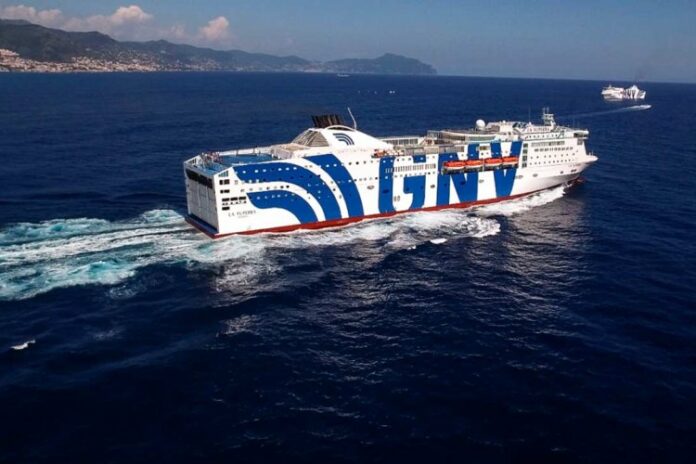
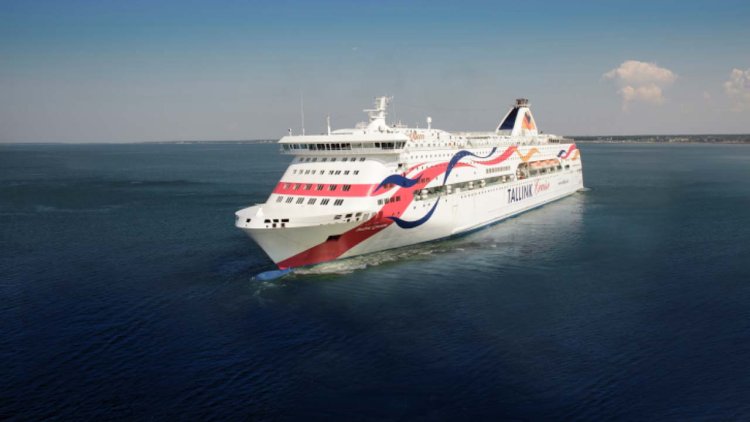
GNV is one of the first ferry operators to onboard seven vessels to NAPA Stability, while Tallink Silja Line is trialling applications of the solution on Silja Serenade, and Baltic Queen in Q2 2024. This marks the expansion into the ferry segment of the advanced stability software, which is already installed onboard 69 cruise vessels, with additional features tailored to fast-paced ferry operations.

NAPA Stability is an onboard system which can connect to the shoreside with the cloud-data platform, NAPA Fleet Intelligence, allowing the continuous monitoring and dynamic adjustment of the ship’s stability parameters in real-time by crew and shoreside teams alike. This enables enhanced operational efficiency and better-informed decision-making for safe and smooth voyages. The data underpinning the technology is based on NAPA’s accurate 3D modelling, which accounts for the ship’s unique design, and uses this to cover a wide range of calculations related to hydrostatics, intact stability, damage stability, and longitudinal strength. Real-time access to stability data gives shoreside teams and crew a clearer picture of their current loading condition. This helps assess risks on an ongoing basis and provides better communication of vital information which, ultimately, supports faster response in an emergency.

Markus Tompuri, Chief Stability Officer, Safety Solutions, NAPA, said:

“NAPA Stability for Ferries is our answer to the sector’s growing safety and efficiency challenges. The advanced solution brings the best of stability management, fine-tuned for ferry operations, allowing them to tap into a wealth of insights tailored to their unique requirements. Working in collaboration with industry leaders also ensures we’re building a solution that not only meets their operational objectives but also supports critical decision making, often on a time crunch.”

Davide Orecchia, Chief Technical Officer at GNV, added:

“The safety of our passengers is our utmost priority. Working with NAPA gives us the peace of mind that we are maintaining the industry’s highest standards to keep our ferries operating safely and smoothly, while also unlocking data insights to improve the efficiency of our fleet and teams. With dynamic new cargo loading features, and real-time shipboard stability data available onshore via cloud services, our onboard and shoreside teams can communicate and collaborate like never before.”

Clas-Johann Westen, Technical Superintendent at Tallink Silja Line, commented:

“We have been actively engaged in the evolution of the NAPA Stability software, previously known as NAPA Loading Computer, for over two decades. We are pleased to have contributed to the development of its latest iteration. Building upon the same dependable platform and delivering calculation results validated by over 100,000 successful departure conditions across our fleet over the years, our commitment to reliability remains unwavering. With its contemporary interface and enhanced functionality, we assure precision in results and ease of adoption for operators as they prepare for departures, ushering in a new era of efficiency and confidence.
 

Port Canaveral plans new cruise terminal to meet growing industry demand

0

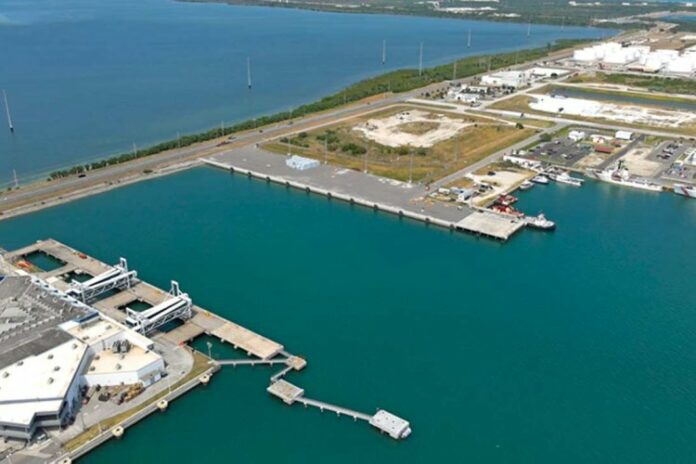
Port Canaveral has announced its plan to build a new cruise terminal to meet the growing demands of the cruise industry. The strategic decision to build a new multi-user cruise terminal at the Port’s existing North 8 berth provides significant cost savings, operational flexibility, and an expedited construction timeline of approximately two years to accommodate the largest ships in the world across a spectrum of brands.

“We have cruise partners with immediate needs to locate assets in Florida and Port Canaveral is where they want to be,” stated Capt. John Murray, Port Canaveral CEO. “Our ability to efficiently bring a new cruise terminal online was key to retaining and growing this important business segment that supports many jobs and delivers high value to our regional and state economy.”

Port Canaveral’s existing North 8 berth shares its basin with the Port’s Cruise Terminal 5 on the northside of Port Canaveral. Designed and built in 2018 for multi-purpose flexibility, North 8 berth will require minimal modifications to extend the current 1,020 linear feet bulkhead to 1,344 feet to accommodate large cruise vessels. Additionally, waterside improvements to the northside of the shared basin will also extend and improve the berthing capacity of Cruise Terminal 5.

The new multi-user cruise terminal and parking facility will leverage technology to provide optimal flexibility for multi-users, multi-brands. The North 8 location, current berth configuration and vacant uplands affords the opportunity for minimal disruption to current port and tenant operations during construction.

“A new cruise terminal and the business it will deliver builds on our Board’s commitment to the economic prosperity of our Port community,” said Micah Loyd, Chairman of the Canaveral Port Authority Board of Commissioners. “This proactive, business-oriented strategy reaffirms our commitment to ensure the State of Florida continues to prosper from cruise tourism and remains the ‘Cruise Capital of the World’.”

Timeline for design, engineering, and construction are in development with target completion for the new facility by summer 2026. The new terminal campus will include a multi-story parking facility to accommodate up to 3,000 vehicles and roadway improvements in and out of the new facility, including turning lanes and a “flyover” ramp directly connecting the site with State Road 401.