-10.9 C
New York
Home Blog Page 148

Port Of Hueneme to deploy STAX Engineering’s emissions capture and control system

0

The Port of Hueneme has announced its groundbreaking collaboration with STAX Engineering. 

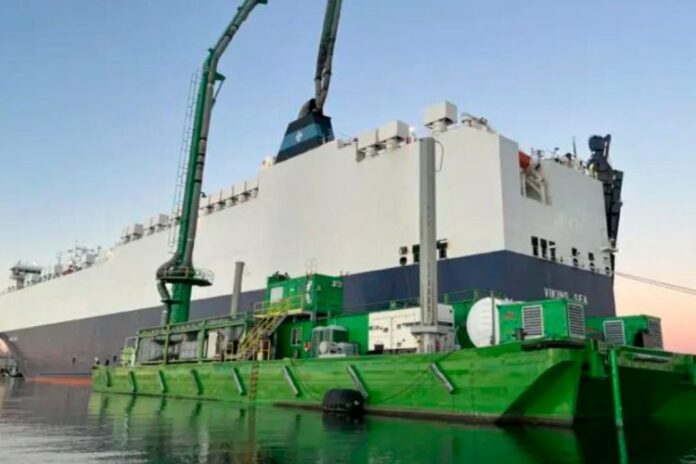
The system will consist of mobile floating barges that can place filters on ocean-going vessel stacks and filter out harmful emissions like particulate matter and oxides of nitrogen.  This new effort is a direct response to mitigate impacts due to the damage incurred to Port’s Shoreside Power system last December during the major storm that flooded Port Hueneme.

The first-of-its-kind system developed by STAX Engineering represents a significant leap forward in tackling air pollution from ships while at berth. Here’s how it works:

  • Capturing Emissions: STAX’s system is ingeniously designed to envelop a vessel’s smokestack, capturing particulate matter (PM) and oxides of nitrogen (NOx) emissions directly at the source.
  • Efficiency and Cost-Effectiveness: Unlike traditional shore power solutions, the STAX system doesn’t require expensive modifications to vessels. It efficiently captures pollutants without disrupting vessel operations, making it a cost-effective choice for both shipowners and port authorities.
  • Renewable Energy: The barge is powered by renewable diesel, making it cleaner than the electric grid. Its cleaned exhaust stream meets the health-protective standards required by CARB. This aligns perfectly with the Port of Hueneme’s commitment to sustainability.

As a Green Marine-certified port, the Port of Hueneme has consistently prioritized environmental responsibility. The collaboration with STAX Engineering underscores their dedication to cleaner air, healthier communities, and a more sustainable future.

Celina Zacarias, Board President for the Oxnard Harbor District said:

“We must continue to move forward towards our goal of becoming a zero emissions Port.  The storm damage has created an opportunity to continue showing how resilient our Port can really be.  We are putting the community first through this type of collaboration, and we will continue to pursue these types of partnerships so that our neighbors can rest assured that their Port is doing everything in its power to reduce its emissions and continue moving forward toward the goal!”

Kristin Decas, CEO and Port Director, Port of Hueneme, said:

“We’re thrilled to partner with STAX Engineering on this transformative project. The emissions capture and control system exemplifies our commitment to innovation and environmental stewardship, which is in our Port DNA, and highlights the flexibility of the Port’s response to finding new solutions in the maritime industry.” 

STAX Engineering CEO, Mike Walker, said:

“One of the most important aspects of STAX technology is that it breaks fleet operator dependence on the local grid. Shore power isn’t always available due to factors like major storms, limited outlet access, and vessel incompatibility. Our solution addresses these challenges, providing an easy, cost-effective, and environmentally friendly solution that solves the at-berth regulation requirements for ports like the Port of Hueneme. We are grateful for their partnership and excited about the positive impact we will achieve together.”
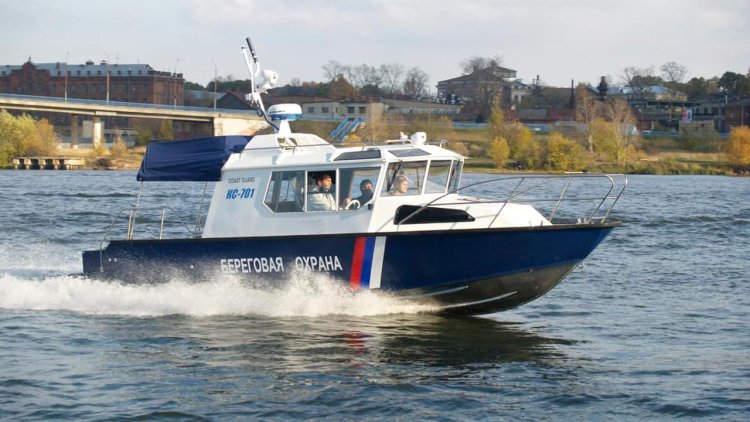
DIU’s naval drone hits invaders’ KS-701 “Tunets” boat

0

Intelligence officials said that the operation involving naval drones had been conducted on the night of August 8-9.

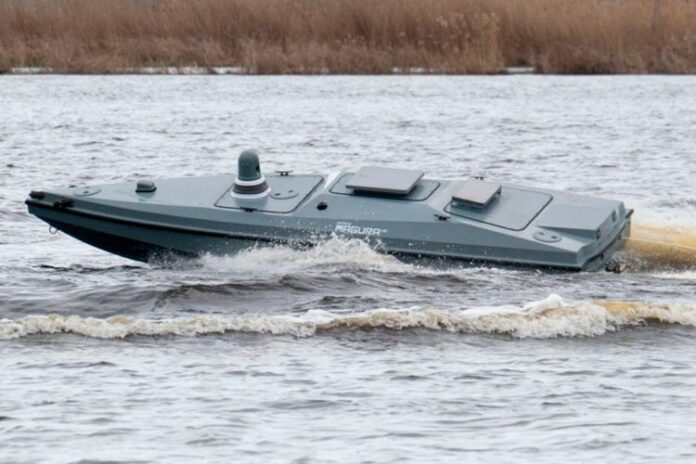
MAGURA V5 naval drones of the Group 13 special unit were sent to destroy Russian maritime facilities in Crimea.

The Russians tried to stop the Ukrainian drones with the help of helicopters firing from heavy machine guns.

However, the naval drone managed to break through to the shores of Chornomorske and hit the Russian “Tunets” boat.

“Three other invaders’ boats were also damaged as a result of the operation. Their type is being determined,” the DIU added.

This is not the first KS-701 “Tunets” captured off the coast of the peninsula.

Earlier, two Russian boats of this type were destroyed by Ukrainian intelligence, and two more were damaged in May of this year.

Diesel boats with an aluminum hull of the KS-701 type are used by Russians in the occupied Crimea for patrolling and logistics.

The boat is 8.8 meters long, 2.5 meters wide, and has a beam height of 1.2 meters. The total draft of the boat is 0.37 m. The boat can accommodate up to 6 people, and the crew consists of one person.

“In total, 18 maritime facilities of the Russian aggressor state were successfully hit with the help of Ukrainian-made MAGURA V5 naval drones, 9 of them were destroyed,” the DIU said.

The MAGURA V5 drone is controlled by a special portable remote control with screens and a set of keys and switches. The operator uses cameras to see the situation around the drone and can control it until the target is hit. For this purpose, the drone can carry up to 320 kilograms of explosives.

Source: mil.in.ua 

Brunvoll secures contract with Tersan Shipyard for chemical tanker propulsion systems

0

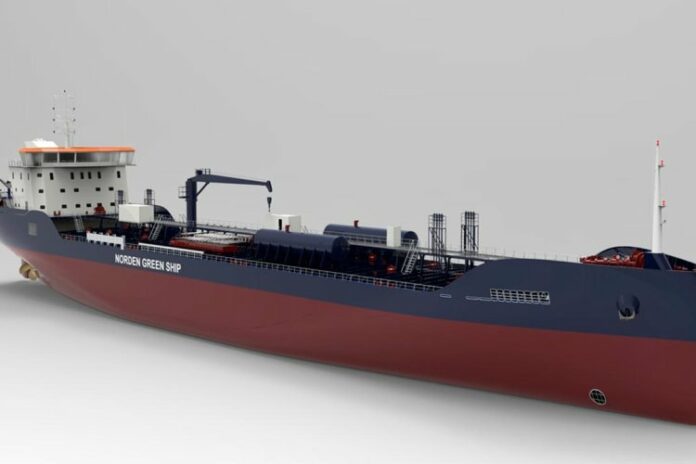
Brunvoll has signed a contract with Tersan Shipyard for the delivery of propulsion and manoeuvring systems for two stainless steel chemical product tankers. 

Brunvoll’s delivery for the vessels consists of a complete shaft line solution with a reduction gearbox and a controllable pitch propeller, a tunnel thruster, and Brunvoll’s Propulsion and Thruster Control system, BruCon PTC.

The reduction gearbox features both Power-Take-In (PTI), and Power-Take-Out (PTO). This solution provides a versatile platform to optimize for the lowest possible fuel consumption, and at the same time provide good performance during manoeuvring operations. The gearbox has a front-mounted clutch for enabling fully electric propulsion and provides a take-me-home functionality. The gearbox also has a clutch for the propulsion line, enabling the main engine and PTO can be utilized as a generator set when the vessels are in port.

‍Tune Chemical Tankers (TCT) is a global tanker operator with its headquarters in Rotterdam, Netherlands. TCT is a part of Tersan Group, which Tersan Shipyard also is a part of. TCT operates a young fleet consisting of 18 chemical tankers.

The vessels are designed by Norden Ship Design House, based in Istanbul, Turkey.  The vessels will have an overall length of approximately 150 meters and will have a loading capacity of 16.500 deadweight tonne.

‍“What does it say when the shipbuilder, Tersan, who also happens to be the ship owner, chooses Brunvoll? Well, it makes me believe that they have seen the long-term cost benefit of choosing a company that delivers excellent quality and service, over the vessel’s life span.
We wish to thank Tersan and Norden for the cooperation on these projects and I hope to maybe see the vessels delivering chemicals to one of our local producers of styrofoam one day”, says Per Endre Woldsund, Sales Manager at Brunvoll.

Swire Shipping completes sustainable biofuel trial on Transpacific Service

0

A collaboration with UWL, the Sun Chief Express Ocean service directly connects Vietnam to the United States and is the fastest in the market, with express connections into the heart of North America and Cambodia, Indonesia and Thailand.

Harry Stones, President of Swire Shipping North America, said,

“We are excited to announce a successful biofuel trial on our Sun Chief Express Ocean service. This initiative reflects our commitment to exploring sustainable shipping solutions in response to increasing demand for greener options. The use of sustainable B24 biofuel in our Sun Chief Express Ocean service is projected to reduce well-to-wake emissions for our customers by an estimated 15%. We look forward to continuing such efforts to minimize our environmental impact and contribute to a more sustainable future for the maritime industry.”

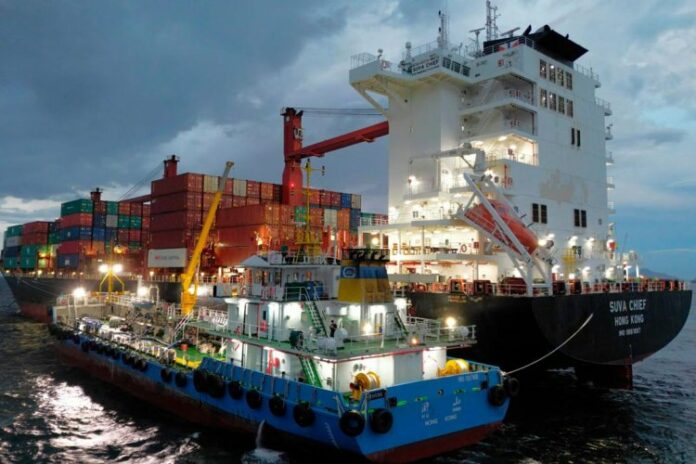
MV Suva Chief, a vessel on the Sun Chief Express Ocean service, was bunkered in Hong Kong with sustainable B24 biofuel, a blend of sustainable biodiesel of waste origin and conventional fuels. The trial was conducted in partnership with Hong Kong-based marine fuel supplier Chimbusco Pan Nation Petro-chemical Co Ltd (CPN) and Swire Shipping’s bunkering partner, the Hafnia Bunker Alliance.

Peter Grünwaldt, Head of the Hafnia Bunker Alliance states

“We are proud to have supported Swire Shipping in their successful biofuel trial, furthering our shared commitment to reducing emissions and fostering a more sustainable maritime future.”

Calvin Chung, Director of Chimbusco Pan Nation Petro-chemical Co Ltd, shares

“As the leading biofuel physical supplier in Hong Kong, we are pleased to assist Swire and Hafnia in their first biofuel supply in our port. This biofuel delivery serves to reinforce our dedication to eco-friendly port energy supply and achieving the global decarbonization goals.”

Maersk continues with fleet renewal plan

0

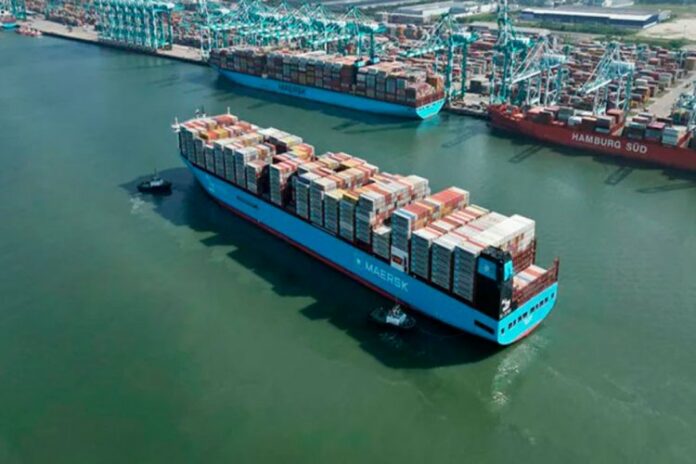
In continuation of its fleet renewal programme initiated in 2021, A.P. Moller – Maersk (Maersk) is in the process of signing newbuilding orders and time-charter contracts for dual-fuel vessels matching the planned renewal pace of around 160,000 TEU per year.

Rabab Boulos, Chief Operating Officer at Maersk, said:

“Our fleet renewal program is fundamental to maintaining competitive edge in our ocean business, and it is a cornerstone in decarbonising our operations. As the shipyard orderbooks have been filling up quickly and lead time for vessel deliveries have increased significantly, we decided to place orders and charter contracts of 800,000 TEU (twenty-foot equivalent) dual-fuel vessels, which ensures a steady flow of needed capacity for our network for the years 2026-2030 while building a competitive toolkit.”

The ordered capacity will be a mix of owned and chartered, ensuring that Maersk maintains strong financial and operational flexibility while continuing to own a significant part of its strategic tonnage. The vessels come in different sizes offering great network optionality. In line with Maersk’s commitment to decarbonisation, all vessels will be dual-fuel with the intent to operate them on low emissions fuel. To ensure the long-term competitiveness of the fleet and its ability to deliver on the decarbonisation goals, Maersk has elected a mix of methanol and liquified gas dual-fuel propulsion systems. While green methanol is likely to become the most competitive and scalable pathway to decarbonisation in the short term, Maersk also foresees a multifuel future for the industry which includes liquified bio-methane. Once the vessels have been delivered, around 25% of the Maersk fleet will be equipped with dual-fuel engines.

Ahmed Hassan, Head of Asset Strategy & Strategic Partnerships at Maersk, said: 

“These orders will not add to the overall capacity and over time every vessel coming in will be replacing a scrapped vessel having reached end of life, ensuring that we maintain our fleet size at around 4.3 million TEU. By diversifying our fleet and fuel options, we gain the flexibility, knowledge, and experience to cater to a future with multiple fuel paths. We thank our partners for working with us to move the industry further towards enabling a future with decarbonised ocean transport.”

More about the vessel orders and contracts

  • The orders will reach a total of 50-60 combining both owned and chartered dual-fuel vessels equaling 800,000 TEU.
  • Approximately 300,000 TEU will be owned capacity while the remaining 500,000 TEU is planned through time-charter agreements.
  • The exact split of propulsion technologies will be determined considering the future regulatory framework and green fuels supply.
  • Maersk has commenced the work of securing offtake agreements for liquified bio-methane (bio-LNG) to ensure that the new dual-fuel gas vessels provide greenhouse gas emissions reductions in this decade.
  • Maersk has previously announced the orders of 25 owned dual-fuel methanol vessels; 5 in service and 20 on order providing around 350,000 TEU of dual-fuel capacity.

Concordia Damen secures contract to deliver River Cruise 135 to Swiss luxury cruise operator

0

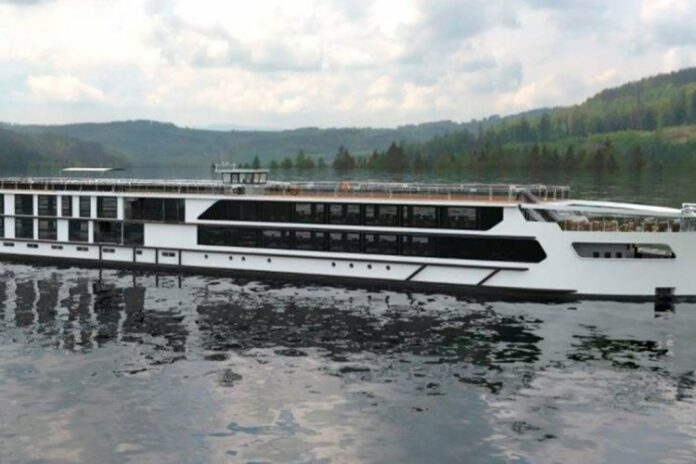
This in-house designed vessel represents a step forward in sustainable and luxurious river cruising and has the Green Award Gold Standard.

The new ship will have hybrid propulsion for reduced fuel consumption and lower emissions, high insulation, laser-controlled ventilation, and environmentally friendly materials are used for the outfitting, to name but a few features.

After the hull is completed, the cruiser can of course be adapted in many ways to suit individual customer’s needs and wishes. 

Johan Muilenburg, Project Manager at Concordia Damen, comments:

“We are excited to partner with this leading Swiss operator to deliver our innovative River Cruise 135. This contract underscores our commitment to eco-friendly practices and excellence in shipbuilding; and these are not just words! Cruise vessel owners and operators are welcome to visit our yard and see for themselves what this statement means in practice. One of the features I personally like best is the fact that we’ve integrated solar panels in the railing, which are instrumental in charging the battery system.

Another one is that we’ve proven that this design needs significantly less power to sail under normal circumstances – a real fuel- and cost saver. We are thankful to our client and very happy with this contract. After the A-Rosa Sena, this new ‘135’ proves that Concordia Damen is really establishing itself in the River cruise market, the sustainable cruise market, to be precise.”

Gasum powers Equinor’s platform supply vessel with bio-LNG

0

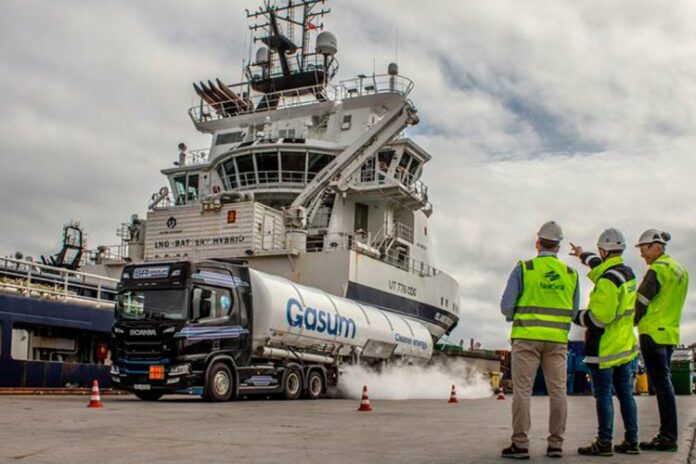
Gasum is bunkering ISCC-EU certified mass balanced bio-LNG to Equinor’s chartered platform supply vessel Island Crusader.

The first bio-LNG delivery was successfully carried out mid-July. Gasum will continue to supply Island Crusader with 2–3 truckloads of bio-LNG approximately every other week. Each truckload contains about 22 tons of bio-LNG.

Both Gasum and Equinor are committed to ambitious sustainability goals to enable a cleaner energy future. Equinor’s goal is to become a net-zero emissions energy company by 2050 and the bio-LNG deliveries to Island Crusader is one step on the journey towards achieving this goal.

Biogas is a fully renewable and environmentally friendly fuel with life-cycle greenhouse gas emissions that are, on average, 90% lower when compared with fossil fuel use. Biogas can be used in all the same applications as natural gas, including as a road and maritime transport fuel and as energy for industry.

The Island Crusader also features battery hybrid technology, which further improves its environmental performance.

Biogas production is part of the circular economy, as biogas is produced from waste feedstocks such as biowaste, sewage sludge, manure and other industrial and agricultural side streams. The organic matter generated as a by-product of biogas production is high in nutrient content. These nutrients can be further recycled for use in industry and agriculture.

Gasum is dedicated to procuring more renewable gas to satisfy the increasing demand for sustainable energy. Gasum’s goal is to offer 7 TWh of renewable gas to its customers yearly by 2027, including biomethane and e-methane. A large portion of this volume relies on establishing long-term partnerships with trusted and certified biogas producers throughout Europe.

Achieving this goal would mean combined carbon dioxide reduction of 1.8 million tons per year for Gasum’s customers.

Bespoke dual fuel standby vessels begin operations in Hong Kong

0

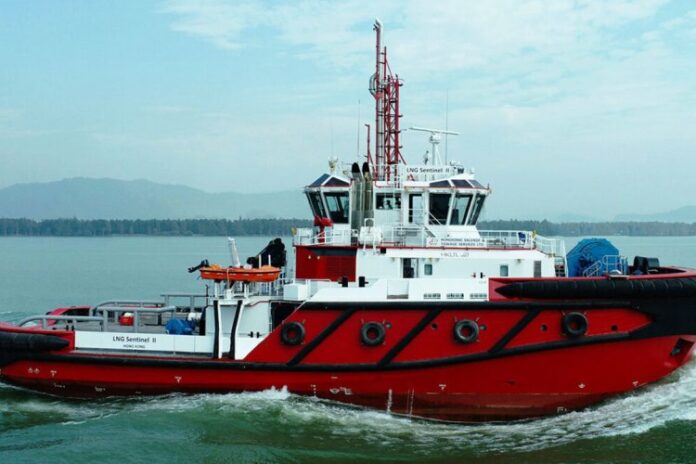
Built by Cheoy Lee Shipyards, LNG Sentinel I and LNG Sentinel II were specifically designed for service at the Hong Kong LNG Terminal Limited (HKLTL) import terminal.

Featuring a unique electrical propulsion system with Z-drives that can receive power from both diesel and dual fuel (diesel and LNG) propulsion gensets, these vessels will help maintain a safety zone around the terminal and assist with berthing of LNG carriers to the jetty. They will also transport personnel plus equipment between Hong Kong and the floating regasification and storage unit (FSRU) and jetty. Their standby duties may include emergency towing of the FSRU, fire-fighting, spill response, and rescue.

Working closely with both HKST and Cheoy Lee Shipyards through the design process was key to enabling Robert Allan Ltd. (RAL) to design this vessel pair that are customized for the missions for which they will be tasked.

These vessels are notably the 8th and 9th LNG dual fuel tugs completed to five different Robert Allan Ltd. designs, with three classification societies, and for service on three continents, which is illustrative of the company’s unique expertise in the design of workboats incorporating the use of alternative fuels and propulsion technologies for any service, class, or region.

KEY PARTICULARS

  • Length, overall: 42.0 metres
  • Beam, moulded: 16.0 metres
  • Depth, moulded: 6.6 metres
  • Maximum draft (navigational): 6.8 metres
  • Gross tonnage: 1275 tons

CAPACITIES

  • Diesel oil: 265 m3
  • LNG (gross volume): 110 m3
  • Potable water: 66 m3
  • Recovered oil: 46 m3
  • Foam: 18 m3
  • Dispersant: 12 m3
  • Complement: 11 crew + 2 supernumeraries
  • Survivors: 20 persons

RINA clears Saipem’s protocol for subsea hydrogen

0

Saipem has obtained from RINA, the multinational inspection, certification and engineering consultancy group, two significant certifications for the performance qualification methodology of materials used in the construction of subsea pipelines for the transportation of gaseous hydrogen.

One of the challenges of transporting hydrogen through converted or newly constructed pipelines is the risk of weakening materials. Saipem has developed its own protocol to evaluate the performance of the metallic materials and the relative welds to the passage of the hydrogen, which allows it to ascertain the compatibility of the pipelines in both the planning and operational phases.

RINA, specifically, has released to Saipem the Approval in Principle (AiP) and the Technology Qualification, certifications of primary importance in the development of innovative technologies, which pave the way for further qualification processes and scalable methodology.

Jan De Nul awarded two major contracts in Georgia and Kazakhstan

0

Both projects will provide a significant boost to the Middle Corridor, also known as the Trans-Caspian International Transport Route.

The maritime trade route through the Caspian and Black Seas is considered a reliable alternative to the northern route through Russia, or the southern route via the Suez Canal. However, the existing sea ports currently act as bottlenecks for cargo traversing the route.

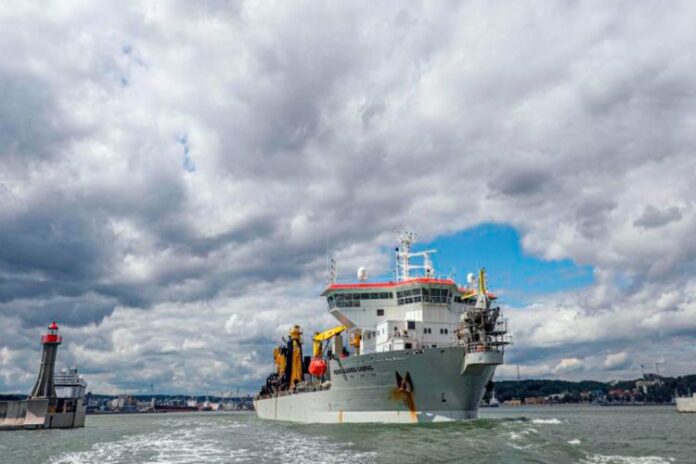
The construction of a new deep water port in Anaklia, Georgia, expanding cargo capacity by 600.000 containers, along with the expansion of the Kuryk port in Kazakhstan, will effectively address these challenges. We are involved in both projects, undertaking capital dredging work in Kazakhstan and building a breakwater, access channels and turning points in Georgia. 

Stefan Muntoiu, Business Development Manager at Jan De Nul Group:

“These projects will have a big economic impact on the region. The Georgia and Kazakhstan governments made firm decisions. We are proud to take part in the development of this important trade route.“

Another challenge for the development of the Middle Corridor is the dropping sea level of the Caspian sea due to climate change. Besides a major threat for nature and biodiversity, it also risks to restricting transport through the Caspian Sea. 

Stefan Muntoiu said:

“For sea level changes, we are actively discussing possible solutions with Turkmenistan and Azerbaijan, among others. No matter how big the challenges are, I’m convinced that Jan De Nul has the knowledge, tools and expertise to provide tailor-made solutions.”