-3.4 C
New York
Home Blog Page 141

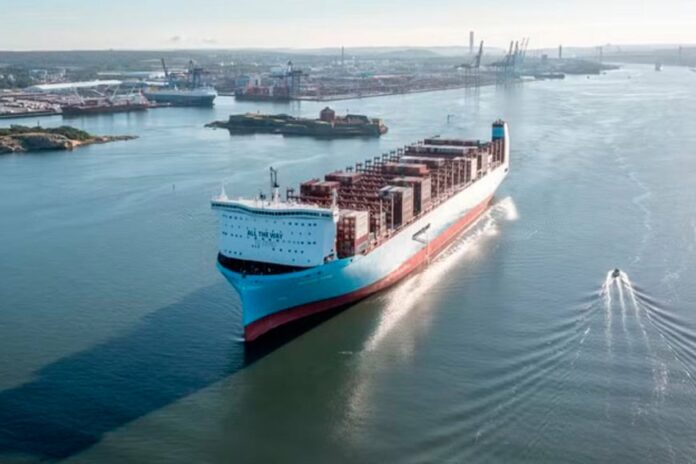
Maersk deploys largest methanol-powered ship on Gothenburg-Asia route

0

That the Port of Gothenburg now has two methanol-powered container ships that regularly call at the port.

The new ship, Antonia Maersk, with a cargo capacity of 16,592 TEU (twenty-foot equivalent units), was christened in Aarhus in August. The ship is now in service on the AE5/Albatross route, which is part of the 2M shipping alliance. With its weekly service between the Port of Gothenburg and Asia, the route forms an important connection for the Swedish and Scandinavian import and export industry. After its maiden call at the Port of Gothenburg, the ship is currently on its journey to ports in Southeast Asia.

“With Antonia Maersk, we are taking another important, concrete step in the green transition of shipping and enhancing our Sweden-based customers’ ability to further reduce their transport emissions. Before 2027, we will launch an additional 20 methanol-powered ships, so this is a journey that has just begun,” says Birna Ödefors, Area Managing Director Nordics at A.P. Moller Maersk.

Antonia Maersk is powered by bio-methanol, which means a savings of 280 tons of carbon dioxide each day the ship is in operation, according to Maersk’s own data. The daily savings are equivalent to the emissions of a truck with a trailer driving around the world more than six times.

“This ship represents another piece of the puzzle for the transition towards sustainable shipping. It is, of course, particularly exciting that this ship regularly calls at the Port of Gothenburg on one of our most important trade routes, benefiting Swedish industry. And in addition to reducing our customers transport emissions—it also reduces emissions in our port and provides cleaner air in the city of Gothenburg,” says Jacob Minnhagen, Senior Market Development Manager at the Port of Gothenburg.

Earlier this spring, the smaller methanol-powered ship Laura Maersk started calling at the Port of Gothenburg on an intra-European shipping route between Gothenburg and Bremerhaven. Antonia Maersk and Laura Maersk are both propelled by bio-methanol.

Methanol is a liquid fuel at normal temperatures, which makes it easy to handle for shipping. The handling of the fuel follows well-established safety procedures and has been managed at the Port of Gothenburg since 2015. Bio-methanol reduces CO2 emissions by approximately 65% compared to conventional fuels.

Today, there are about 30 methanol-powered container ships in operation, and nearly 300 more are on order from various shipping companies. Methanol-powered ships account for about 10% of the total order book today.

At the Port of Gothenburg, efforts are systematic and long-term to create conditions for the transition of shipping to a mix of renewable fuels, where methanol is a key component. The port aims to be able to store, handle, and provide a variety of renewable fuels, with the goal of becoming Scandinavia’s largest hub for renewable energy.
Auramarine launches ammonia fuel system for marine engines

0

Auramarine has launched an Ammonia System to accelerate the energy transition and support the industry in meeting its decarbonisation targets. 

The launch is in line with Auramarine’s commitment to support its customers in meeting their sustainability and decarbonisation targets, regardless of fuel choice. This is a natural continuation of Auramarine’s green strategy, which started with biofuels and continued with the launch of the methanol fuel system in 2022.

Auramarine has over 50 years of experience in designing and delivering entire fuel supply systems, from which the technical capabilities of the new Ammonia Fuel System is based. The Ammonia System is designed in adherence to all safety, design and material requirements. It is suitable for both two-stroke and four-stroke engines as well as other ammonia consumers. Safety measures include gas and leak detection, ammonia capture, reliquefying and Ammonia Release Mitigation (ARMS) functions. Full and ongoing training in the safe use and operation of the system will also be provided to all customers as part of Auramarine’s lifecycle services offering.

The system has been developed in collaboration with experts on ammonia as well as using findings from the HENNES research project which Auramarine is part of. In developing the Ammonia System, the partnership with HENNES helped in mitigating any risks, as well as ensuring that the system meets the full scope of client needs and complies with the highest safety requirements and regulations. 

Commenting on the announcement, John Bergman, CEO, Auramarine said:

“Ammonia offers a zero-carbon pathway to shipping’s net zero transition and, as experts in fuel supply systems for the last 50 years, we see it as our role in making its adoption a safe and viable reality. That’s why we’re pleased to launch our Ammonia Fuel System.

“In navigating the energy transition’s unknowns, experience and collaboration matter. That’s why we’ve spent significant efforts in developing this system and working with industry partners to ensure long-term performance, safety and reliability, as well as ease of use. We’re already receiving interest from shipowners, operators, OEMs, and shipyards for these units, and expect to be ready for first delivery in 2026.” 

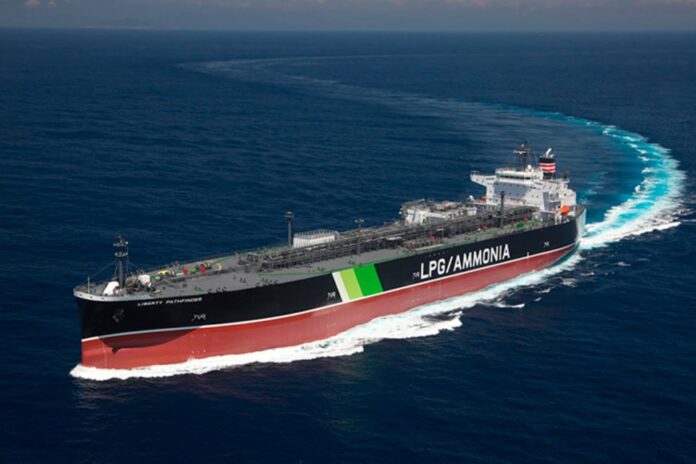
LPG dual-fuel VLGC for Astomos named “Liberty Pathfinder”

0

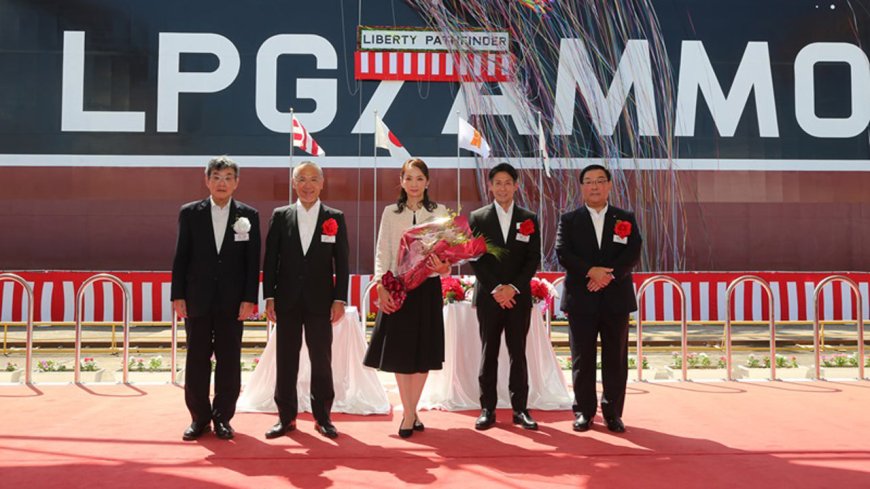
A naming ceremony was held on September 4 at the Sakaide Works (Kagawa Prefecture) of Kawasaki Heavy Industries Ltd. for a very large gas carrier (VLGC) for Astomos Energy Corporation (Astomos Energy), the world’s pre-eminent liquefied petroleum gas (LPG) company. 

About 40 people attended the ceremony, including Mitsuru Yamanaka, president of Astomos Energy, and Takaya Soga, president of NYK. Kei Sakaguchi, Astomos Energy director and general manager of its Trading and Shipping Department, named the vessel “Liberty Pathfinder,” and his wife cut the ceremonial rope holding the ship in place.

The vessel can also carry ammonia, so the name “Liberty Pathfinder” was chosen because the ship will be a pathfinder to future decarbonization, embodying the independence and freedom that epitomizes “liberty.”

The vessel is equipped with a dual-fuel engine that can use heavy oil and LPG as fuel. When LPG is used as fuel, sulfur oxides (SOx) in exhaust gas are reduced by more than 95% and carbon dioxide (CO2) by more than 20% compared with conventional heavy oil–fueled vessels.

In addition to LPG, the vessel can carry ammonia, for which demand is expected to increase as it is attracting attention as a means of realizing a decarbonized society in the future.

First offshore wind turbine stands tall at US revolution wind project

0

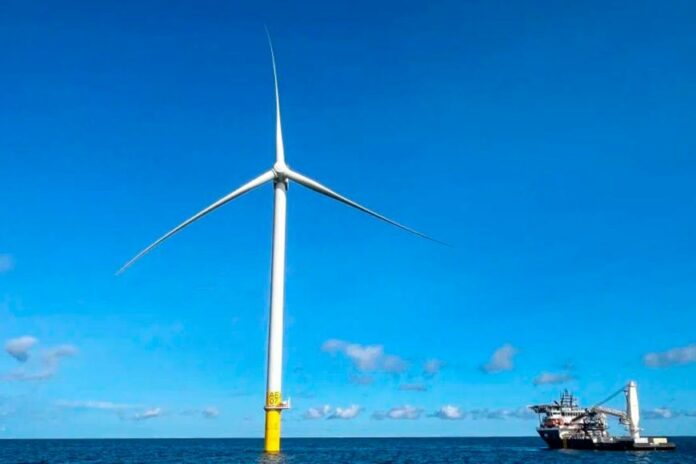
Revolution Wind will utilize 65 Siemens Gamesa turbines, the same 11-megawatt turbine model used at the recently completed South Fork Wind. Once in operation, Revolution Wind will have the capacity to generate 400 megawatts of clean, affordable offshore wind power for Rhode Island and 304 megawatts of the same for Connecticut, enough to power more than 350,000 homes and bring both states closer to reaching their climate targets.

Rhode Island Governor Dan McKee said:

“This is a monumental moment for Revolution Wind, the Northeast region, and Rhode Island. The installation of the first turbine speaks to the strong private and public partnership driving the project forward. Rhode Island is excited to build upon this progress and lead in clean energy and the offshore wind economy for decades to come.”

Connecticut Governor Ned Lamont said:

“The completion of this first turbine represents a milestone as we work towards decarbonizing our electric grid while also creating new, good-paying jobs in this growing sector for Connecticut residents.”

David Hardy, Group EVP and CEO Americas at Ørsted, said:

“Revolution Wind is bringing local union jobs and economic development to Rhode Island and Connecticut, and it will deliver clean offshore wind power to hundreds of thousands of homes in the region. We thank our state and federal partners, our hard-working construction, marine and safety teams, and our local labor, port, and supply chain partners, as we continue building this historic project.”

Revolution Wind’s offshore construction phase is powered by hundreds of union workers, three Northeast ports, and a variety of vessels – all supporting work to install the wind farm’s foundations, two offshore substations, inter-array and export cables, and wind turbines. All the work is done according to Revolution Wind’s local, state and federal approvals and with the strictest safety standards.

Meanwhile, offshore construction crews continue to make steady progress installing the foundations for the turbines, with more than three-quarters of the foundations now in place offshore.

“Rhode Island has been the proud home of many firsts for the growing offshore wind industry, and we’re excited to celebrate another major clean energy milestone today,” said U.S. Senator Sheldon Whitehouse. “Revolution Wind will help protect the Ocean State by powering its clean energy future and will support more good union jobs in a growing industry.”

“Offshore wind is one step closer to becoming a reality for Connecticut residents with this momentous milestone,” said U.S. Senator Richard Blumenthal. “I am thrilled to see this project is not only going to bring clean energy to our state, but is already delivering good paying jobs — including union jobs — for our talented workforce. As we continue to confront the climate crisis, I will keep fighting for federal funding to make our energy infrastructure and communities more resilient.”

U.S. Representative Seth Magaziner said:

“Offshore wind can help lower electric bills for Rhode Islanders while putting hundreds of tradesmen and women to work. With the completion of Revolution Wind’s first turbine, we are one step closer to bringing affordable, clean energy to power thousands of homes in our state.” 

Saipem, newcleo to explore offshore nuclear technology

0

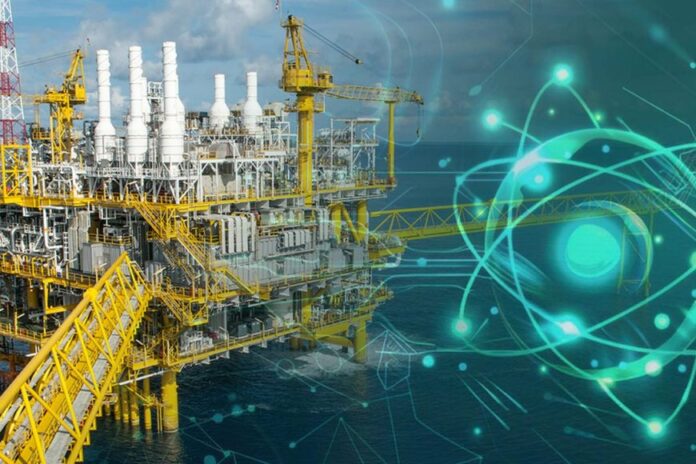
Saipem and newcleo have signed a collaboration agreement to identify solutions for the offshore application of newcleo’s technology to produce nuclear energy.

The objective of this agreement is to study the application of newcleo’s “Small Modular Lead-cooled Fast Reactor” (SM-LFR) technology to provide zero-emission electricity and process heat to oil and gas offshore installations, thereby improving their sustainability performance. The agreement also allows for the possibility of extending the use of newcleo’s technology to produce zero-emission electricity through floating nuclear units, connected to the electricity grid on land or to other users.

The collaboration between the two companies, which will combine their skills, experience and knowledge, involves the creation of a feasibility analysis on the possible development of prototypes of newcleo’s SM-LFR technology for offshore applications. newcleo’s solution employs one of the most promising technologies in the field of small nuclear fission reactors. newcleo’s technology leverages passive security systems (i.e. exploiting natural forces or phenomena without requiring active mechanisms), unique in the marine environment, enabling much greater efficiency in the use of extracted uranium compared to other types of conventional fission reactors. This is thanks to the reuse of spent nuclear fuel used by other reactors, in line with the principles of the circular economy.

Saipem’s interest in nuclear energy is part of its technological development programme, dedicated to​​energy transition, with the aim of helping to achieve Net Zero objectives by 2050. Nuclear energy is, in fact, an energy source that can efficiently and sustainably support growing energy needs and ensure the diversification and security of energy supply. In this light, Saipem intends to evaluate, the potential application of the new generation of compact reactors (Small Modular Reactors – SMR) for offshore plants, to generate power and heat with very low climate-changing emissions, equal to those of renewable energies, and therefore with a high sustainability profile.

Alessandro Puliti, CEO of Saipem, stated:

“The production of zero-emission energy through floating offshore plants equipped with new generation compact reactors could represent a new frontier in the energy transition. With this collaboration agreement, we leverage Saipem’s distinct skills in the offshore sector as well as our ability to bring innovation to the world of energy infrastructure, to explore new solutions that can accelerate the path towards decarbonisation.”

Stefano Buono, CEO of newcleo, commented:

 “Saipem is a global leader in the engineering and construction of large projects in the energy and infrastructure sectors, both offshore and onshore, and is an ideal partner for newcleo, which aims to collaborate with the main players in the energy world to promote technological innovation for a sustainable future. Our next generation reactor technology will not only reduce the environmental impact of offshore oil and gas operations improving energy efficiency and promoting long-term sustainability, but also design offshore power plants that can provide decarbonised electricity onshore, anywhere in the world. This is the first agreement between two European companies for the offshore application of our sustainable nuclear technology and we are honoured to work with such a recognised partner. We believe that this synergy can revolutionise the industry, contributing in a concrete and meaningful way to the decarbonisation of the sector and to the global energy transition.”

Wärtsilä secures pivotal role in developing Singapore’s Next-Generation Vessel Traffic Management System

0

Technology group Wärtsilä has been awarded the prototyping tender for the revolutionary Next Generation Vessel Traffic Management System (NGVTMS) project by the Maritime and Port Authority of Singapore (MPA). This initiative is set to transform maritime safety and efficiency at one of the world’s busiest ports. The order was booked by Wärtsilä in Q3 2024. 

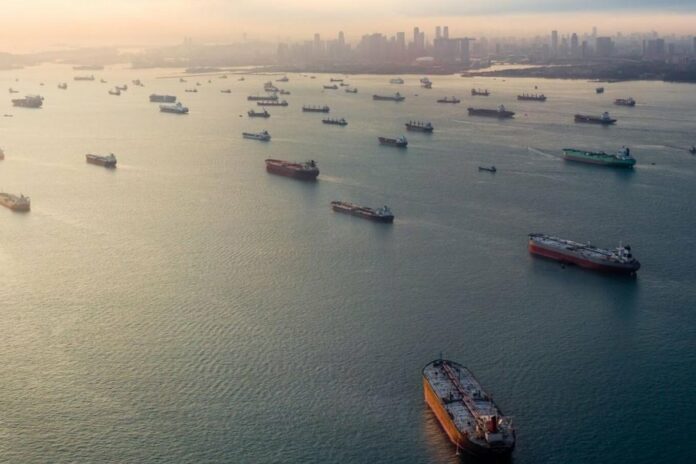
As Singapore continues to elevate its status as a global maritime hub, the increasing traffic volumes highlight the need for more sophisticated and proactive traffic management solutions. In response, MPA is leading the charge in pioneering AI-enabled solutions to enhance navigational safety and port efficiency. Following an extensive assessment and preparation phase, Wärtsilä, along with other global leaders, was selected in April 2024 to undertake this ambitious project.

“MPA is committed to the maritime industry’s digital transformation and green transition by leveraging cutting-edge technology and working with like-minded partners to enhance the safety, efficiency and sustainability of port operations,” says David Foo, Assistant Chief Executive (Ops-Tech) at the Maritime and Port Authority of Singapore (MPA). “MPA awarded the tender to three companies, including Wärtsilä, to develop the NGVTMS prototype using an agile approach, based on open system architecture. With its innovative solutions and deep domain knowledge, Wärtsilä will play an important role in this project and help explore new standards for maritime traffic management.”

Over the next 15 months, Wärtsilä will collaborate at the MPA’s Maritime Innovation Lab 2.0. Wärtsilä’s focus will be on developing a system with an open architecture enhanced by advanced features, including data analytics to pinpoint traffic hotspots and machine learning algorithms capable of predicting potential collisions. This technology empowers vessel traffic officers to manage increased volumes and complex traffic scenarios safely.

“The NGVTMS initiative represents a collaborative venture aimed at redefining the future of maritime traffic management through advanced technology and shared expertise. Wärtsilä is honoured to bring our state-of-the-art solutions and deep industry knowledge to this transformative project, helping to establish new benchmarks in the field,” comments Hannu Mäntymaa, Vice President for Voyage Services, Wärtsilä Marine.

Wärtsilä’s approach to this project will showcase the company’s unique strengths with a broad portfolio in the maritime domain leveraging its advanced capabilities in new alternative fuel engine management, fleet and port optimisation and state-of-the-art simulation and training technologies. This aligns with the company’s purpose to enable sustainable societies through innovation in technology and services.

Wärtsilä’s Vessel Traffic Management Systems are already implemented in over 55 countries with more than 300 installations worldwide. Wärtsilä’s commitment to innovation and sustainability closely aligns with Singapore’s vision for a smarter, greener maritime sector, making it a key player in the wider energy transition agenda making it a key player in the wider energy transition agenda.

Halliburton confirms data was stolen in ongoing cyberattack

0

In a brief filing with government regulators on Tuesday, Halliburton said it was “evaluating the nature and scope of the [stolen] information,” and what data breach notifications it is required to make.

Halliburton last week said it took some of its systems offline following the detection of the cyberattack. The company now says it is “working to identify effects of the incident” on its ongoing oil and fracking operations.

When contacted on Tuesday, Halliburton spokesperson Amina Rivera did not comment or say if the company knows what kinds of data were stolen. “We are not commenting beyond what was included in our filing,” said Rivera.

Halliburton says its “ongoing investigation and response” includes the restoration of its systems and the “assessment of impacted data.” Much of the company’s public-facing systems remain offline at the time of writing, TechCrunch has found.   

The oil and fracking giant — one of the world’s largest energy companies — has close to 48,000 employees in dozens of countries, according to its most recent public filings. Halliburton remains largely synonymous with the explosion and oil spill caused by the Deepwater Horizon oil rig disaster in the Gulf of Mexico in 2010 (pictured). Halliburton subsequently agreed to plead guilty and settle U.S. government charges for $1.1 billion.

Halliburton has said little else about the ongoing cyberattack. When asked, Halliburton spokesperson Rivera did not dispute the incident was linked to ransomware. 

TechCrunch has seen a copy of a ransom note purportedly related to the Halliburton incident that claims to have encrypted and stolen the company’s files. The note says a ransomware gang known as RansomHub is taking credit for the cyberattack. 

RansomHub’s dark web leak site, which the gang uses to publish stolen files to extort its victims into paying a ransom, has not yet listed Halliburton as one of its victims. It’s not uncommon for ransomware and extortion gangs to publish the name of its victims when negotiations fall through. 

A representative for RansomHub, when reached by TechCrunch, did not comment on the Halliburton hack.

According to a recent U.S. government assessment of the ransomware gang, RansomHub has claimed more than 210 victims since its inception in February 2024. The gang is also linked to the cyberattack at U.S. health tech giant Change Healthcare.

Halliburton said it has and will continue to incur expenses related to the cyberattack. Halliburton made $23 billion in revenue during 2023, and its chief executive Jeff Miller made $19 million in total executive compensation during the year.

Halliburton would not say who presently oversees cybersecurity at the company, and would not make them available for an interview.

Source: TechCrunch 

Damen signs contract with AMBPR at SMM for five state-of-the-art paint robots

0

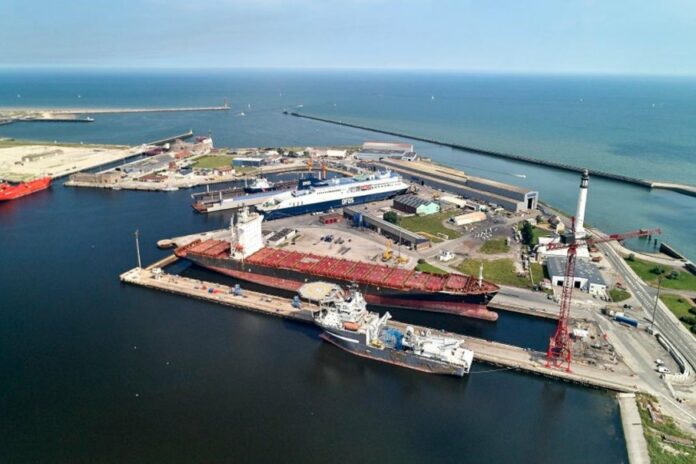
Following years of collaboration and recent successful final trials, Damen Shiprepair Dunkerque (DSDu) has signed a contract with AMBPR, a subsidiary of SERCEL Group, for the supply of five Autonomous Mobile Blast & Paint Robots. 

The robots are revolutionary, bringing with them many advantages over conventional painting methods, the most significant being in the fields of sustainability and health and safety, as well as being faster and the quality more consistent.

The robots are also designed to do much more than just painting. They can be programmed to undertake complete hull restoration cycles including washing, grit / hydro blasting, painting and final inspections. No human intervention is required aside from tool changes, which take no more than twenty minutes each. The new autonomous robots will initially be powered by hybrid energy but can be upgraded to 100% electric in the future for use in environments that require zero emissions.

The health and safety benefits are derived from the fact that the personnel responsible for the equipment no longer need to be in the immediate vicinity of the hazardous, high-pressure blasting activities using water and grit. The blasting agents, overspray and the other residues from the painting are also contained to protect personnel in the area from inhaling them as well as preventing pollution of atmosphere. An additional benefit of this is that other activities nearby can continue without interruption. 

The process is also highly sustainable. Not only does the precision of the robots result in less paint and water being used per square metre, around 90% of the water that is used by the AMBPRs is collected, cleaned and reused, thereby reducing the impact that DSDu has on the environment and workforce. This alignment with Damen Shipyards Group’s commitment to sustainability throughout its operations makes AMBPR and DSDu natural partners.

The signing ceremony took place at SMM on September 4 with Jeroen Heesters, Managing Director of the Damen Shiprepair Division, Fabien Guillemot, Managing Director of DSDu, Stephane Renouard, President and Founder of AMBPR SAS, and Claude Pelzer, VP Operations SERCEL Group Saint Gaudens. 

AMBPR, a SERCEL Group company, has been working with DSDu since it was founded to develop the technology twelve years ago, with the shipyard providing the perfect testing ground as the designs evolved. 

“The successful implementation of this advanced technology represents a significant leap forward for Damen Shiprepair Dunkerque and the industry in general, says Jeroen Heesters. “We remain committed to pushing the boundaries of innovation and sustainability in ship repair, and achievements such as the 90% recycling of the water that the AMBPR robots can deliver gives us a competitive advantage with ship operators who are looking to reduce their own ecological footprints.”

Saipem awarded two offshore contracts in Saudi Arabia worth approximately 1 billion USD

0

Saipem has been awarded two offshore contracts in Saudi Arabia under its existing Long-Term Agreement with Saudi Aramco. 

Saipem’s scope of work under the first contract involves the engineering, procurement, construction, and installation (EPCI) of three production deck modules (PDMs), 33 kilometers of subsea rigid pipelines with diameters of 12 inches and 16 inches, and 34 kilometers of subsea power cables. The infrastructures will be installed in the Marjan oil and gas field.

The second contract involves the EPCI of three jackets, five PDMs (Production Deck Modules), 22 kilometers of subsea rigid pipelines with a diameter of 16 inches, 5 kilometers of subsea flexible pipelines, and 35 kilometers of subsea power cables. The infrastructures will be installed in the Zuluf and Safaniyah oil fields.

For the offshore component of the two projects, Saipem will deploy its construction vessels that are operating in the region.

The fabrication related to the projects will be executed at Saipem’s Saudi fabrication yard, Saipem Taqa Al-Rushaid Fabricators Co. Ltd., aiming to increase and develop the capabilities of local industry.

The awards strengthen Saipem’s presence in Saudi Arabia and its longstanding relationship with Aramco.

Corvus Energy inherently gas-safe marine fuel cell system awarded type approval by DNV

0

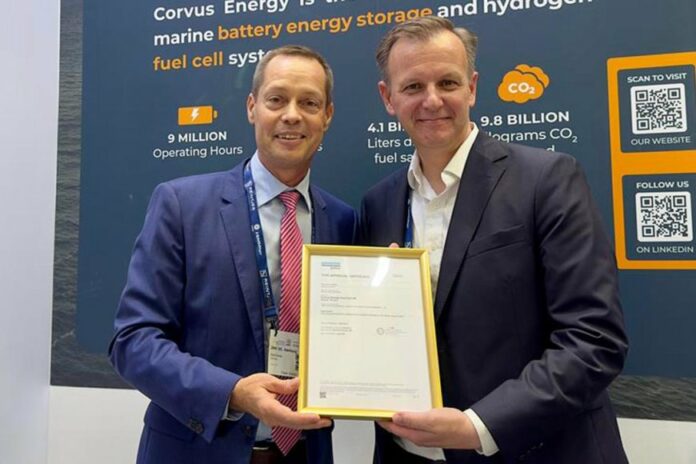
Receiving type approval from DNV, a leading maritime classification society, confirms that the Corvus Pelican Fuel Cell System meets the most stringent performance and safety standards required by the maritime industry.  

Olaf  Drews, Head of Engines & Pressurized Equipment Maritime says,

“It is a special fuel cell system, because the Pelican uses nitrogen for inerting of the fuel cell space. It is the first fuel cell system that uses this technology and this brings it to a very preferred safety level. This is a milestone, and we look forward to the first ship project.”

Despite technology improvements and advancements in battery electric vessels, most vessels cannot achieve zero-emission operations for extended periods of time using batteries alone.  For vessels on longer routes and vessels that are unable to charge often enough, we need to add clean fuel and fuel cells to enable extended zero-emission capabilities.

Corvus` CEO, Fredrik Witte is clear on the success factors for the project:

“Toyota`s unsurpassed knowledge in developing high-quality and efficient fuel cells, in addition to the strong collaboration and high level of maritime experience among the partners in this development project, has been key.  This is a milestone for net zero shipping. We now have a high-quality range extender to add to our existing ESS portfolio with the scalability and the safety needed to be a real driver in the future of marine decarbonization.”