3.9 C
New York
Home Blog Page 1331

Djibouti Government Nationalizes Port Company

0

The Republic of Djibouti has nationalized the company that owns a majority stake in the Port de Djibouti SA (PDSA). This latest move in its clash with DP World follows an order from the President issued on September 9 which calls for the immediate nationalization of all the shares and social rights of PDSA in the Doraleh Container Terminal (DCT) joint venture with DP World. 

This government says that the decision aims to protect the fundamental interests of the nation of Djibouti and the legitimate interests of its partners and to ensure that the situation of the DCT joint venture company aligns with reality, as it has not been in charge of the container terminal of Doraleh since the termination of the concession contract in February 2018.

DP World will therefore have the State of Djibouti as a single interlocutor for all the discussions regarding the consequences of the concession contract termination.

Djibouti terminated the DCT contract due to what it calls “severe irregularities,” and says the contract was prejudicial to the fundamental interests of the Republic of Djibouti, to the development of the country and to its ability to control its most strategic infrastructure asset.

“DP World's "strategy", which consists in trying to oppose the will of a sovereign state, is both unrealistic and destined to fail. In any case, the proliferation of legal procedures, the 'fake news' campaigns and the intimidation attempts against Djibouti will have no effect on the case. That is why a fair compensation outcome is the only possible option for DP World, in line with the principles of international law.”

The move follows a decision earlier this month by the High Court of England & Wales which granted an injunction restraining PDSA from treating its joint venture shareholders’ agreement with DP World as terminated. 

The High Court has further prohibited PDSA from removing directors of the DCT joint venture company who were appointed by DP World. PDSA is not to interfere with the management of DCT until further orders of the Court or the resolution of the dispute by a London-seated arbitration tribunal.

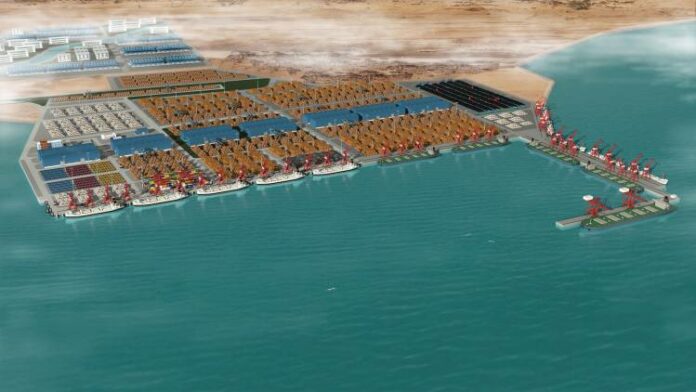
On February 22, the Djibouti government seized control of the DCT from DP World, which had been awarded the concession in 2006. The move came after the government had attempted to force DP World to renegotiate the terms of the port concession. The port has three berths and an annual capacity of 1.2 million TEUs.

This is the third legal ruling in relation to the DCT following two previous decisions from the London Court of International Arbitration, all of them in favor of DP World. 

Source:seawanderer.net

ROCK-DUMPING VESSELS

0

Rock dumping vessels (Fall Pipe Vessel) are a category of watercraft that exist for the purpose of dumping rocks on the seabed. They are able to transport and dump rocks of variable sizes. The vessels range from large bulk-carrier style vessels, able to carry out precision operations using fallpipes, to smaller deck-loading vessels mainly used for erosion remediation.

Almost all such vessels are fitted with a dynamic positioning system, which makes it possible to position rocks very accurately. Large cranes or fall pipes are used to dump the rocks from the vessels. Side-discharging by means of crane is usually done in shallow waters, while fall pipes are more commonly used in deep-water rock-dumping operations.

The most common need for rock dumpers is to provide protection to previously laid pipelines in areas where they may be damaged by fishing gear. Pipelines at risk are not trenched, but remain on the seabed. There are a number of protection methods for such pipelines, including the placement of concrete mattresses, but for areas where a long distance of pipeline has to be protected, a rock-dumping operation may be most cost efficient.

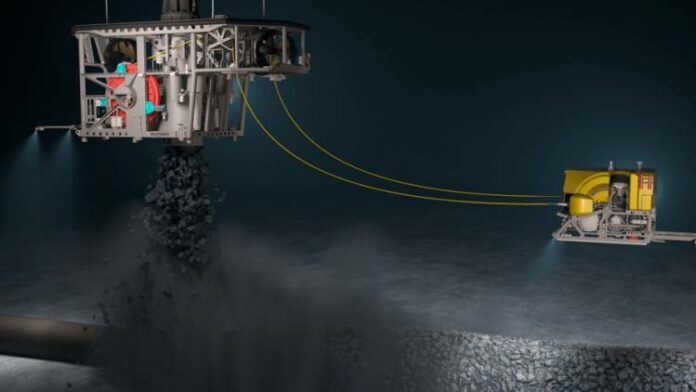
Fall pipe vessels (FPV) are equipped for rock installation at great water depths. The fall pipe end is positioned by a powerful remotely operated underwater vehicle (ROV) and allows for accurate rock installation on the seabed.

This equipment is most frequently applied to support the offshore oil and gas industry. The precision with which the rock is placed increases the safety of offshore pipelines from scouring and also anchors of other ships passing by.

Fall pipe vessels have been developed specifically for rock installation. Depending on the ship, a fall pipe may be able to install rocks with a size up to 400 mm in water depths ranging from 50 to 2200 metres.

To keep up with the pace of oil and gas field developments in deeper waters the dredging industry created an entirely new tool: A fall pipe, which could guide the rocks from the water surface underwater to much greater depths.

The video below shows typical rock dumping offshore operations.

At the end of the 1970s a steel, telescopic fall pipe was developed for rock installation at water depths significantly exceeding 50 metres. The large diameter steel fall pipes are, however, sensitive to drag and gravity forces.

In the mid-1980s an improved technique was developed based on a semi-open, flexible fall pipe consisting of a string of bottomless, heavy plastic buckets along two chains. At the lower end of the string a remotely operated, propelled vehicle (ROV) was attached. The ROV was equipped with a range of sophisticated technologies such as a camera and survey and positioning equipment. This flexible fall pipe design, with the ROV, installed on a dynamically positioned vessel, was able to achieve more accurate placement of rock by correcting the off-setting caused by currents. The drag forces were lower and therefore the system was less sensitive to rupture. This guaranteed a higher workability as the semi-open and flexible string of buckets is able to adjust its shape to the currents.

In the early 1990s DGPS (Differential Global Positioning System) was introduced in the offshore oil and gas and marine construction worlds: Differential drift of the rock-laying fall pipe vessel with respect to the subsea pipeline or cable could be achieved by dynamic positioning.

The success of this technique has proven invaluable as the dredging industry has become more and more involved with the offshore energy industry, working at ever greater depths.

DREDGING TECHNOLOGY AND DREDGERS

0

Dredging is a displacement of soil, carried out under water. It serves several different purposes. One of the applications meets the need to maintain minimum depths in canals and harbours by removing mud, sludge, gravel and rocks. Maintenance dredging is now only a basic task, while other fields are growing in demand much faster: creating new land for port and industrial development; trenching, backfilling and protection work for offshore pipelines, coastal outfall pipelines and for cables laid on the sea bed; environmental dredging and clean-up of contaminated sediments; replenishment of beaches and coastlines, not only for coastal protection, but also for recreational uses.

There are two methods of dredging: mechanical excavating and hydraulic excavating. Mechanical excavating is applied to cohesive soils. The dredged material is excavated and removed using mechanical means such as grabs, buckets, cutter heads or scoops. Hydraulic excavating is done with special water jests in cohesionless soils such as silt, sand and gravel. The dredged material which has been loosened from the sea-bed is sucked up and transported further as a mixture (solid material and water) using centrifugal pumps.

Mechanical dredgers

Backhoe dredger – A backhoe dredger is based on the giant land-based backhoe excavator that is mounted at one end of a spud-rigged pontoon. Its main advantage is its ability to dredge a wide range of materials, including debris and soft, weathered or fractured rocks.

Bucket chain dredger – Bucket chain dredge or bucket ladder dredge is a stationary dredger equipped with an endless chain of buckets carried by the ladder. The buckets are attached to a chain and graded according to size (200 to 1000 litres). Bucket dredgers are held in place by anchors. These days, this classic vessel is mainly used on environmental dredging projects.

The bucket chain dredger uses a continuous chain of buckets to scoop material from the bottom and raise it above water. The buckets are inverted as they pass over the top tumbler, causing their contents to be discharged by gravity onto chutes which convey the spoil into barges alongside. Positioning and movements are achieved by means of winches and anchors.

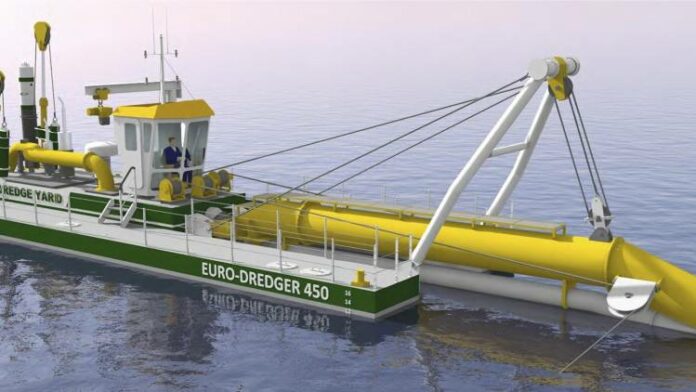
Cutter suction dredger – The cutter suction dredger is a stationary dredger equipped with a cutter head, which excavates the soil before it is sucked up by the flow of the dredge pump. During operation the cutter suction dredger moves around a spud pole by pulling and slacking on the two fore sideline wires. These dredgers are often used to dredge trenches for pipe lines and approach channels in hard soil. Seagoing cutter suction dredgers have their own propulsion. See also Cutter suction dredger d’ARTAGNAN.

Grab dredger – A grab dredger employs a grab mounted on cranes or crane beams. Dredged material is loaded into barges that operate independently. Grabs can manage both sludge and hard objects (blocks of stone, wrecks) and this makes them suitable for clearing up waters that are difficult to access (canals in cities), or for gravel winning and maintenance dredging on uneven beds.

Suction dredgers

Plain suction dredger – A plain suction dredger is a stationary dredger positioned on wires with at least one dredge pump connected to the suction pipe situated in a well in front of a pontoon. The dredged soil is discharged either by pipeline or by barges.

Trailing suction hopper dredger (TSHD) – The trailing suction hopper dredger is nonstationary dredger, which means that it is not anchored by wires or spud but it is dynamically positioned; the dredger uses its propulsion equipment to proceed over the track. It is a shipshaped vessel with hopper type cargo holds to store the slurry. At each side of the ship is a suction arm, which consists of a lower and a higher part, connected through cardanic joints. Trailing suction hopper dredgers are used for maintenance work (removal of deposits in approach channels) and dredging of trenches in softer soils.

TSHD has several special features, the main one being a drag arm which works as vacuum cleaner. Drag arm consists of a suction bend, lower and upper suction pipes connected via double cardan hinge and a draghead.

The suction bend is mounted in a trunnion which forms part of the sliding piece; as the pipe goes outboard the sliding piece enters the guide on the hull and is lowered until the bend is in line with the suction inlet below the waterline.

The suction pipe can be equipped with an integral submerged dredge pump. Submerged dredge pumps have become more and more popular with operators of larger trailing suction hopper dredges. Locating the dredge pump in the suction pipe positions is much closer to the seabed than a conventional dredge pump housed in the hull.

The drag arm is hoisted outboard and lowered to dredging depth with the aid of gantries. When not in use, it is lifted above the main deck level and pulled inboard with the hydraulically powered gantries for storage.

Discharge operations, discharge installations

When the vessel has to be discharged, jet pumps are used in the hopper to dilute the spoil so that it can be pumped ashore or discharged o the seabed through bottom doors. Occasionally, accurate placement of the material at great depths is possible via the suction pipes.

Fixed means of transporting dredged soil requires a floating pipeline from ship to shore, a powerful pump and a special link between pipeline and vessel – the bow coupling. Fixed and flexible models are in use. Fixed bow coupling has one degree of freedom (pitch), the flexible one has two degrees of freedom (pitch and turn). The flexible bow coupling can handle difficult sea conditions and reduces loads on the floating pipeline.

The mixture can also be jetted forward over the ship bow via a mixture jetting nozzle (rainbowing).