-12.9 C
New York
Home Blog Page 659

UECC replaced conventional fuel with biofuel onboard Ro-Ro vessel Autosky

0

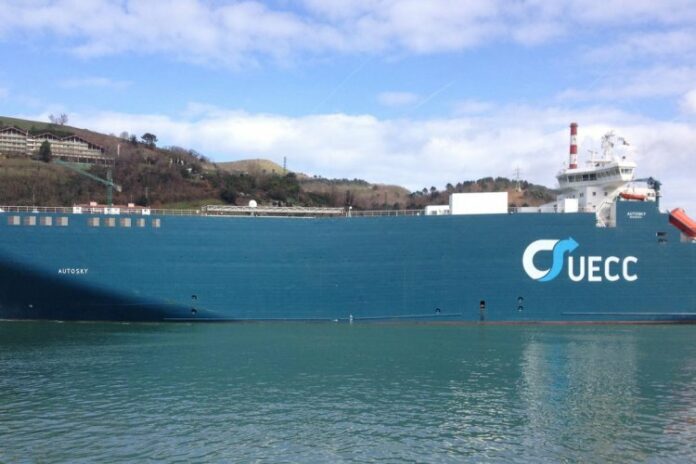
In a 12-month trial, United European Car Carriers (UECC) replaced conventional fuel with biofuel onboard the 20-year-old, 140m long Ro-Ro vessel Autosky. The results give a tantalising view of how aging assets can be transformed into environmental front-runners almost overnight.

With a stringent IMO target of reducing maritime GHG emissions by 50% by 2050, and growing environmental awareness throughout society, there’s a natural emphasis on replacing “dirty” aging vessels with modern, efficient assets. That’s understandable, says Daniel Gent, Energy & Sustainability Manager at UECC, but it has an add on cost and comes with its own environmental impact.

He ponders:

“But what if there was a ‘drop-in’ solution? A means of dramatically improving the environmental performance of the current fleet without significant modification? That could be an important stepping stone on maritime’s transitional journey to a sustainable future.”

In March 2020 the 6,500dwt car carrier, boasting a 2,080-vehicle capacity, started an innovative trial. After a deep cleaning of its fuel tanks, and appropriate crew training, the vessel swapped conventional fuel for sustainably sourced biofuel. Provided by supplier GoodFuels, this green shipping ‘smoothie’ is made from a variety of food stocks, including processed cooking oil. Compared to HFO it’s an ultra-clean alternative.

The initial three-month pilot was extended to a year with support from BMW Group, a key UECC customer.

The results, Gent explains, constitute “a remarkable achievement” with stunning emissions reductions.

Over the course of the initiative Autosky used 6,000 tons of biofuel, reducing its overall CO2 (per ton-km) from 85.62gCO2/tkm in 2019 to 35.96gCO2/tkm. In other words, an almost 60% reduction in carbon intensity. To put this into context, IMO has set the seemingly ambitious target of a 40% reduction by 2030.

The figures are impressive. In total Autosky reduced CO2 emissions by 20 million kilograms, equating to a reduction of around 9,000 kilograms of sulphur oxide and a near total elimination of particulate matter. As a result, UECC has now decided to continue with the use of biofuel for the vessel – which serves a short sea route from Rotterdam to Zeebrugge, Santander, Pasajes and back to Rotterdam – introduced it on another ship, and is now investigating the possibility of utilising bioLNG for its operations in the Baltic.

Gent comments:

“We are committed to being at the front of shipping’s green transition and providing low emission or carbon neutral solutions. As we can see from this trial, that’s now viable on ‘legacy’ tonnage.”

The UECC executive sees potential for greater uptake right across the industry – a move that can be accelerated with governmental incentives (allaying extra cost) and buy in from cargo owners.

Gent concludes:

“If biofuel is to succeed as a marine fuel, customers need to back it, embracing this simple, tried and tested solution as an excellent way to reduce the total lifecycle footprint of their goods. More and more cargo owners are focused on their own environmental goals throughout the value chain, as well as meeting demands of both society and other key stakeholders, so I think, as awareness grows, increasing numbers will come on board.”
First vessel call at HHLA PLT Italy

0

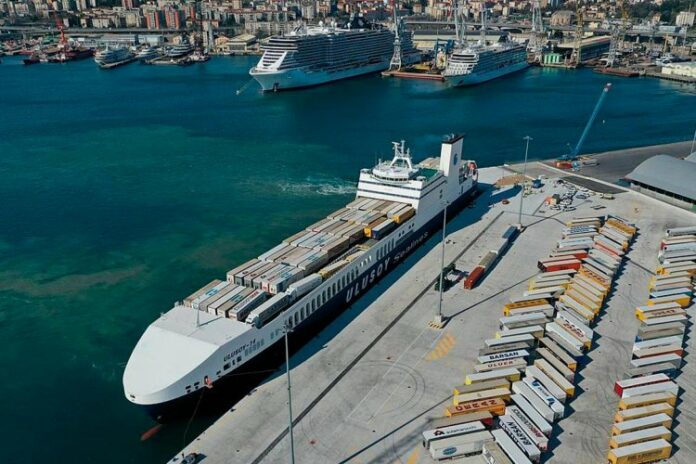
This is the first commercial vessel call at the new multi-function terminal majority-owned by Hamburger Hafen und Logistik AG (HHLA) since the beginning of the year. 

Representatives of the shipping company, the Port Authority, terminal staff and the newly appointed Managing Director of HHLA PLT Italy, Antonio Barbara, welcomed the vessel on its arrival.

The M/S Ulusoy 14 is a RoRo ferry of the shipping company Ulusoy Sealines, based in Turkey with a longstanding experience in servicing the Mediterranean, represented in Italy by the General Agent Samer & Co. Shipping. The vessel operates in regular liner service between Cesme, located west of Izmir in Turkey, and the Adriatic seaport of Trieste. In future, Ulusoy Sealines will call at the HHLA PLT Italy terminal every Saturday to discharge and load trucks, trailers and swap body containers. The ship has a length of 208 metres and a capacity of 4,100 lane metres. A new 35-metre-wide ramp specially built for RoRo handling is available at HHLA PLT Italy able to handle the newest generation of RoRo ships deployed in the Mediterranean.

Philip Sweens, Managing Director of HHLA International:

“I’m delighted to have Ulusoy Sealines as our launch customer for our new Adriatic terminal. Together with our Italian partners and a highly motivated team, HHLA has worked intensively in recent months to successfully begin operations at HHLA PLT Italy. I would like to thank the Port Authority of Trieste as well as all other involved authorities for their support and contribution to making this first call a reality.”

Mesut Cesur, General Manager Ulusoy Sealines Management SA:

“We congratulate HHLA for their investment in HHLA PLT İtaly terminal in Trieste and commencing their terminal services with M/S Ulusoy 14 as the first vessel. We are proud to have the honour of being the first ship-owner to use the PLT terminal under the management of HHLA whom we consider as worldwide well-known top experienced terminal and port operators. We wish the best of success to HHLA both in our mutual cooperation and in their future running of their new venture in Italy with the PLT terminal. In the meantime we would like to express our sincere thanks to the Trieste Port Authority and our business partner Samer & Co. for their utmost efforts and cooperation for the commencement of operations in the PLT Terminal in a short period.”

Van Oord plans for long-term efficiency with ABB Turbocharging service agreement

0

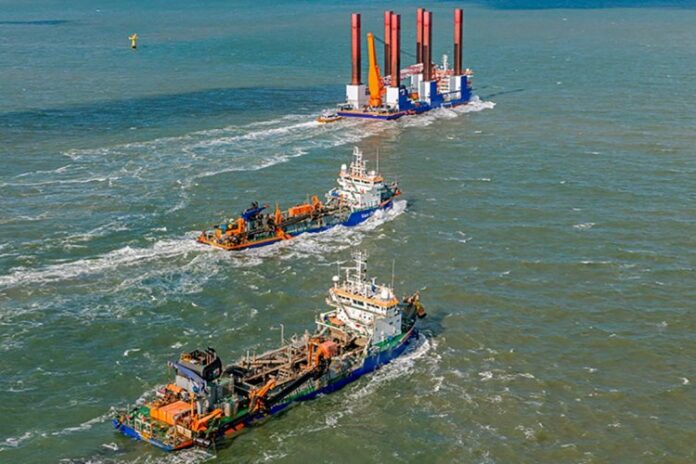
Dutch dredging company Van Oord has signed a three-year agreement with ABB Turbocharging to provide fleetwide maintenance and optimization services. The agreement comes as two Van Oord vessels receive the first turbocharger upgrades of their kind in the dredger sector, saving thousands of tons in fuel and carbon emissions over the next decade.

The service agreement, which marks more than thirty years of cooperation between Van Oord and ABB Turbocharging, will help the owner minimize lifecycle costs and improve emissions across its fleet. As well as offering full technical support and access to the latest turbocharger technologies and digital solutions, ABB Turbocharging will provide maintenance planning and budget control based on a ten-year strategic outlook.

Jorn Bertens, Category Manager Ship Management, Van Oord, said:

“With fleet renewal underway and the IMO 2030 target approaching, we are jointly searching for continuous improvements in sustainability.” 

Andre Kreemer, Responsible Fleet Manager, Van Oord, added:

“Technical support is more important than ever as we introduce new engine technologies to our fleet, and we are pleased to extend this cooperation with a trusted partner.”

Ron Vlasblom, General Manager Turbocharging Benelux, ABB Turbocharging said:

“Turbocharger maintenance and upgrades play an important role in keeping vessels operating at optimal efficiency. Multi-year agreements give extra certainty and a long view that you cannot get when working on an ad hoc basis. This is the third such agreement we have signed with Van Oord and we are delighted to have earned their trust over our many years of working together.”

Van Oord’s largest trailing suction hopper dredging vessel was the first dredger to receive an upgrade to ABB’s TPL-A turbochargers. A similar upgrade will be performed on a second large dredger. The two upgrades are projected to save thousands of tons in fuel and carbon emissions over the next decade.

The TPL turbocharger component upgrade consists of improvements to several key components, including new compressor wheel and diffusor designs, improved turbine and nozzle ring, and optimized low friction bearings. As well as significant fuel savings, the reduction in exhaust gas temperatures also improves reliability, resulting in lower maintenance costs and downtime.

Equinor to conduct fish survey at Hywind Scotland Floating OWF

0

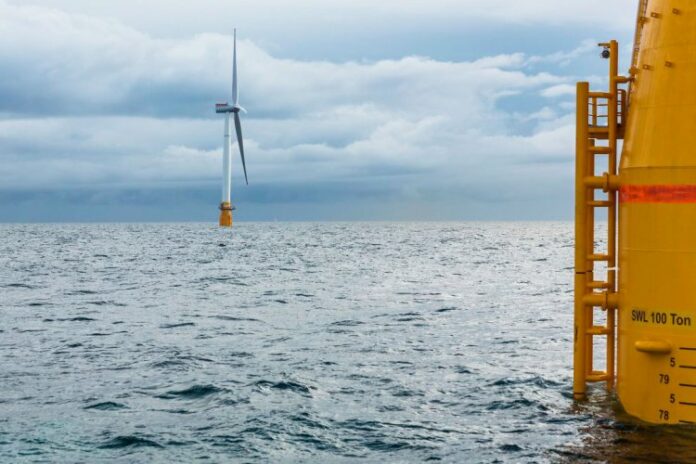
“Hywind Scotland is the world’s first floating wind farm. This pilot park, at the East coast of Scotland,” has been producing since 2017 and is operated by Equinor.

Having learned about the work of Akvaplan-niva in the “GLIDER” project, Equinor has now contracted Akvaplan-niva to deploy a glider to perform a fish survey by the wind farm. The data collected in the survey will help scientists to identify whether the windmill infrastructure creates a reef effect leading to aggregation of fish.

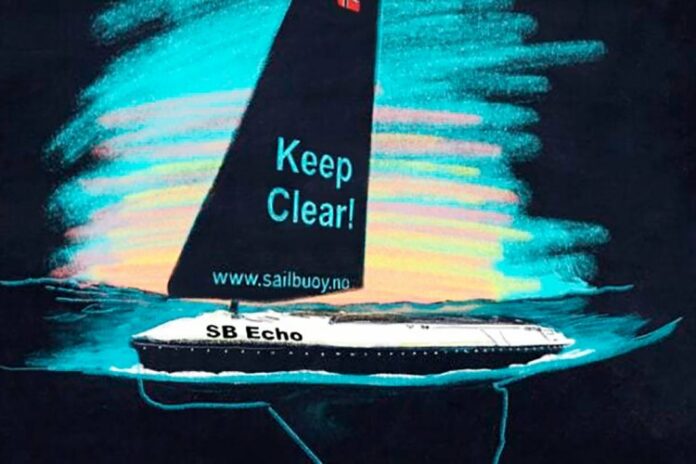
Akvaplan-niva operates 3 different types of gliders. For this operation we will use our Sailbuoy. This glider is 60 kg and 2 meters long. It utilizes wind for propulsion and solar energy to charge the batteries that power the sensors, the navigation system and the satellite communication. For the fish survey the glider will be equipped with a Simrad broad band echo sounder (WBT mini EK80).

The Sailbuoy will be deployed from Norway and a Sailbuoy pilot, Yngve Svensby, will operate the glider remotely from his PC as it crosses the North Sea to Peterhead where it will carry out its mission. After one month of survey, the Sailbuoy will be piloted back to Norway and be recovered from the sea.

This project exemplifies how green digital technology allows scientists to collect large datasets without any CO2emission as with traditional survey vessels. Further, as there are no personnel at the survey site, we avoid accidental risks, minimize costs and we free time for scientists to work on data interpretation. All of this add scientific value which may lead to digital innovation.

Parkwind selects DEME Offshore for foundation EPCI contract at Arcadis Ost I

0

DEME Offshore has been awarded a substantial Engineering, Procurement, Construction and Installation (EPCI) contract for the foundations at Parkwind’s Arcadis Ost I offshore wind farm. 

The next-generation XXL monopiles will be the largest ever installed in Europe with a weight of around 2,000 tonnes each.

The Arcadis Ost I wind farm is developed by the Belgian offshore wind specialist Parkwind and has a capacity of 257 MW. The wind farm will be located in the Baltic Sea, northeast of the island of Rügen in the coastal waters of Mecklenburg-Vorpommern, Germany.

Manufactured by Steelwind in Germany, the 28 XXL monopile foundations will be about 100 m long and weigh around 2000 tonnes each. One of the 28 foundations will support the offshore substation. The monopiles for the wind turbines will not be equipped with common transition pieces but will have a direct connection with the turbine tower.

DEME Offshore will deploy the DP3 offshore installation vessel ‘Orion’ for this project. ‘Orion’ is a front runner in the industry – effectively a mega monopile installation machine – and will be equipped with a tailor-made, motion compensated gripper system able to handle enormous foundations of up to 2,500 tonnes.

Bas Nekeman, Business Unit Director DEME Offshore:

“Being awarded such a pioneering project highlights how Parkwind has confidence in the game-changing DP3 offshore installation vessel ‘Orion’. DEME Offshore is delighted that it will be the first company to install these XXL monopiles, as the offshore wind industry takes the next step forward. With ‘Orion’ we will be strongly positioned to offer solutions for the installation of larger foundations and turbines, and large-scale wind farm projects such as Arcadis Ost I, delivering energy at lowers costs.”

Clement Helbig de Balzac, Arcadis Ost I Project Manager:

“The signing of the foundation EPCI contract with DEME Offshore is another important step towards the realisation of Arcadis Ost I. The project is pushing the limits of what has been done to date in offshore wind in terms of foundation technology. Therefore, it was key for the project’s success to select a strong and highly experienced EPCI contractor such as DEME Offshore, deploying state of the art installation vessels and technology”. 

Production of the monopile foundations will start in 2021, while the installation campaign is planned to start before the summer 2022. Arcadis Ost I is scheduled to be fully commissioned in 2023.

A ‘substantial’ contract refers to a contract with a value of EUR 150-300 million.

Wärtsilä to support Japanese LNG carriers with digital solutions

0

The 15-year agreements cover the Wärtsilä 50DF dual-fuel engines and other equipment installed on two LNG carrier vessels. The contracts were signed in December 2020 and took effect from January 2021.

The agreements are designed to maximise operational availability and ensure long-term maintenance cost predictability through the utilisation of data input to optimise all maintenance procedures. The agreements also include Wärtsilä’s Expert Insight, a predictive maintenance product that leverages artificial intelligence (AI) and advanced diagnostics to monitor equipment and systems in real-time. Specialists at Wärtsilä Expertise Centres are thus able to support the customer proactively with advice and appropriate resolutions to avoid potential operational disturbances and thus increase the vessels’ uptime and availability.

The technical support provided by Wärtsilä and the application of the company’s digital technology will both enhance the reliability of the ships’ operations, and allow accurate budgeting of the long-term maintenance costs.

Henrik Wilhelms, Director, Agreement Sales, Wärtsilä Marine Power, says:

“As part of our Lifecycle Solutions approach, these agreements are designed to improve our customers’ business performance and competitiveness. By including Expert Insight into our offering, we are adding considerable value to the proposition since it takes predictive maintenance to a completely new level.”

The full scope of the agreements includes all scheduled parts, workshop services, field services, maintenance planning, remote operational support, Expert Insight’s asset diagnostics and anomaly detection, and dynamic maintenance planning.

Equinor: Hywind Scotland remains the UK’s best performing offshore wind farm

0

With an average capacity factor of 57.1% in the twelve months to March 2021, the floating offshore wind farm set a new record in the UK.

During its first two years of operation, the wind farm achieved an average capacity factor of 54%. That compares to an offshore wind average in the U.K. of around 40%. The capacity factor is the ratio of actual energy output over a given period of time, to the maximum possible output.  A higher capacity factor means lower intermittency and higher value.

With this top of the charts performance, the Equinor-operated wind farm has truly proven the potential for floating offshore wind, paving the way for the UK’s announcement of 1GW of floating offshore wind to be developed in the UK by 2030.

With Hywind Tampen onstream in 2022 Equinor will operate a third of floating offshore wind production worldwide.

Sonja Chirico Indrebø, plant manager for Hywind Scotland and Dudgeon, the bottom-fixed wind farm off the coast of North Norfolk, who also can show to strong results, says:

“The turbines on Hywind Scotland are covered in sensors, to extract as much data from the wind farm as possible. We’re monitoring everything from ballast, mooring, structural strains and the more regular wind turbine sensor data, looking at how best to optimise this innovative technology as we prepare to develop at scale. We’re sharing parts of this data across industry to help the advancement of the technology globally and more widely than just our own operations.”

As the first project of its kind, the Hywind Scotland wind farm has provided valuable data and results that will help drive the whole industry forward.

Sebastian Bringsværd, head of floating wind development at Equinor, says:

“It’s great to see the results Hywind Scotland and the floating technology keeps delivering. The potential for floating offshore wind is huge. With access to deeper waters and therefore higher and more consistent wind speeds, floating offshore is not only an efficient way to generate electricity from wind, this exciting technology can also provide jobs and value creation for the countries supportive of floating. In the UK alone, we are talking at least 17000 jobs and £33bn GVA by 2050. We believe Scotland has the potential to build a globally competitive offshore wind industry, including a real chance to enhance the development of floating offshore wind.”

Bureau Veritas certified Polar Pod, the oceanic platform for the Furious Fifties

0

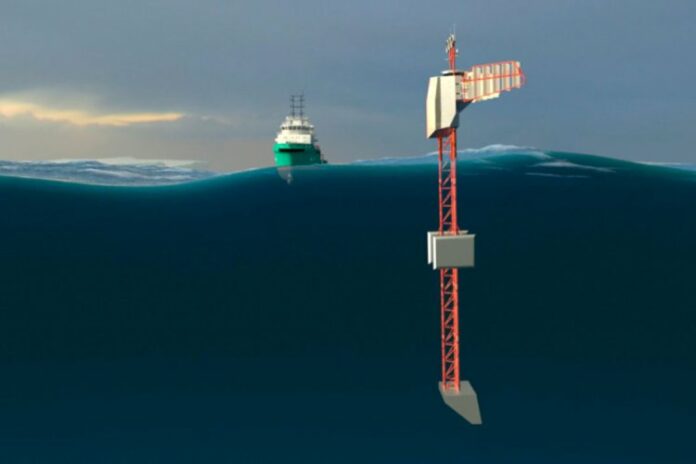
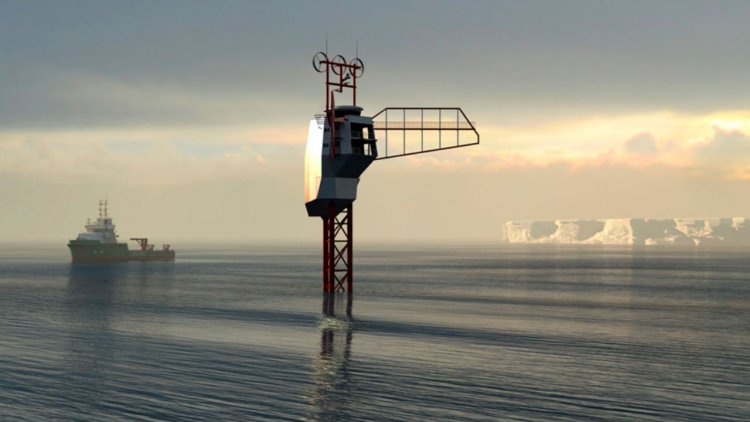
Bureau Veritas has certified the structural resistance of Polar Pod, a new research ship type designed to handle extreme weather conditions in the “furious fifties” and the impact of the biggest waves in the world (38 meters high).

POLAR POD is an ecological ship that will allow the acquisition of data and long-term observations of the marine biodiversity and climate change that will be transmitted to researchers, oceanographers, climatologists, biologists; and scientific institutions from 12 countries.

The platform is 100 meters high and weighs 1,000 tons. The legs of the lattice are made of steel from 38 to 50 mm thick. Bottom ballast weighs 150 tons. The structure of the nacelle is made of aluminum and the outer shell made of special steel to handle the most violent storms. The POLAR POD is much more stable and comfortable than a traditional ship. With a draft of 75 meters, this “vertical vessel” is very stable: 5° heel in the mean time of the Southern Ocean and a vertical movement that does not exceed 10% of the height of the waves. The architecture is designed not to resonate with the swell.

Matthieu De Tugny, Executive Vice President, Bureau Veritas M&O, said:

“Being the trusted certification partner for a project such as POLAR POD, is an exciting adventure. This demonstrates our high technical expertise and innovation capabilities while supporting research and finding ways to protect the marine biodiversity. We contribute to shaping a better and more sustainable world. I am proud Bureau Veritas is part of this pioneering project.”

Superyacht success for MarineGuard and Falcon

0

Known for creating a ‘virtual security bubble’ around a yacht, MarineGuard, chose the Falcon as a resource for its reputation as the world’s top rated underwater robotic vehicle in its class.

Their superyacht client was also keen for a Falcon to be part of MarineGuard’s security system.

As superyachts become larger and more technologically sophisticated, MarineGuard see the Falcon, with its intelligent future-flexible control technology, playing an increasing role in the growing world of superyacht security.

For underwater surveillance the Falcon can be fully equipped with advanced video and sensor systems that can integrate into MarineGuard’s security network.

Proven in defence and marine science operations, the Falcon can examine a yacht’s hull, millimetre by millimetre, with its HD cameras, and descend down 1000 metres to explore the seabed below.

As an underwater workhorse the Falcon is fitted with a gripper for recovering items from the seabed, with other tools added as needed. Tools such as rope cutters for severing 15mm rope and 12mm steel wire rope, powerful manipulators and cleaning systems for keeping critical fittings clear.

As the ‘eyes underwater’ for superyacht owners, the Falcon is fitted with high definition cameras and can roam deep underwater transmitting live images direct to stateroom screens on board.  

With a reliability record covering thousands of hours of undersea operations, the Falcon’s 20-year success comes from creating a powerful, highly manoeuvrable, multi-tasking, easy to use vehicle, depth rated to 300 and 1000 metres, enhanced with Saab Seaeye’s revolutionary iCON™ future-flexible intelligent control system, all in a handy metre-size package. 

In addition to superyachts, MarineGuard’s integrated technology-based security solutions are also deployed for commercial shipping and at offshore installations.

Navis updates MACS3 to address growing safety concerns related to transportation of Dangerous Goods

0

Navis, the leading provider of maritime software solutions for efficient and compliant cargo, stowage planning and vessel performance, announced that the MACS3 loading computer has successfully complied with the International Maritime Dangerous Goods (IMDG) code amendment 40-20.

The MACS3 loading computer is setting the industry standard in maximizing operational safety for container vessels as well as efficient loading operations worldwide. 

Younus Aftab, Chief Product Officer at Navis, said:

“When it comes to handling dangerous goods, safety is not just part of the job – it is the job. The increasing number of incidents at sea clearly emphasizes the importance of prioritizing safety for daily operations. With dangerous goods, there is just too much at the stake including legal sanctions and incidents leading to collateral damages, so it is imperative that appropriate safety measures not be overlooked and that key stakeholders across the ocean shipping supply chain operate with seamless solutions.” 

The MACS3 DG module allows shipping companies to gain a holistic view and greater control over the safe handling of hazardous cargo. One of the unique benefits of the MACS3 DG module is the integration with StowMan and MACS3 API, which increases visibility and the robustness of operational safety. Connecting key stakeholders – terminals, ports, crew on-board, liners and ship managers and owners – ensures maximum safety of handling dangerous goods can be achieved at different operational stages.  

Planners can now share the same view on stowage-related KPIs as the crew on board, helping to optimize the cargo load and trim based on accurate vessel profile information. This is especially important when managing dangerous goods transportation under unexpected situations such as incidents at sea. In case of an incident or an emergency situation, the segregation and storage rules produced by MACS3 prevent collateral damage from happening. 

Younus Aftab, Chief Product Officer at Navis, continued:

“We know that shipping dangerous goods is not an easy task and safety of the vessel and crew aboard are of the utmost importance. At Navis, we are aiming to facilitate safer vessel operations and improve visibility of dangerous goods flowing through ports and terminals. That includes making sure that the solutions we provide are in compliance with the latest industry safety standards and that our customers have access to all of the relevant data necessary to make informed decisions that will make seaborne operations safer. We remain committed to delivering technology that will get our customers’ goods and people where they need to go without incident.”