-9.1 C
New York
Home Blog Page 372

Iberdrola appoints ABL Group for marine support services

0

Iberdrola has awarded the framework agreement to ABL’s local operation in Germany, specifically a four-year (3+1) agreement for the Baltic Eagle offshore wind farm and a five-year (3+2) agreement for the Wikinger offshore wind farm.

Under the terms of the agreement, ABL could be called upon to provide engineering, technical support, assurance and marine warranty survey services to oversee construction and O&M campaigns that involve Iberdrola’s offshore wind assets.

Emek Ersin Takmaz, general manager of ABL Germany, said: 

“Iberdrola continues to grow Germany’s offshore wind market in an impressive manner. We look forward to assisting them throughout this journey. We are continuously expanding our team in Germany with multidisciplinary experts, to provide our clients with the best service offering possible. We will apply our local specialist expertise here in Germany and tap into our group’s broader competence base when required, to fully support Iberdrola.”

Iberdrola operates the Wikinger offshore wind farm, with an installed capacity of 350 MW since 2017. The company is adding two further offshore wind farms named Baltic Eagle (476 MW, under construction) and Windanker (300 MW, in development) to its offshore wind portfolio in the German Baltic Sea. This means, by 2026 Iberdrola’s so called Baltic Hub will be operating with more than 1,100 MW in combined capacity in Germany.

Kraken completes submarine power cable survey with KATFISH towed sonar

0

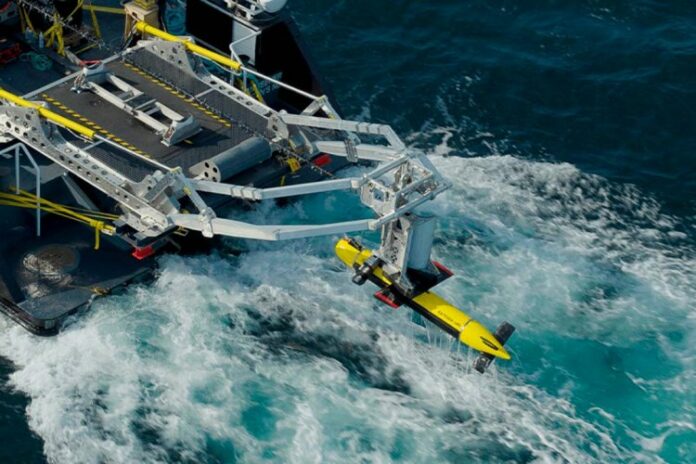
Kraken Robotics Inc. announces completion of the offshore portion of a Robotics as a Service (RaaS) contract for the marine inspection of critical underwater infrastructure, including a submarine power cable. 

The contract value is $0.5 million. Kraken completed the offshore survey in challenging sea state conditions, including up to 4 kts of cross current, by using the KATFISH™ high-speed towed synthetic aperture sonar (SAS) system coupled with Kraken’s Automated Launch and Recovery System (ALARS).

Moya Cahill Executive Vice President – Services, Kraken Robotics, says:

“Synthetic aperture sonar is rapidly being recognized as the next standard for commercial offshore activities such as seabed survey, pre-route surveys, and infrastructure monitoring, due to its high resolution and high speed capability. We are expecting an accelerated adoption across the Oil & Gas and Offshore Renewable sectors as we introduce our military-proven COTS solutions into the commercial market. Following on from our notable European defense industry successes, we will be mobilizing SAS assets in Europe meet this rising commercial market demand for 2023.”

Subsea7 awarded contract offshore Trinidad and Tobago

0

Subsea7’s scope of the awarded Subsea Integration Alliance contract is substantial2.

Subsea7’s scope covers the concept and design, engineering, procurement, construction and installation of a two-phase liquid natural gas tieback to the Juniper platform through dual flexible flowlines and a manifold gathering system, along with topside upgrades.

Design, engineering, and project management will commence immediately at Subsea7’s offices in the USA, with offshore installation planned for 2024.

Craig Broussard, Vice President for Subsea7 US, said:

“We have been working closely with bp and our suppliers at the earliest possible stage to help develop and deliver an integrated SPS and SURF solution that optimises cost and efficiency, to accelerate first gas.”

Olivier Blaringhem, CEO for Subsea Integration Alliance said:

”bp’s Cypre project is a prime example of our ability to harness the key strengths of Subsea Integration Alliance; Subsea7 with its expertise in executing complex EPCI projects, and OneSubsea’s fast-track distribution of subsea production systems. Combined, we are delivering a refined solution which enables early first gas.” 

Merganser consortium receives 7.8M for Offshore Floating Solar pilot

0

Dutch Offshore Floating Solar (OFS) consortium Merganser has received a 7.8m EUR project subsidy from RVO (Netherlands Enterprise Agency) to develop, test and validate the Merganser solar energy platform in harsh North Sea weather conditions. 

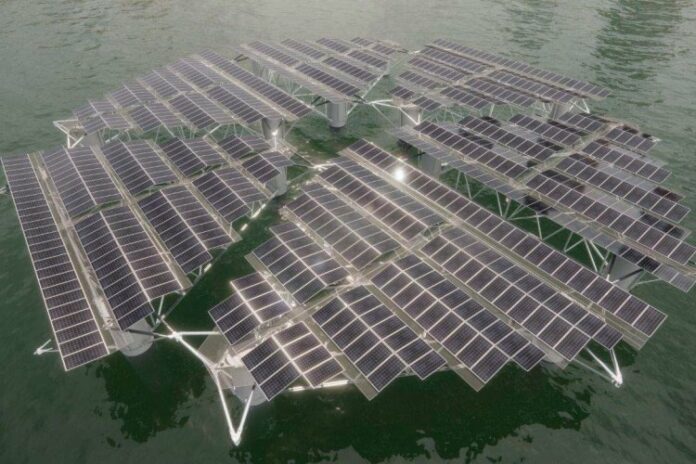
OFS company SolarDuck and marine research institutes TU Delft, TNO, MARIN and Deltares aim to prove that the new installation can accelerate and scale up the energy transition through marine solar energy, solving the problem of limited available land space at the same time.  In the pilot, the six linked OFS platforms will deliver 500 KWp.

Global annual electricity consumption is expected to double to about 42,000 TWh by 2050. In addition, climate change and environmental degradation are major challenges for coastal communities around the world, incl. the Netherlands and its energy supply. Due to technical developments and limited space on land, the exponentially growing solar market is moving offshore, partly initiated by the forerunners of the Merganser consortium, who now move forward together. 

The pilot project is executed under the assumption that the installed capacity of ocean energy systems needs to speed up to meet both national and international climate and energy supply goals. The project also adheres to the United Nations’ goal of moving from negotiations and planning to implementation, as stated by COP27 (the 27th Climate Change Conference under Egypt’s presidency).

The Demonstration Energy & Climate Innovation (DEI+) subsidy is a Dutch governmental programme for new projects and innovations aimed at reducing energy consumption and harmful emissions, manufacturing based on recycling and more. It is a result of the Paris Climate Agreement and recognises that its goals can be brought about by innovative demonstration projects. The Merganser project aims to prove just that by showing the practical and strategic advantages of offshore photovoltaic energy solutions. 

Perhaps the biggest advantage of floating solar applications is the availability of many square miles of space, something that both in the Netherlands and in coastal megacities across the globe is in short supply. An additional promising feat is that they can be installed safely in between existing offshore wind turbines and could be built anywhere with ‘pop-up’ assembly lines. These (and more) assumptions will be tested and monitored as well by the consortium. 
Yet another advantage is energy supply stability. For example, the Dutch regular grid is close to reaching its limits. Knowing that Offshore Wind only uses about 50% of the (Dutch) North Sea’s export cable means that here is a huge opportunity to complement electricity supply by means of solar power. 

The Merganser is a prototype installation capable of generating 500 kWp of renewable energy at sea. This new and scalable concept includes six interconnected platforms that can withstand extreme offshore conditions. The consortium will use the 7.8m EUR subsidy to get Merganser built, waterborne and tested offshore in the North Sea. Last but not least, when the project delivers the expected results, it can easily be upgraded to gigawatt scale, making it ideal for coastal (mega)cities’ energy needs. 

The total scope of work is huge. SolarDuck will take on project management, develop the final technical specifications of Merganser and provide technical support for the partnering knowledge institutes. In addition, the consortium will develop the requirements for a commercial-sized project of at least 5 MWp. To that end, containerization and pop-up assembly concepts will be designed to arrange for efficient transport and local construction of future Merganser units.

The partner institutes will cover a large research scope, including for example corrosion resistance of the solar and electrical systems, UV degradation of the synthetic anchors and marine growth on the floaters. From monitoring cost of virtually all Merganser aspects (including decommissioning) to investigating possible electrical integration of offshore solar and wind energy and from building fatigue prediction models to flexible mooring line concepts in shallow water, virtually everything is covered in this pilot. The group will even do research into the social acceptance of OFS technology among stakeholders and if Merganser can bring positive contributions to marine biodiversity and ‘new’ habitats.

Don Hoogendoorn, CTO of consortium partner SolarDuck says:

“We are very proud to have the DEI+ subsidy on board to build a scalable floating solar energy solution. Based on our first, successful pilot in 2021, our technology has already obtained an Approval in Principal from Bureau Veritas. We are proud to collaborate with such renowned knowledge institutions as Deltares, Marin, TNO and TU Delft. You must realise that these people are the best in their field – all of them have dedicated their professional lives to Solar and maritime research. Together, we’ll make this project successful and make sustainable offshore solar energy  commercially viable much faster. This fits perfectly with our aim to power the world with clean energy and support the energy transition.” 

Wiep Folkerts, program manager at TNO, says:

“This project is an important building block for our mission to generate attractive and affordable options for the energy transition. I am sure that everyone who has an interest in renewable offshore energy generation will learn valuable new knowledge from this project.”

Merganser is expected to complete testing and monitoring by the end of 2024, in line with the DEI+ subsidy requirements.

Huisman awarded Japan’s first Monopile Gripper order

0

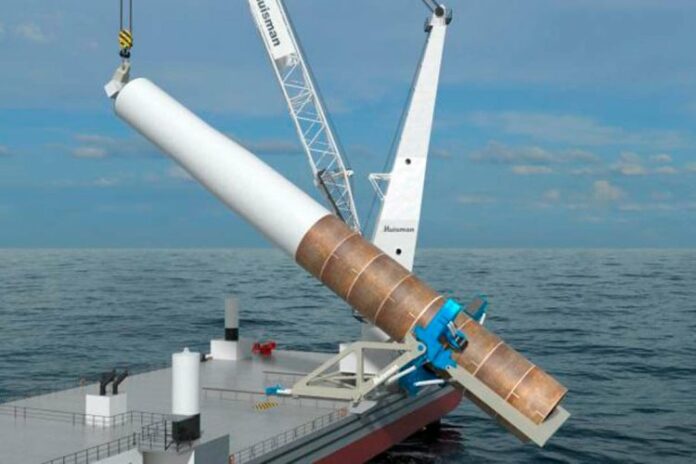
Huisman has been awarded a contract by TOA Corporation and Obayashi in Japan for the delivery of a state-of-the-art Monopile Gripper. 

The gripper allows TOA and Obayashi to upend and install monopiles without using a separate upending bucket, improving safety and efficiency of operations on board. 

The Huisman Monopile Gripper will be the first of its kind to be used in Japan. The gripper will be installed on TOA and Obayashi’s Self Elevating Platform (SEP), which is outfitted with a 1,250mt Huisman Pedestal Mounted Crane. This Huisman mission equipment will play a significant role in Japan’s transition towards a renewable future. 

The gripper will be capable of handling monopiles of up to 8 m in diameter, fully utilising the capacity of the SEP. Huisman has paid special attention to optimising the upending process, in which the gripper and crane control software communicate with each other to ensure the system – as a whole – operates within its limits. 

Timon Ligterink, Commercial Director Asia-Pacific at Huisman:

“We are extremely honoured to be awarded our very first monopile gripper contract in Japan. This order is the result of our partnership with TOA Corporation and Obayashi, which we have developed over multiple years. Together with the Huisman-built crane, the gripper will allow safe upending and installation of monopiles in Japanese waters, accelerating the energy transition in the country. We thank TOA Corporation and Obayashi for their continued trust in Huisman and look forward to successfully developing this gripper together.”

Argeo granted patent for subsea electromagnetic remote-sensing system

0

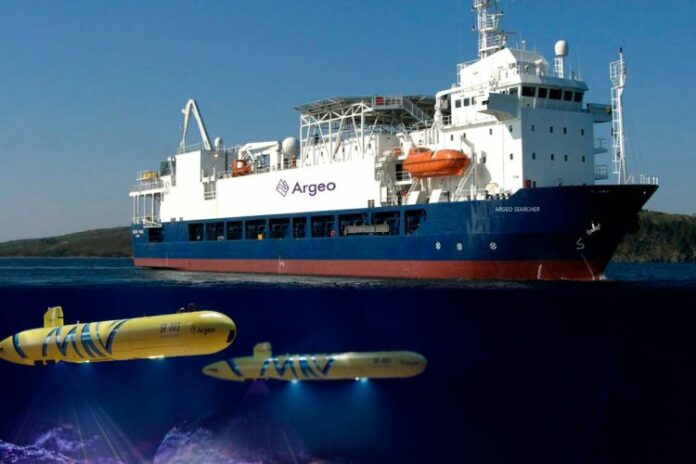
Argeo has developed a portfolio of electromagnetic source and receiver systems for Autonomous Underwater Vehicles, Underwater Intervention Drones and ROVs. 

This patent protects Argeo’s exclusive services with the products “Argeo Whisper” and “Argeo Discover”. “Argeo Whisper” is an AUV and ROV system developed for localizing and tracking buried pipelines as well as detecting buried objects in a decommissioning survey. It can also be used for detecting unexploded ordnances. “Argeo Discover” is an application or detecting, delineating, and characterizing deep sea mineral deposits or other conductive objects below the seafloor utilizing an electromagnetic source integrated in an AUV or ROV.

Argeo has developed an electromagnetic source that is designed to operate down to 6000 meters water depth. This technology enables ultra-high resolution characterization of minerals that has previously not been possible. With Argeo Discover added to Argeo’s AUV and ROV sensor portfolio, Argeo is in a sole position to provide effective ultra-high resolution data acquisition for both larger regional and detailed local exploration over large areas with deposits utilizing its fleet its AUVs rated to 6000m water depth.

Trond F. Crantz, CEO in Argeo, says:

“Sourcing of critical metals and the introduction of new elements to the value chains is crucial to satisfy mineral requirements of the Energy transition. Deep-sea minerals present a potential solution in the transition enabling the scaling of various green technologies that demand vast amounts of diverse metals. This prompts a surge of deep-sea mineral exploration activities worldwide, with Norway currently preparing a decision on the opening of its continental shelf due in Spring 2023.”

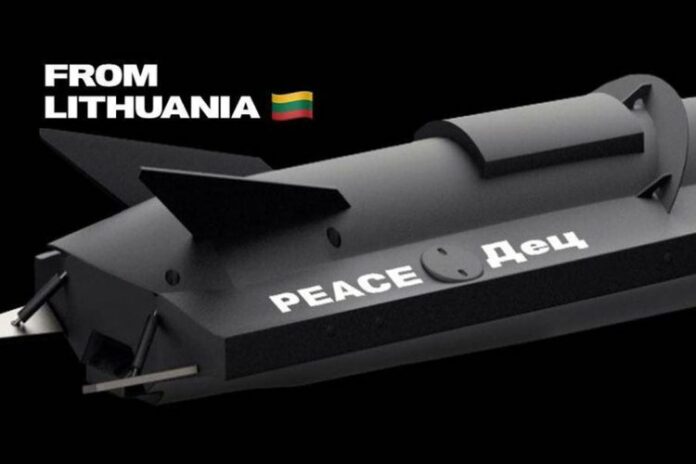
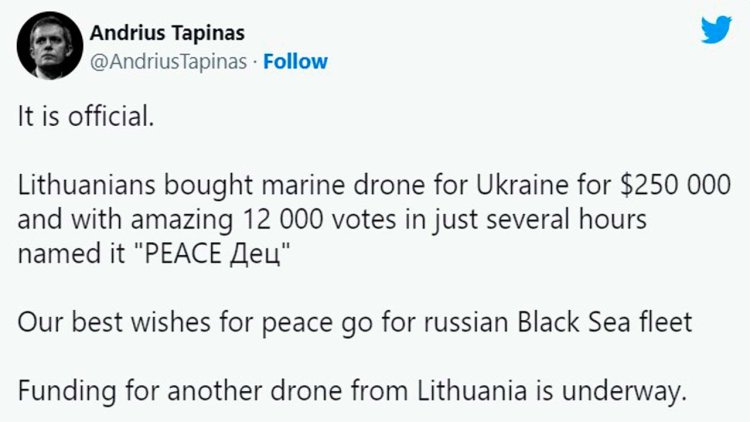
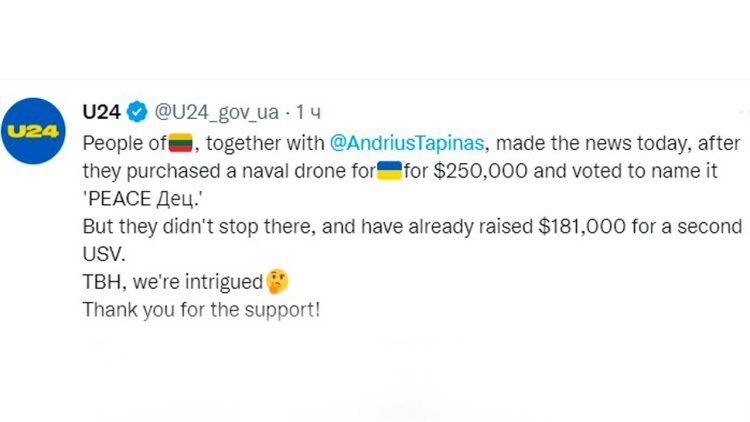
Lithuania buys marine drone for Ukraine

0

This was reported by Lithuanian journalist and author Andrius Tapinas.

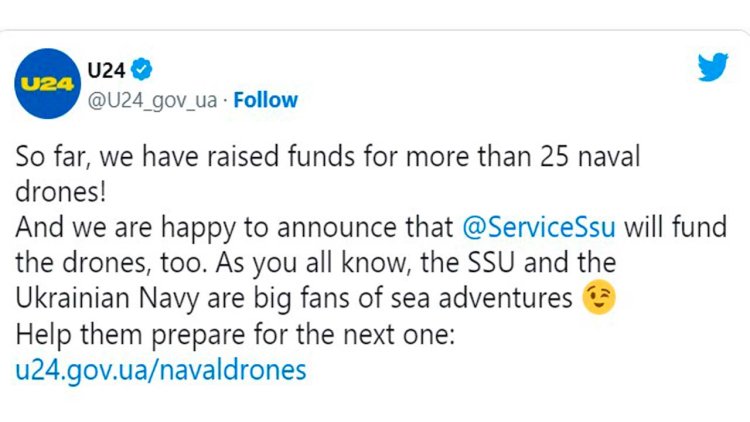
UAH 250 million has been already raised for 25 naval drones after Zelenskyy announced the first-ever fundraising campaign for a naval drone fleet on the U24 platform.

The unmanned sea vehicle in question is a unique Ukrainian project, the work on which has been classified. One such device costs UAH 10 million. The cost covers a drone equipped with an autopilot system, video subsystems, including night vision, special communication with e-warfare protection, backup communication modules, and a combat unit, as well as an autonomous ground control station, transportation and storage systems, and a data center.

These drones have already proven their effectiveness during an attack on the Russian fleet in occupied Sevastopol in October.

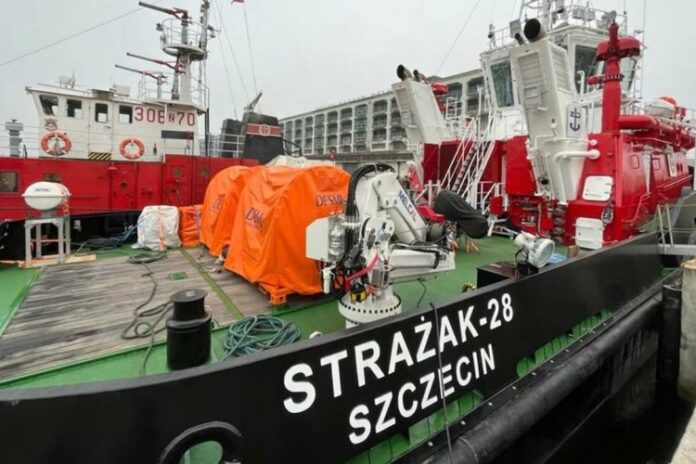
Port of Szczecin welcomes a firefighting vessel Strazak-28

0

It will provide assistance to ships carrying dangerous cargo, ensuring fire protection, e.g. will be adapted to fight fires on LNG carriers and will ensure fire safety in the waters of Szczecin, Police and Świnoujście seaports.

The ship is 29.2 m long and 10.47 m wide. Its design draft is 3.45 m. It will develop max. speed up to 12.00 knots. Its purchase by ZMPSiŚ S.A. is co-financed by the European Union from the Cohesion Fund under the Operational Program Infrastructure and Environment. The value of the project is approx. PLN 40.6 million. Co-financing from the European Union approx. PLN 34.5 million.

“Strażak-28” will be the third in the fleet of ZMPSiŚ S.A. Currently, “Strażak-24” is moored in Szczecin, and “Strażak-26” in Świnoujście.

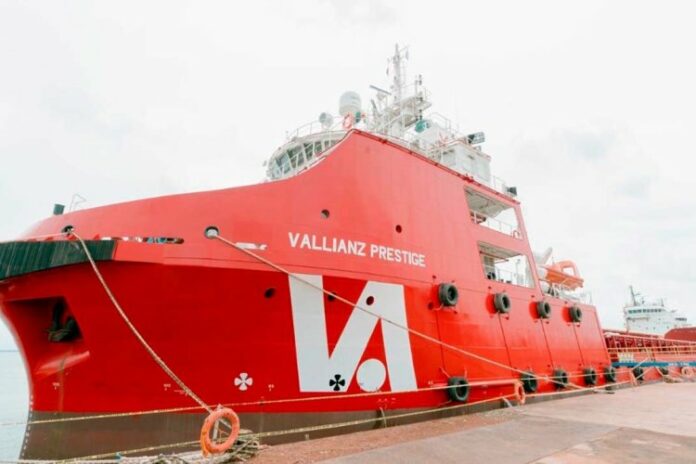
Vallianz Holdings accelerates digitalisation of offshore support vessel fleet

0

Vallianz Holdings is accelerating the digitalisation of its fleet of offshore support vessels (OSV) with a comprehensive package of connectivity services from Inmarsat.

Through Fleet Data, provided on the Fleet Edge platform, Vallianz can collect, transfer, store and analyse IoT data to support decision-making in real time. Also included is Fleet Connect, which offers Vallianz and their technology partners access to the vessels through dedicated bandwidth The offshore specialist has already adopted ultra-low-bandwidth maritime-surveillance technology to enable live vessel monitoring from a shore-based operations centre.

Elisa Woodward, Head of Engineering, New Building and Technology, Vallianz Holdings, said:

“By utilising Inmarsat’s solution, the Group will be able to accelerate the digitalisation of our worldwide offshore support vessels fleet and lay the foundation for future developments based on IoT data and services. In an increasingly competitive offshore environment, Vallianz will be able to stand out from the crowd by offering our customers with smarter vessel operations that meet modern requirements for data analytics, cyber resilience, and seafarer welfare.”

Vallianz will also enhance crew welfare through Fleet Hotspot, which is a crew connectivity solution that recently won the Mission to Seafarers Innovation Award for its outstanding contribution to seafarer welfare. Fleet Hotspot allows the crew to maintain contact with loved ones ashore and access online entertainment on their own devices – without interfering with business-critical bandwidth. Vallianz will be providing each of its crew members with free internet allowance every month.

In addition, to combat the ever-evolving threat of cyber-attacks, Vallianz has signed up for Inmarsat’s Fleet Secure Unified Threat Management (UTM), a complete package of network security tools consolidated on a single device. Designed specifically for the shipping industry, Fleet Secure meets the International Maritime Organization’s 2021 functional cyber-security requirements for demonstrating cyber-risk management.

Vallianz’s contract with Inmarsat also includes Fleet Mail for secure and stable email, as well as Fleet Care which provides round-the-clock maintenance, repairs, and support for Fleet Xpress.

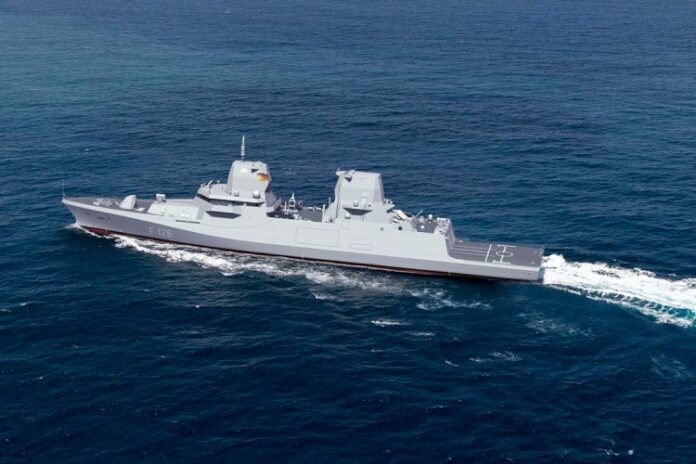
Damen selects Rheinmetall to supply gun systems for F126 frigates

0

Damen Naval has selected German technology group Rheinmetall to supply eight state-of-the-art MLG27-4.0 defence systems for the F126 frigates the shipyard is building for the German Navy. Each frigate will be equipped with two MLG27-4.0 systems. The contract includes an option for further MLG27-4.0 systems for two additional vessels.

The 27mm cal. MLG27 4.0 light naval gun is a member of the new SeaSnake RCWS family of products made by Rheinmetall Waffe Munition GmbH of Unterlüß, Germany, a Group subsidiary with multiple locations. The core element of the remotely controlled MLG27 4.0 is the BK-27M revolver gun. In use throughout the German Navy, the predecessor of the new MLG27 4.0 serves as secondary armament on Germany’s current F125 frigates.

Compared to previous models, the next-generation MLG27-4.0 defence system features a series of technological innovations. It is a highly advanced ship defence system equipped with daylight cameras, infrared sensors and laser rangefinders, and can be integrated into an existing shipboard command system, taking full account of all applicable IT and OT security requirements. Moreover, its new, fully digital system architecture enables direct impact on external target coordinates in standard WGS-84 format.

The 27mm cal. revolver gun can operate in single-shot mode, in adjustable bursts, or at a sustained rate fire of up to 1,700 rounds per minute. Its low weight and adjustable grid-firing capability, coupled with an integrated simultaneous tracker, make the MLG27-4.0 weapon system a powerful armament for modern frigates such as the F126 class.

In combination with other weapon systems envisaged by Damen Naval for the project, the F126 frigates will feature a comprehensive, highly effective array of armament that delivers a critical tactical edge against a multitude of threats. 

“We are extremely pleased to join forces with Rheinmetall on the F126 project for the German Navy. The broad range of capabilities make their MLG27-4.0 weapon system the right choice for the F126 frigates,” says Hein van Ameijden, the Managing Director of Damen Naval.

“Our MLG27-4.0 weapon system and basically the entire SeaSnake family, have proven highly effective against asymmetric threats. We’re very pleased to be taking part in the ambitious F126 programme and to be supporting Damen Naval in building the frigates” adds Roman Köhne, managing director of Rheinmetall Waffe Munition GmbH.

The Dutch shipbuilder Damen Naval, prime contractor for construction of the German Navy’s new F126 frigate generation, will work closely with key subcontractors Blohm+Voss Shipyards GmbH and Thales Netherlands B.V. in planning and building the four frigates.  All four ships will be built entirely at German shipyards (in Wolgast, Kiel and Hamburg), with the first frigate slated for delivery in 2028.  The contract between Damen and Germany’s Federal Office for Bundeswehr Equipment, Information Technology and In-Service Support (BAAINBw) includes an option for two more frigates.