
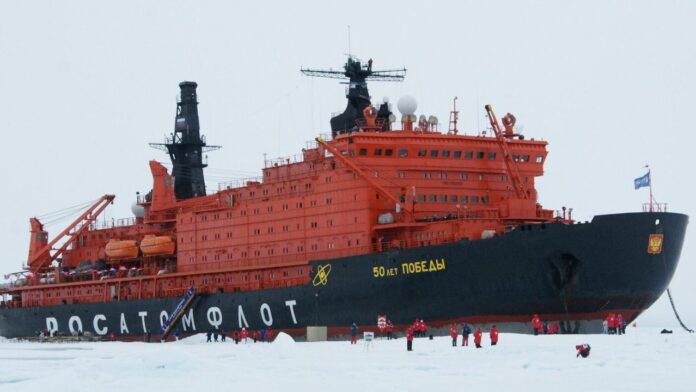
For the first time in history, Russia has deployed all eight of its nuclear-powered icebreakers simultaneously to keep Arctic shipping lanes open.
The Arctic has emerged as a vital economic lifeline for Russia amid Western sanctions that have narrowed access to traditional export routes, financing and shipping services. Keeping northern shipping lanes open through winter allows Moscow to move oil, liquefied natural gas (LNG) and metals to Asian markets, helping sustain hard-currency revenues critical to its war economy. The unprecedented deployment of Russia’s entire nuclear icebreaker fleet signals how essential these Arctic flows have become.
Russia operates the world’s only nuclear-powered icebreaker fleet, managed by the state nuclear corporation Rosatom. The fleet consists of four modern Project 22220 icebreakers—Arktika, Sibir, Ural and Yakutiya—alongside two older Arktika-class vessels, Yamal and 50 Let Pobedy, and two shallow-draught Taymyr-class ships, Taymyr and Vaygach, designed to operate in Arctic river estuaries.
According to gCaptain and Breakbulk News, six of the icebreakers are currently operating in the Gulf of Ob, while the remaining vessels are assigned to the Yenisei Gulf and Yenisei River. Their mission is to keep export routes open for traffic serving major Arctic energy and mining hubs, including Yamal LNG, the Arctic Gate oil terminal and Norilsk Nickel.
Nuclear propulsion allows these ships to sustain very high power output for extended periods, enabling them to break thick multi-year ice and operate continuously through the polar winter. This capability is essential for maintaining navigation along the Northern Sea Route during months when conventional icebreakers and ice-class merchant ships struggle.
Despite the scale of the deployment, Russia still faces bottlenecks. Breakbulk News reports that shortages of high ice-class tankers and LNG carriers have already disrupted shipments, highlighting that even the world’s most powerful icebreaker fleet cannot fully compensate for a lack of suitable commercial vessels.
Sanctions have also accelerated the use of a so-called “dark fleet” of ageing tankers operating outside standard insurance and regulatory systems. Analysts warn that attempts to push some of these vessels into Arctic waters raise the risk of accidents and environmental damage in one of the world’s most fragile ecosystems.
Western analysts note that while Russia’s nuclear icebreaker capability is unmatched, operating all eight vessels simultaneously is expensive and difficult to sustain over long periods. By comparison, the U.S. Coast Guard operates just two ageing heavy icebreakers and is only beginning construction of new Arctic Security Cutters, while countries such as Finland, Sweden and Canada rely on advanced but conventionally powered fleets.
Russia’s all-out icebreaker deployment underscores the growing strain on Arctic logistics—and how dependent Moscow has become on northern exports to sustain state revenues under sanctions. Analysts expect that maintaining such an intensive operational tempo will drive up costs, accelerate wear on ageing vessels and eventually force gaps in coverage.
Source: newsbreak


