
The National Antarctic Scientific Centre has strengthened its cooperation with the British Antarctic Survey (BAS) in the areas of logistics and science development
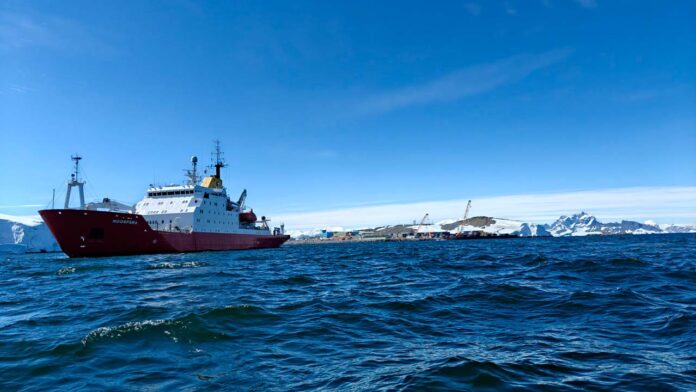
As part of this collaboration, the Ukrainian research vessel “Noosfera” delivered personnel and cargo to the British Antarctic Survey’s (BAS) largest station, “Rothera”, for the first time. Joint research was also conducted on the impact of climate change on marine ecosystems.
During this Antarctic summer season, Ukrainian scientists on the Noosfera worked together with the BAS marine team out of Rothera Research Station and scientists from the Natural Environmental Research Council (NERC) funded POLOMINTS project. They were carrying out CTD (conductivity, temperature and depth) oceanographic measurements and collecting seawater samples together. The measurements and analyses will be critical for our work in understanding the impact of climate change on coastal Antarctica.
Besides scientific research, a mutually beneficial logistical cooperation proved to be successful.
Both Rothera Research Station and Vernadsky Research Base are staffed all year round. Throughout the year, research and station operations are carried out by overwintering teams. During the Antarctic summer, they are joined by seasonal expeditions.
This March, before the start of the Antarctic winter, there was a need to rotate some specialists at Rothera and deliver important cargo. This station is located south of Vernadsky base; it takes one day to reach it from here.
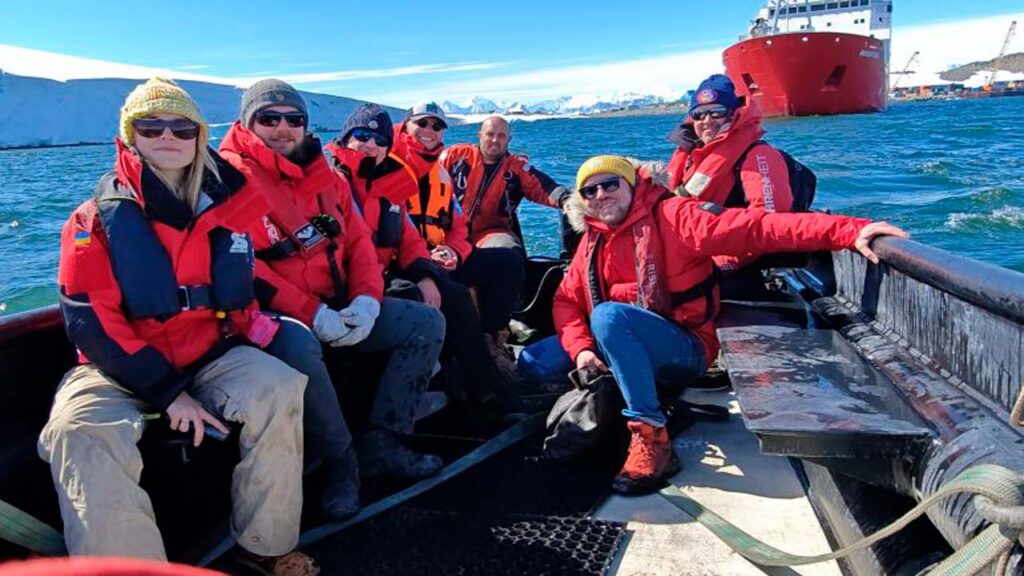
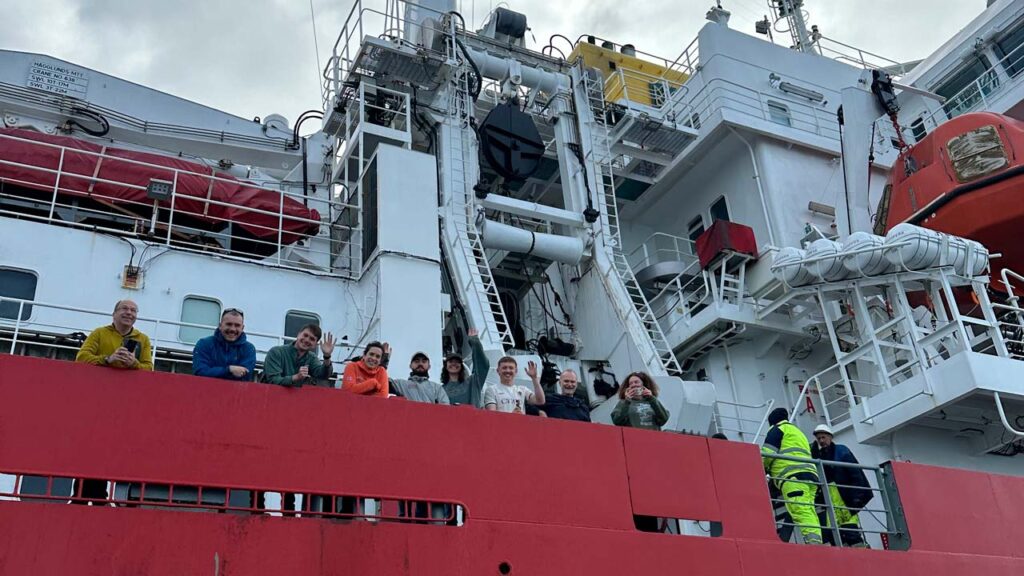
Using Noosfera, 7 specialists were brought to the station, and 35 people were transported away from Rothera to Chile.
It is worth noting that the BAS operates its own modern RSS, the Sir David Attenborough. It serves all British polar stations (both Arctic and Antarctic) and supports various oceanographic research projects. Given the significant distances between stations, BAS enlists the vessels of neighbouring polar nations to service some of them, so as not to have to move the “Attenborough” thousands of kilometers.
This operational cooperation strengthens the relationship between BAS and NASC, demonstrating the value of shared infrastructure and mutual support among national Antarctic operators.
Oliver Darke, Director of Polar Operations, Engineering and Infrastructure (BAS), said:
“This collaboration highlights the strength of international partnerships in Antarctica. By working closely with the National Antarctic Scientific Centre, we are enhancing resilience, reducing environmental impact through shared logistics, and ensuring our teams can continue their vital scientific and operational work safely and efficiently”.
Evgen Dykyi, Director of the National Antarctic Scientific Centre, said:
“It is a particular pleasure for me to develop cooperation with the British Antarctic Survey, because 30 years ago, it was a generous gift from the United Kingdom – the transfer of the Faraday Station to Ukraine that launched our national Antarctic program. The RRS James Clark Ross delivered the first Ukrainian expedition to ‘Faraday/Vernadsky’, and now the same vessel, but under the name “Noosfera,” flying the Ukrainian flag and with a Ukrainian crew, supported the British expedition to Rothera. We learned a lot from our British colleagues in the past, and in addition to the station and the vessel, we adopted many best practices in organising Antarctic research. Therefore, we are very pleased to continue developing Ukrainian-British cooperation in Antarctica, now as a partner”.
Photo: NASC, Chris Jackson, BAS, Oleh Lazutin.


