
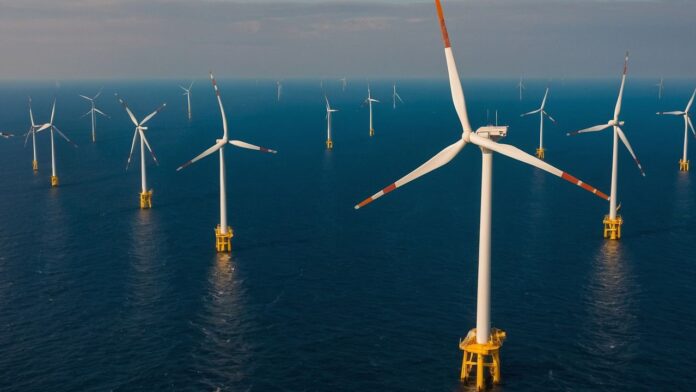
The Offshore TSO Collaboration (OTC) has presented recommendations which bring together regional planning, cost sharing and financing for the first time.
Europe’s path to energy independence, security and climate neutrality lies across the North Seas. By 2050, the northern seas could supply up to 1,000 terawatt hours of clean electricity – around 40 per cent of Europe’s energy needs. To realise this potential, a strong, cross-border network is needed. At the North Sea Summit in Hamburg today, the OTC presented its latest findings in the presence of heads of state and government and energy ministers from the North Sea coastal states.
The OTC’s work focuses on the development of an offshore grid across the North Seas region, enabling the rational development and utilisation of shared resources. Completing national lines, the alliance is focusing on cooperation projects – hybrid connections that connect offshore wind farms with several countries simultaneously.
Initial joint analyses show clear advantages of a regionally coordinated approach: lower costs, higher efficiency and a more robust European energy system. A grid map developed by the OTC has already identified specific cross-border projects in the North Sea, the Irish Sea and the Celtic Sea which could deliver benefits to consumers in each of the connected countries.
In addition to technical planning, the OTC is also addressing other challenges associated with major projects. The considerable differences in ownership structures, regulatory systems and revenue models among TSOs in the North Sea indicate that a uniform financing solution is not feasible. Issues of financing, cost sharing are therefore key challenges. The OTC is developing models for multilateral cooperation and joint cost sharing – a crucial step in enabling investment decisions and the actual implementation of projects. The aim is to establish an integrated process for planning, cost sharing and financing with governments, national regulatory authorities and TSOs.
Possible elements of such a financing mix include public loans, private financing, green bonds, guarantees, hybrid instruments or grants to close financing gaps.
At the same time, the OTC is expanding its cooperation with other players in the offshore value chain, including wind farm developers, infrastructure operators and the hydrogen industry.
A key obstacle to cross-border offshore projects to date has been the unresolved question of how to distribute costs and benefits fairly. As a solution, the OTC proposes a combined model that combines ex-ante planning security with ex-post flexibility. Ex-ante means that countries determine their share of costs before the project begins on the basis of jointly modelled scenarios – an important step in enabling reliable investment decisions at an early stage. Ex-post allows these shares to be adjusted after commissioning when real data shows how much individual countries actually benefit. Combining both elements creates a system that is reliable enough to trigger large infrastructure investments while remaining flexible enough to fairly reflect the actual system benefits.


