
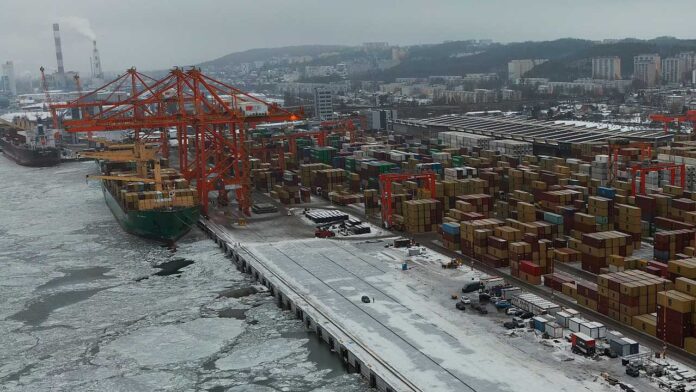
The Port of Gdynia is commissioning the modernized Helskie Quay – one of the key stages of the project “Deepening of the approach fairway and internal waters of the Port of Gdynia and reconstruction of quays,” co-financed by the European Union.
The investment significantly increases the port’s operational capabilities, strengthens its competitiveness in the Baltic Sea, and improves the security and resilience of European supply chains.
The modernized quay, nearly 800 meters long, has been dredged to a depth of -15.5 m. This means that it can handle container ships up to 400 meters long and with a draft of up to 14.5 meters – the largest vessels currently operating in the Baltic Sea basin. In practice, this makes it possible to handle a larger number of direct ocean calls and reduce dependence on foreign ports.
The value of the work on the Helskie Quay amounted to approximately PLN 300 million net. The investment is part of a broad project implemented with the support of EU funds, aimed at adapting the technical parameters of the Port of Gdynia to the requirements of modern shipping and the growing scale of container operations. European funds played a key role in enabling the implementation of a project of such scale and strategic importance.
The works began in September 2023 and were carried out in stages, while maintaining the continuity of port operations. The reconstruction covered not only the quay structure, but also the reinforcement of the foundations, the construction of an additional crane rail enabling the operation of larger container cranes, and the reconstruction of technical and road infrastructure.
The investment required the sinking of nearly 7,500 tons of steel, the extraction of approximately 80,000 m³ of spoil, and the incorporation of 2,000 tons of steel and nearly 20,000 m³ of concrete. Hundreds of foundation piles and kilometers of micropiles were also installed to reinforce the structure.
A particular challenge was to design the structure in such a way that it would only protrude about 1.2 meters into the water. This allowed the container cranes currently in use to remain fully functional. With a standard solution, the equipment would not be able to reach the last rows of containers on ships. The solutions used made it possible to deepen the water area and maintain the terminal’s full operational efficiency.
The commissioning of the Helskie Quay comes at a time of increased volatility in international trade and growing challenges for global supply chains. In such conditions, the development of port infrastructure is important not only for current competitiveness, but also for the operational stability of the economy. Today, modern ports play a key role in ensuring continuity of supply and the smooth functioning of trade.
The entire EU project will increase the cargo handling capacity of the Port of Gdynia by approximately 5 million tons per year. This is an important step towards strengthening Poland’s position as a stable link in the European TEN-T transport network and building the resilience of the Baltic Sea region to disruptions in international trade.
Importantly, despite the ongoing modernization works, in 2025 the Port of Gdynia exceeded 1 million TEU for the first time in its history, confirming the growing importance of the port in handling international cargo flows.
“The commissioning of the Helskie Quay is a strategic investment. Thanks to EU funding, we are building infrastructure that strengthens the competitiveness of the Polish economy and increases the resilience of our supply chains in an unstable international environment. The Port of Gdynia is consistently developing its technical parameters to respond to the challenges of modern logistics and the country’s economic security,” says Piotr Gorzeński, President of the Port of Gdynia Authority S.A.
The reconstruction of the Helskie Quay is one of the key elements of the long-term development strategy of the Port of Gdynia, which assumes a systematic improvement of infrastructure parameters, an increase in throughput, and a strengthening of the port’s role as one of the pillars of the Polish maritime economy and the European transport system.


