
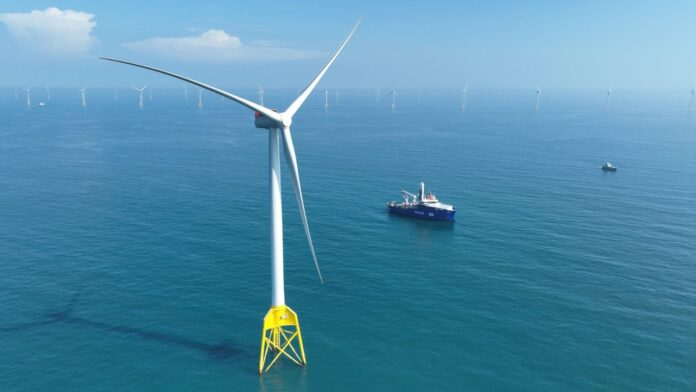
Danish offshore wind developer Orsted has lodged its federal environmental application for the 2.8 gigawatt (GW) Gippsland 1 project, which would install turbines as high as 350m at their tip in the ocean off Victoria.
At 56km offshore, Gippsland 1, and its separate neighbour the 2 GW Gippsland 2, are the furthest off the coast of the nine remaining projects that will likely compete in the country’s first offshore wind tender, scheduled to begin in August this year.
Australia has no offshore wind projects, but Victoria has a target of having 2 GW of capacity online by 2032, and 9 GW by 2040, as part of its plans to move from fossil fuels to renewables, and reach a renewables target of 95 per cent by 2035.
The latest EPBC application from Orsted covers Gippsland 1, and the company notes that the project may not end up being as large as the full 2.8 GW.
“The referral is for the full 2.8 GW but the project will be phased, with the phasing to be determined based on decisions around commercial viability during the development stage,” the EPBC referral says.
“The preferred staging approach would be progressively refined to align with the broader development of Victoria’s offshore wind industry, taking into account the capacity of key supporting infrastructure, including ports, supply chain readiness, transmission networks, and grid connection capabilities.
Once the year’s long research and permitting process is finished, Orsted expects to install up to 200 turbines and lay between 90km and 120km of export cables in three to four years.
It warns that this timeline could be longer, “depending on staging” but feasibility studies are expected to be finished by the end of 2027.
This is not Orsted’s first EPBC referral for Gippsland 1.
In 2024 it asked whether its seabed investigation activities would need to be monitored under the EPBC Act, but this was waved through with conditions a few months later.
That monitoring yielded news that the part of the Bass Strait where Orsted wants to build is tumultuous – but nothing the company can’t handle given its extensive North Sea experience.
The Danish company’s studies so far show its patch of seabed is around 56m deep, falling to 60-70m in some areas where it’ll need to run a cable.
It sees year round wind speeds of 6 to 12 metres per second and “significant” wave heights between 1.5m and 2.5m, but which can reach up to 7m during winter.
Being the furthest offshore project, Orsted’s cabling plans will be more costly and more complicated than its neighbours nearer the shore.
The plan is to run six cables between the Greater Eastern and Aurora Green feasibility licence areas, and onshore near McGaurans Beach as at 9km it’s the shortest distance to the proposed VicGrid connection hub at Giffard.
If it can’t secure that shore crossing, Orsted is proposing Reeves beach which is further to the south.
The cables will be buried from the point they leave the offshore substations to where they connect at the Giffard connection hub.
The EPBC referral is just one of a slew of permissions the Victorian offshore wind projects need, given it borders the Beagle marine conservation area and a majority of ships use the yellow-striped area to get through the Bass Strait.
In addition to EPBC approval, given they’re all likely to be controlled under the federal Act, they also need further licences including a commercial permit and a transmission and infrastructure licence from the commonwealth, as well as an approved management plan for each licence.
From Victoria, they need to go through the state environmental approval process, planning approval, and have greenlit Cultural Heritage Management Plans, and marine development consent.
They may also need any one of 10 other state and federal permits such as for sea dumping, or a “cetacean interference permit” if the work interferes with whales, dolphins or porpoises.
In its EPBC referral, Orsted says the key themes to come out of community consultation so far are around protecting Gippsland’s coastal and marine areas, how commercial fishing will coexist with turbines, how much the turbines will be able to be seen from the beach, and the need to fully understand Indigenous country and sea values.


