
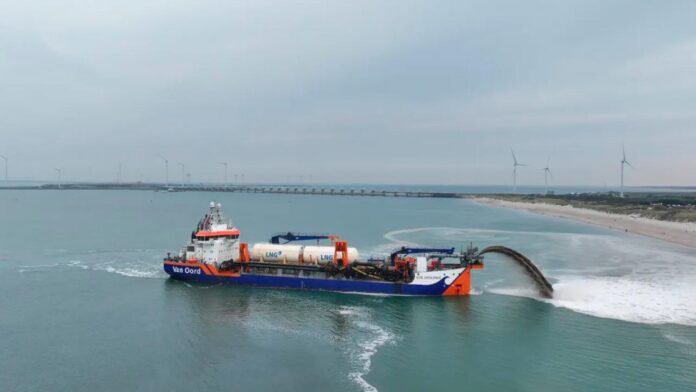
Van Oord has successfully completed coastline maintenance in the Dutch Noord-Beveland, Zeeland, as commissioned by Rijkswaterstaat.
In total, 1 million cubic metres of sand was deposited on and right in front of the Banjaard beach using the LNG-fuelled trailing suction hopper dredger Vox Apolonia. A special aspect of this project was the use of 100% Bio-LNG fuel, which further underlines Van Oord’s and Rijkswaterstaat’s commitment to an implementation method that minimises emissions.
The assignment was part of the Dutch Coastline Care programme. Next year, Van Oord will also carry out beach replenishment for the beaches at Goeree-Westkop and Heemskerk.
A key aspect of this project was the use of 100% Bio-LNG, in line with the sustainability ambitions of both Rijkswaterstaat and Van Oord. This was made possible by Van Oord’s Green Fuel Fund, which was launched in late 2024 to accelerate the use of sustainable fuels. This fund serves as a financial mechanism to reduce the cost of renewable fuels for our clients, such as Rijkswaterstaat, and makes their large-scale use more feasible.
Harry Zondag, Strategic Advisor for the dredging market at Rijkswaterstaat, said:
‘Rijkswaterstaat sets minimum requirements for emissions and encourages even greater efforts in its procurement process by offering award advantages. It’s great that Van Oord is on board with this and is developing its own ideas.’
The use of a Bio-LNG-fuelled trailing suction hopper dredger underlines Van Oord’s leading position in the energy transition within the maritime sector. Van Oord is the first maritime contractor whose climate targets were approved by the Science Based Targets initiative (SBTi) and is actively working on further decarbonisation to achieve its net-zero ambition. Together with clients and partners, Van Oord will continue to invest in innovative and sustainable solutions for projects worldwide.
Tom van Eijk, Project Manager at Van Oord, said:
‘I’m proud that we have executed this entire project using 100% Bio-LNG. This proves that sustainability in the maritime sector isn’t just a future ambition for us, it’s already a reality. Together with Rijkswaterstaat, we’re taking a significant step toward emission-free coastal maintenance.’


