
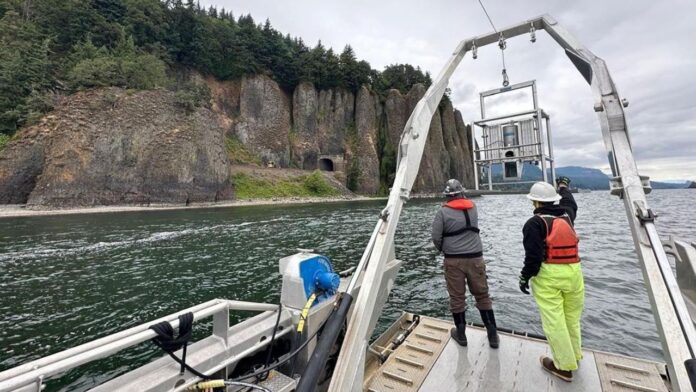
CSA Ocean Sciences Inc. has announced the completion of a Sediment Profile Imaging (SPI)/Plan View (PV) Survey of an 85-mile stretch of the Columbia River.
The survey, conducted between The Dalles, Oregon to Vancouver, Washington, supports planning for the Cascade Renewable Transmission (CRT) Project, a proposed underwater and underground transmission line capable of transferring approximately 1,100 MW of energy beneath the Columbia River to the Portland area.
This environmental baseline survey, awarded to CSA by HDR on behalf of the CRT Project, utilized CSA’s exclusive SPI/PV technology. This specialized capability is led by CSA Senior Scientist and Director of SPI Services, Ian Stupakoff, who brings more than a decade of experience using SPI equipment.
Led by Mr. Stupakoff, the field team deployed CSA’s SPI/PV camera system to acquire two types of images. The SPI camera captures vertical profiles of the sediment producing high‑resolution images that reveal a cross‑section of sediment layers, textures, redox boundaries, subsurface organisms, and estimates of bioturbation depth, without disturbing the sediment’s natural structure. In contrast, PV images provide plan-view perspectives that reveal grain types, shell deposits, surface morphology, and visible organisms.
“The SPI/PV system is incredibly versatile, and we have already successfully used it to study sediment conditions in a diverse range of marine environments, from shallow inland marshlands to deep oceans,” said Mr. Stupakoff.
The 400+ images captured from the Columbia River are now being examined by CSA Subject Matter Experts (SMEs) for sediment composition, fauna, and submerged aquatic vegetation to produce a precise map and environmental baseline of the riverbed to help inform planning and design of the CRT project.
The investment in SPI/PV technology services comes during a moment of significant expansion for CSA, as the company continues to diversify its service offering.
“While CSA is perhaps better known for planning and executing marine scientific survey projects in coastal and offshore waters, many of our SMEs and Senior Scientists have extensive experience in investigating freshwater ecosystems,” said Gordon Stevens, CSA President. “This is an exciting period of growth for CSA, and we continue to invest in tech-led survey specialisms across all types of marine environments. Establishing our SPI/PV services is just the latest example of CSA’s response to market demand for comprehensive multidisciplinary survey capabilities under one roof.”


