
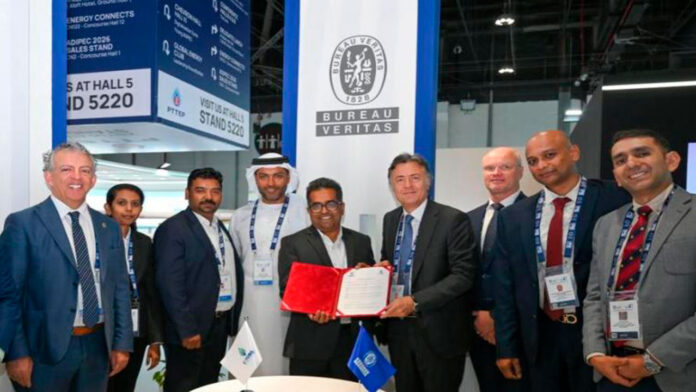
Bureau Veritas Marine & Offshore (BV) and C-Torq Marine Services LLC have signed a Memorandum of Understanding (MoU) in Abu Dhabi to collaborate on the development and Approval in Principle (AIP) of W-VOLT120, a hydrogen-based energy system intended to support clean, safe, and efficient power generation for maritime and industrial applications.
W-VOLT120 is an engineered hydrogen energy system designed with an emphasis on safety, compliance, and operational performance. The project seeks to evaluate the integration of hydrogen energy technologies within class-compliant frameworks and to contribute to the broader objective of reducing emissions in propulsion and power generation. Through this initiative, C-Torq and BV aim to assess the system’s design concept, establish a clear safety framework, and determine its technological readiness for use in real-world applications.
The MoU outlines the intention of both organizations to cooperate toward achieving the AIP for W-VOLT120, which represents an essential step in validating the system concept and confirming compliance with BV’s classification standards. The collaboration will involve structured technical discussions, data evaluation, and a formal assessment process designed to ensure the system meets the necessary safety and performance criteria. The AIP process is expected to serve as the foundation for subsequent phases of validation, prototype testing, and certification.
As C-Torq commented, the partnership accelerates validation and certification for a clean, safe and intelligent power solution for maritime decarbonization. Together they are bridging innovation and rigorous class standards, paving the way for scalable, zero-emission propulsion.
Matthieu de Tugny, Executive Vice President, Industrials and Commodities at Bureau Veritas, said:
“This collaboration between BV and C-Torq on the W-VOLT120 project reflects our shared commitment to advancing the safe and responsible application of hydrogen technologies in the maritime and industrial sectors. By combining technical innovation with rigorous classification expertise, we aim to support the development of compliant, efficient, and sustainable energy solutions that contribute to the industry’s transition toward lower emissions.”


