
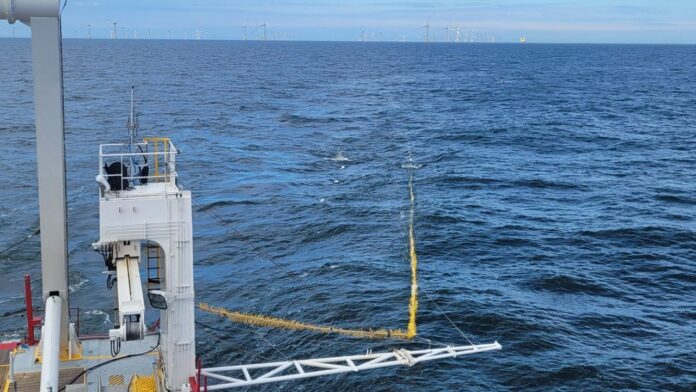
Fraunhofer IWES and Fugro Germany Marine GmbH have successfully completed the Geophysical Site Characterization of the N-9.5 area in the German Exclusive Economic Zone (EEZ) of the North Sea.
The survey was conducted for the German Federal Maritime and Hydrographic Agency (Bundesamt für Seeschifffahrt und Hydrographie BSH) during April and May 2025. The campaign included recording both Sub-Bottom Profiler and Ultra-High-Resolution Multi-Channel Seismic data (UHR MCS) for a dense grid of 2,349 kilometers of survey lines. Thus, an area-wide overview of the geological setting is created.
Both datasets aim to resolve different depth ranges of the subsurface in the study area. The sub-bottom profiler data provides high-resolution images of sediments and existing geological structures down to 15 meters below the seabed. The UHR MCS data enables imaging of larger sediment bodies and geological structures, down to 200 m below the seabed. After integrating both datasets, a preliminary interpretation of the subsoil conditions was carried out.
“As part of the central preliminary site investigation, the preliminary interpretation provides us with a valuable planning basis for the preliminary geotechnical investigation and forms the starting point for the development of an engineering geological model”, says Marcel Ruhnau, coordinator of geophysical site investigation at the BSH. The dataset will also support future geotechnical investigations and reduce constructions risks for the planned offshore wind farm.
“It is vital that OWF developers and their engineers are provided with precise geological information to enable them to make informed decisions and plan accordingly. This will ultimately reduce costly project delays and contribute to the development of the wind farm”, summarizes Fugro project manager Manfred Stender. According to the site development plan from January 30, 2025, the site N-9.5, with a size of approximately 146 km2, is planned to add 1 GW to the offshore grid in Germany.
Fugro acted as the main contractor, providing the survey vessel (Fugro Discovery) and being responsible for acquiring, processing, and interpreting the sub-bottom profiler data. As a subcontractor, Fraunhofer IWES was responsible for acquiring, processing, and interpreting the UHR multichannel seismic data. Jesley Geoservices provided Fraunhofer IWES with personnel support in processing the recorded ultra-high-resolution multichannel seismic data in order to successfully complete the very tight project schedule.
“The successful completion of this project marks our eight consecutive years of conducting an UHR MCS campaign for the BSH in the German North Sea. We have been working with Fugro on preliminary geophysical site investigations of offshore wind farm planning areas for six years now. Thanks to our long-standing partnership with Fugro, we have a deep understanding of our shared goals and processes”, says Tim Burmeister, project manager at Fraunhofer IWES. Supporting windfarm pre-investigation projects, the institute is actively contributing to the successful implementation of the energy transition in Germany.


