
Researchers at the California Academy of Sciences recently traveled to Guam to retrieve valuable data collected over nearly a decade in deep coral reefs (>330 ft).
A major milestone for twilight zone research and conservation, their findings provide the most comprehensive understanding of mesophotic reef biodiversity to date as well as evidence that ocean warming trends occur in deep reefs. Their insights will help marine scientists and conservation managers determine how to best protect these understudied ecosystems that are just as vulnerable as shallow reefs.
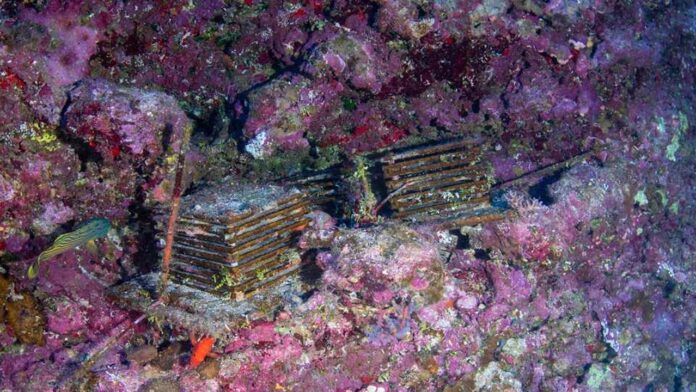
Eight years after placing them, this November a team of scientific divers returned to Guam to retrieve 13 of the world’s deepest reef monitoring devices that have been passively collecting biodiversity and temperature data since 2018.
“The autonomous reef monitoring structures, or ARMS, that we recently retrieved in Guam are essentially small underwater hotels that coral reef organisms colonize over time,” says Luiz Rocha, PhD, Academy Curator of Ichthyology. “As deep-reef scientists, our biggest limitation in studying the mesophotic zone is time, due to the long decompression needed to ascend. While we humans can only spend 15-25 minutes surveying at these depths, ARMS have been collecting data 24/7 for eight years. This long-term snapshot of deep reef biodiversity is unparalleled, revealing everything from never-before-seen species to evidence of a clear and steady warming trend at depth. Understanding twilight zone ecology, connectivity, and vulnerability is essential for effective conservation planning in a rapidly changing ocean.”
Shannon Bennett, PhD, Academy Chief of Science, says: “We are not the only scientists diving to mesophotic depths, and we are not the only team using ARMS, but we are pioneering the application of hand-placed ARMS to understand deep reefs on a global scale. Our scientific diving program is pushing the boundaries of underwater research, allowing us to build the first ecological baseline for these virtually unknown and underappreciated reefs, whose life forms are usually unique, often strange, and very much in need of protection.”
The expedition to Guam launches a two-year retrieval process to collect 76 ARMS that were deployed in deep reefs across the Pacific, including in Palau, French Polynesia, and the Marshall Islands. The resulting data will not only build the world’s most comprehensive baseline of upper twilight zone biodiversity, but also provide critical insights into thermal conditions at depth, as the vast majority of ocean temperature data comes from surface waters.
Mesophotic reefs were previously thought to be a refuge for shallow species, but recent studies have shown that plastic pollution, largely stemming from fishing, increases with depth, and is correlated with distance from marine protected areas. Now, ARMS are providing a detailed picture of underwater community composition, enabling more targeted conservation measures to protect reefs from overfishing, plastic pollution, and climate change. These efforts are done in partnership with the Smithsonian Institution’s Global ARMS Program. The collaborative team included Academy scientists and divers along with scientists from the University of Guam, the University of São Paulo, and the Bishop Museum.
ARMS are stacks of one-foot-square PVC plates that function like small, artificial reefs upon which organisms can settle and grow over time. Scientific divers conducted a series of targeted, technical dives using rebreathers (specialized deep-diving equipment that recycle exhaled air) to retrieve ARMS as deep as 330 feet. Once brought to the surface, the ARMS were quickly transported to the University of Guam Marine Lab, where a team of specialists identified, photographed, and collected each individual specimen found on the plates. The remaining encrusted material was then scraped off and sent for DNA analysis. As part of a global initiative to accelerate species discovery, partners at The Ocean Census will host a workshop to advance the taxonomy of the new-to-science species once DNA results are available.


